


Morocco's two largest political parties cemented their standing in local elections, while a closely watched Islamic party made modest gains in the first vote since May suicide bombings by Muslim extremists.
The Socialist Union of Popular Forces and the conservative Istiqlal were the biggest winners in final results announced on Saturday. Both parties are members of the coalition government, and together, they won nearly a third of the vote.
Moroccans voted Friday on 23,689 seats for local councilors across the North African kingdom. The ballot was seen as a test of the strength of a moderate Islamic party, Justice and Development, that has gained ground quickly since its founding in 1997.
The group placed 11th out of a dizzying 27 parties in the running, according to Interior Minister Mustapha Sahel, who announced the figures. However, the showing was not seen as a true measure of its popularity.
Concerned about a growing fundamentalist presence, Morocco's government had put pressure on the party to lower its profile in the election. The party agreed and presented only 4,268 candidates -- less than 4 percent of the 122,658 candidates running.
The interior minister announced turnout of just over 54 percent, higher than expected. The rate was closely watched as a sign of whether Moroccans took seriously their government's pledge of a free and fair election.
With 3,980 seats, the conservative Istiqlal won nearly 17 percent of the vote, and should control Casablanca, Morocco's largest city and economic hub. The Socialist union took 3.373 seats, or nearly 15 percent, and is likely to hold the capital, Rabat.
The Islamic Justice and Development party, which was not present in the last local elections in 1997, made modest though significant gains. It will hold 593 council seats, or about 2.5 percent.
Justice and Development, which draws its support in impoverished urban suburbs and among university students, has rallied against the French-speaking elite, denounced rampant corruption and called for a strengthening of Arab-Muslim identity.
The party surprised Morocco last September, tripling its seats in legislative elections and taking 43 seats in the 325-seat assembly.
Moroccan authorities and the pro-government press have accused the party of "moral responsibility" in May 16 attacks in Casablanca that killed 33 bystanders and 12 suicide bombers.
The attacks shook this Muslim kingdom that had been spared violence despite an 11-year-old bloody Islamic insurgency in neighboring Algeria. Authorities say an international network was behind the bombings that mainly targeted Jewish and Spanish sites.
The government's investigation into the attacks showed that Moroccans from shantytowns carried out the five nearly simultaneous suicide bombings and have yet to show solid evidence of an international link.
Starting with last year's legislative election, Morocco began promising its citizens a free and fair vote. Those elections were an important step in a process of liberalization launched by King Mohammed VI after the 1999 death of his father, Hassan II.
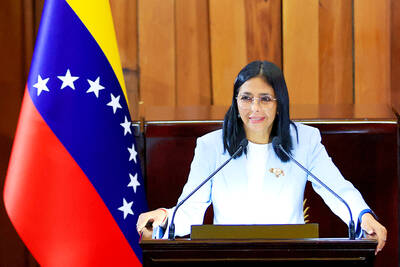
VAGUE: The criteria of the amnesty remain unclear, but it would cover political violence from 1999 to today, and those convicted of murder or drug trafficking would not qualify Venezuelan Acting President Delcy Rodriguez on Friday announced an amnesty bill that could lead to the release of hundreds of prisoners, including opposition leaders, journalists and human rights activists detained for political reasons. The measure had long been sought by the US-backed opposition. It is the latest concession Rodriguez has made since taking the reins of the country on Jan. 3 after the brazen seizure of then-Venezuelan president Nicolas Maduro. Rodriguez told a gathering of justices, magistrates, ministers, military brass and other government leaders that the ruling party-controlled Venezuelan National Assembly would take up the bill with urgency. Rodriguez also announced the shutdown
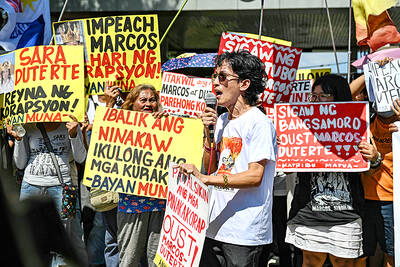
Civil society leaders and members of a left-wing coalition yesterday filed impeachment complaints against Philippine Vice President Sara Duterte, restarting a process sidelined by the Supreme Court last year. Both cases accuse Duterte of misusing public funds during her term as education secretary, while one revives allegations that she threatened to assassinate former ally Philippine President Ferdinand Marcos Jr. The filings come on the same day that a committee in the House of Representatives was to begin hearings into impeachment complaints against Marcos, accused of corruption tied to a spiraling scandal over bogus flood control projects. Under the constitution, an impeachment by the
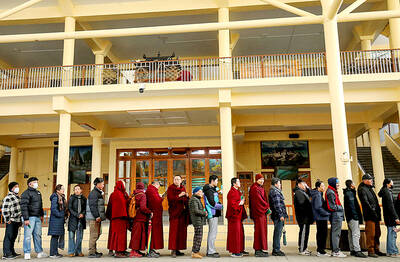
Exiled Tibetans began a unique global election yesterday for a government representing a homeland many have never seen, as part of a democratic exercise voters say carries great weight. From red-robed Buddhist monks in the snowy Himalayas, to political exiles in megacities across South Asia, to refugees in Australia, Europe and North America, voting takes place in 27 countries — but not China. “Elections ... show that the struggle for Tibet’s freedom and independence continues from generation to generation,” said candidate Gyaltsen Chokye, 33, who is based in the Indian hill-town of Dharamsala, headquarters of the government-in-exile, the Central Tibetan Administration (CTA). It

A Virginia man having an affair with the family’s Brazilian au pair on Monday was found guilty of murdering his wife and another man that prosecutors say was lured to the house as a fall guy. Brendan Banfield, a former Internal Revenue Service law enforcement officer, told police he came across Joseph Ryan attacking his wife, Christine Banfield, with a knife on the morning of Feb. 24, 2023. He shot Ryan and then Juliana Magalhaes, the au pair, shot him, too, but officials argued in court that the story was too good to be true, telling jurors that Brendan Banfield set


 RSS
RSS