


UN Secretary General Kofi Annan admitted that the rifts that appeared between nations over Iraq means the organization must change. Also, former chief UN weapons inspector Hans Blix expressed with more certainty that Iraq's report on its weapons of mass destruction was for the most part truthful.
On Monday, Annan urged radical reform of the organization in response to damaging divisions over Iraq.
Annan, who normally tends to be cautious in his assessments, said: "The United Nations finds itself, at present, at a critical juncture."
His normal optimism has been shaken by the debilitating UN Security Council rows over the Iraq war and, more recently, the bombing of the UN headquarters in Baghdad.
He called for a renewed commitment to legitimate international intervention, the expansion of the 15-member Security Council to make it more representative, saying events required something different.
Instead, he delivered his most pessimistic assessment yet of the UN's performance.
A UN source said: "He can no longer pretend it is business as usual."
Annan has written to 191 world leaders asking them to attend the UN General Assembly meeting in a fortnight to debate its priorities. US President George W. Bush, French President Jacques Chirac and the German Chancellor Gerhard Schroder are among 90 leaders who have agreed to attend. The UN said Tony Blair would not be there.
Annan said: "The war exposed deep divisions in the international community, with accusations of double agendas. Although the Security Council has since been able to find common ground on the need to restore Iraqi sovereignty and reconstruct the country, divisions remain that will not be easily overcome."
A new draft resolution on Iraq is being negotiated by Security Council members in which the UN would become marginally more involved in the Iraq political process in return for providing authority for more international troops.
But the UN authorities are treading carefully, fearful the new resolution could turn out to be a dangerous fudge.
In the longer term, Annan said: "Unless the Security Council regains confidence of states and world public opinion, individual states will increasingly resort exclusively to their own national perceptions of emerging threats and their own judgment on how best to address them."
Meanwhile, the declaration, submitted Dec. 7 by the government of then-Iraqi president Saddam Hussein, was quickly dismissed as false and incomplete by the US and Britain, which accused Baghdad of failing to disarm as required by Security Council Resolution 1441.
These charges were later used by Washington and London to justify the invasion of the country in late March.
But more than four months after US President George W. Bush declared victory in Iraq, former chief UN weapons inspector Hans Blix said facts presented by Iraq in the 12,000-page document may have been accurate.
"With this long period, I'm inclined to think that the Iraqi statement that they destroyed all the biological and chemical weapons, which they had in the summer of 1991 may well be the truth," Blix told CNN television.
The retired Swedish diplomat, who headed the UN Monitoring, Verification and Inspection Commission for Iraq, said his inspectors had worked in Iraq for three-and-a-half months in late 2002 and early 2003 and "did not find any smoking gun."
Blix said US and British experts had now been scouring Iraq for weapons of mass destruction for several months and had the opportunity to interrogate members of the Iraqi establishment in their custody.
"I cannot fail to notice that some of the things that they expected us to see that they have turned out not to be real weapons of mass destruction," said the former chief inspector.
US investigators headed by top Central Intelligence Agency weapons analyst David Kay that began its own search for banned Iraqi weapons shortly after the fall of Hussein is to present its preliminary findings later this month.
But US officials indicate it may fail to produce any "smoking gun" as well.
US Defense Secretary Donald Rumsfeld, who met with Kay during his visit to Iraq last week, sought to dampen expectations, telling reporters afterwards, "I'm assuming he would tell me if he had gotten something."
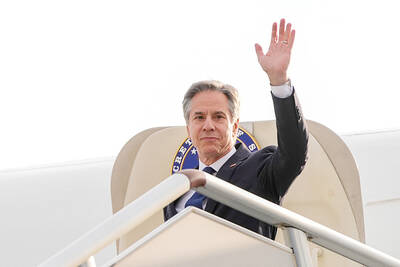
‘IN A DIFFERENT PLACE’: The envoy first visited Shanghai, where he attended a Chinese basketball playoff match, and is to meet top officials in Beijing tomorrow US Secretary of State Antony Blinken yesterday arrived in China on his second visit in a year as the US ramps up pressure on its rival over its support for Russia while also seeking to manage tensions with Beijing. The US diplomat tomorrow is to meet China’s top brass in Beijing, where he is also expected to plead for restraint as Taiwan inaugurates president-elect William Lai (賴清德), and to raise US concerns on Chinese trade practices. However, Blinken is also seeking to stabilize ties, with tensions between the world’s two largest economies easing since his previous visit in June last year. At the
Nearly half of China’s major cities are suffering “moderate to severe” levels of subsidence, putting millions of people at risk of flooding, especially as sea levels rise, according to a study of nationwide satellite data released yesterday. The authors of the paper, published by the journal Science, found that 45 percent of China’s urban land was sinking faster than 3mm per year, with 16 percent at more than 10mm per year, driven not only by declining water tables, but also the sheer weight of the built environment. With China’s urban population already in excess of 900 million people, “even a small portion

UNSETTLING IMAGES: The scene took place in front of TV crews covering the Trump trial, with a CNN anchor calling it an ‘emotional and unbelievably disturbing moment’ A man who doused himself in an accelerant and set himself on fire outside the courthouse where former US president Donald Trump is on trial has died, police said yesterday. The New York City Police Department (NYPD) said the man was declared dead by staff at an area hospital. The man was in Collect Pond Park at about 1:30pm on Friday when he took out pamphlets espousing conspiracy theories, tossed them around, then doused himself in an accelerant and set himself on fire, officials and witnesses said. A large number of police officers were nearby when it happened. Some officers and bystanders rushed

Beijing is continuing to commit genocide and crimes against humanity against Uyghurs and other Muslim minorities in its western Xinjiang province, U.S. Secretary of State Antony Blinken said in a report published on Monday, ahead of his planned visit to China this week. The State Department’s annual human rights report, which documents abuses recorded all over the world during the previous calendar year, repeated language from previous years on the treatment of Muslims in Xinjiang, but the publication raises the issue ahead of delicate talks, including on the war in Ukraine and global trade, between the top U.S. diplomat and Chinese


 RSS
RSS