


Along a potholed road in eastern Afghanistan, Mohammed Jan points through a cloud of dust at a line of mansions that seem out of place in such poverty-stricken surroundings.
"This is where the new, beautiful houses begin. They belong to the commanders. Their money is from drugs, from smuggling. They will never be caught. Their soldiers are working with the Americans," says Jan, himself a small-time opium grower.
Nearly two years after the collapse of Taliban rule, ordinary Afghans like Jan say they are losing faith in the US and its coalition partners.
They point to rampant corruption, Afghan President Hamid Karzai's weak leadership and the behavior of US-backed warlords whose private armies operate with impunity throughout most of Afghanistan.
Their disillusionment is strengthening Taliban holdouts whose attacks are getting bolder. Nowadays the rebels don't fear being turned over to the authorities; they say most villages give them food and shelter.
"The big mistake is from the Americans. They want to bring peace to Afghanistan with thieves and killers. The Americans after two years have learned nothing," said Abdul Raouf, a car dealer in the eastern city of Jalalabad. "Every day the situation is worse."
The American invasion of Afghanistan relied heavily on local anti-Taliban forces, and it was inevitable that these warlords, however unsavory, would continue to be important forces in the hunt for Osama bin Laden and the al-Qaeda network that masterminded the Sept. 11 attacks.
But Afghans increasingly wonder whether the trade-off was worth it.
"Everybody says warlords, but who are these warlords? They are commanders, they are government ministers," said Raouf. "We didn't like the Taliban but there was security then, there were laws. But now anyone with a gun is the law."
Back at the mansions, in the province of Nangarhar, a white marble watchtower peeks over the 3m-high brick wall.
"Drug smuggler," Jan says. "That's a commander of Hazrat Ali's. Are the Americans crazy? We Afghans know who these people are and what they are doing. There is no security, no development, but these people's pockets are fat with money. We know that without the Americans they would be nobody."
Hazrat Ali is military chief of Afghanistan's eastern zone, a powerful man appointed by Karzai but aligned with Defense Minister Mohammed Fahim.
The US says it is committed to strengthening the central government and is putting more than US$1 billion into extending Karzai's control beyond Kabul, the capital to the whole Texas-sized country.
US officials insist that Jan's lament doesn't reflect the full picture. They say some areas are more secure, some less; some Afghans are optimistic, others not. They point to the reconstruction projects that are beginning, the road that links the capital to Kandahar.
Reconstruction, the argument goes, is bound to be slower in the east and south of Afghanistan, where Taliban and al-Qaeda fighters are being hunted. Sometimes, Western diplomats say, solutions entail messy compromises; when Karzai decided that the governor of Kandahar, Afghanistan's second city, was corrupt and ineffective, he removed him but made him a government minister.
The opium industry, harshly suppressed by the Taliban, has made a roaring comeback.
The UN says production in 2002 generated up to US$1.2 billion or almost a fifth of Afghan GDP. Central Asian states and Russia are complaining bitterly about the increase in Afghan drugs flowing north.
Those benefiting most are the commanders aligned to the government and working with the US-led coalition, say Afghans in eastern Jalalabad who spoke to reporters.
Commander Mustafa, a soldier of Zahir's and a partner with the US-led coalition, denies the allegation. In an interview at his base near the border with Pakistan, surrounded by a dozen men with kalashnikov rifles, he said his men would seize and destroy any drugs they found.
A UN official, speaking on condition of anonymity, said the drug trade couldn't possibly flourish without the patronage of government officials and military commanders.
Human Rights Watch recently issued a 101-page report warning that "Afghan warlords and political strongmen supported by the United States and other nations are engendering a climate of fear in Afghanistan." It named a string of men in senior government positions.
This climate of fear, the advocacy group said, jeopardizes efforts to adopt a new constitution and hold national elections in mid-2004.
A disarmament campaign was to have begun July 1, but the UN delayed it, demanding the Defense Ministry first be reformed to reflect Afghanistan's ethnic diversity. The UN wants sweeping changes to take power away from Defense Minister Fahim's private army.
Nearly two years since taking power, Karzai's limited reach is allowing the corruption to flourish.
Several months ago, Karzai banned logging in eastern Afghanistan, but it still flourishes in areas where his appointees govern.
The rock-strewn road from Kunar in eastern Afghanistan to neighboring Nangarhar province is bumper-to-bumper with timber-laden 16-wheelers.
In Kabul, Afghan businessmen who have come back from the US to invest here are disillusioned.
Abdullah Aziz, who returned to Afghanistan from California where he has lived since 1978, said he went to northern Kunduz province to retrieve his property.
He said he brought a letter from Karzai to the governor. "He took the piece of paper and he said `Karzai -- he is no one here.'"
Aziz is still trying to get his property.

SPEAKING OUT: After Siranudh Scott’s allegations surfaced, celebrities and public figures took to social media to share their own experiences of sexual misconduct and abuse A high-profile alleged sexual abuse case within a wealthy Thai beer brewing family has prompted a wave of painful accounts from survivors of unconnected abuse in the conservative nation. Siranudh Scott, a member of the billionaire Thai family that founded the ubiquitous Singha beer brand, posted an emotional video this month accusing his elder brother Sunit of repeatedly abusing him when he was a teenager. Sunit, who is in his 30s, later denied the allegations in a video posted online, but Singha parent Boonrawd dismissed him from his executive role with the company on Tuesday last week. “I felt I needed to speak

‘CROSSING THE LINE’: China’s embassy in Seoul criticized US Forces Korea Commander General Xavier Brunson, asking if his ‘hostile’ remarks were authorized by Washington South Korea and the US are in talks over recent public remarks by the commander of US Forces Korea, Seoul’s presidential office said yesterday, after the comments drew sharp criticism from China. In a recent podcast interview, US Forces Korea Commander General Xavier Brunson described South Korea as “the dagger in the heart of Asia” from China’s east coast, prompting the Chinese embassy in Seoul to say that he had “truly crossed the line.” The interview came amid growing speculation that Washington might seek to expand the role of US Forces Korea in countering the growing regional influence of China, a key

SEEKING ORDER: Rodrigo Paz said that ‘anyone who wants to destroy the nation will have to deal with this president and the full force of the constitution’ Bolivian President Rodrigo Paz on Wednesday said that the nation was at a “breaking point” after nearly a month of protests that have caused shortages of food, fuel and medicine. Paz, who took office six months ago amid the worst economic crisis there in four decades, is battling a groundswell of fury over his policies. The political capital, La Paz, has been besieged by low-income workers and members of the indigenous majority calling for his resignation. “The country needs order and is reaching breaking point,” the 58-year-old said at a public event in La Paz, renewing his appeal for dialogue. On Tuesday, the Bolivian
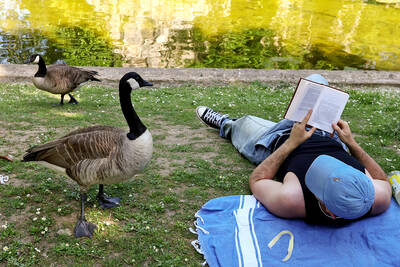
Forecasters in Europe yesterday warned of exceptional heat as record temperatures driven by a “heat dome” push temperatures well above seasonal norms across the continent. The surge follows a record-breaking Monday, with France logging its hottest day in the month of May on record, its weather agency said, and the UK also posting unprecedented highs. A so-called “heat dome” of warm air from northern Africa trapped under a high-pressure system over western Europe is behind the high temperatures not usually seen until high summer. Restrictions on outdoor work were imposed in parts of Italy, beaches in southwest France filled earlier than usual and


 RSS
RSS