


Dead government scientist David Kelly wrote ahead of the Iraq war that although the threat posed by Baghdad was "modest", only regime change could avert the long-term threat of its development of weapons of mass destruction, a British newspaper revealed yesterday.
The day before Kelly's widow would testify before a judicial inquiry into her husband's presumed suicide, The Observer weekly published an article penned by the arms expert on Iraq ahead of the US-led war.
The article was written as part of a major report on Iraq in the weeks leading up to war, but one of the reasons it was not published was because Kelly did not want to be revealed as the source, the editor of the report, Julie Flint, said.
"Iraq has spent the past 30 years building up an arsenal of weapons of mass destruction," Kelly wrote.
"Although the current threat presented by Iraq militarily is modest, both in terms of conventional and unconventional weapons, it has never given up its intent to develop and stockpile such weapons for both military and terrorist use."
He added: "War may now be inevitable. The proportionality and intensity of the conflict will depend on whether regime change or disarmament is the true objective.
"The US, and whoever willingly assists it, should ensure that the force, strength and strategy used is appropriate to the modest threat that Iraq now poses."
The article continued: "The threat from Iraq's chemical and biological weapons is, however, unlikely to substantially affect the operational capabilities of US and British troops. Nor is it likely to create massive casualties in adjacent countries.
"Perhaps the real threat from Iraq today comes from covert use of such weapons against troops or by terrorists against civilian targets worldwide.
"The long-term threat, however, remains Iraq's development to military maturity of weapons of mass destruction -- something that only regime change will avert."
The Observer said Kelly's article would be presented as evidence to the inquiry into his death, which enters a fourth week today.
Kelly, a former UN arms inspector, was the alleged source of a BBC report that British Prime Minister Tony Blair's office had embellished an intelligence dossier on Baghdad's capability to launch weapons of mass destruction in order to boost the case for joining the war in March.
The 50-page document -- which notably claimed that Iraq could deploy chemical or biological weapons in as little as 45 minutes -- was a key part of Blair's attempts to persuade a skeptical British public to back the war.
Kelly's body was found with a slit wrist in woods near his home close to London on July 18, a week after the Ministry of Defence said he was the source of the BBC report.
The row over the way Blair led Britain to war and the death of Kelly has left the prime minister facing his gravest political crisis.
On Friday Blair's top aide, director of communications and strategy Alastair Campbell, announced his intention to resign. Campbell was directly accused by a BBC reporter of "sexing up" the controversial dossier.
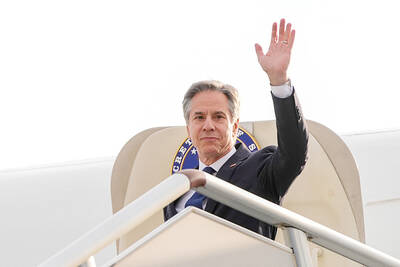
‘IN A DIFFERENT PLACE’: The envoy first visited Shanghai, where he attended a Chinese basketball playoff match, and is to meet top officials in Beijing tomorrow US Secretary of State Antony Blinken yesterday arrived in China on his second visit in a year as the US ramps up pressure on its rival over its support for Russia while also seeking to manage tensions with Beijing. The US diplomat tomorrow is to meet China’s top brass in Beijing, where he is also expected to plead for restraint as Taiwan inaugurates president-elect William Lai (賴清德), and to raise US concerns on Chinese trade practices. However, Blinken is also seeking to stabilize ties, with tensions between the world’s two largest economies easing since his previous visit in June last year. At the
Nearly half of China’s major cities are suffering “moderate to severe” levels of subsidence, putting millions of people at risk of flooding, especially as sea levels rise, according to a study of nationwide satellite data released yesterday. The authors of the paper, published by the journal Science, found that 45 percent of China’s urban land was sinking faster than 3mm per year, with 16 percent at more than 10mm per year, driven not only by declining water tables, but also the sheer weight of the built environment. With China’s urban population already in excess of 900 million people, “even a small portion

UNSETTLING IMAGES: The scene took place in front of TV crews covering the Trump trial, with a CNN anchor calling it an ‘emotional and unbelievably disturbing moment’ A man who doused himself in an accelerant and set himself on fire outside the courthouse where former US president Donald Trump is on trial has died, police said yesterday. The New York City Police Department (NYPD) said the man was declared dead by staff at an area hospital. The man was in Collect Pond Park at about 1:30pm on Friday when he took out pamphlets espousing conspiracy theories, tossed them around, then doused himself in an accelerant and set himself on fire, officials and witnesses said. A large number of police officers were nearby when it happened. Some officers and bystanders rushed

Beijing is continuing to commit genocide and crimes against humanity against Uyghurs and other Muslim minorities in its western Xinjiang province, U.S. Secretary of State Antony Blinken said in a report published on Monday, ahead of his planned visit to China this week. The State Department’s annual human rights report, which documents abuses recorded all over the world during the previous calendar year, repeated language from previous years on the treatment of Muslims in Xinjiang, but the publication raises the issue ahead of delicate talks, including on the war in Ukraine and global trade, between the top U.S. diplomat and Chinese


 RSS
RSS