


Over a long holiday weekend, more than 50,000 American Muslims are expected in Chicago for an annual gathering.
But they won't all be attending the same meeting.
American blacks and immigrant Muslims are holding separate conventions just 5km apart -- underscoring the divide between the two groups that Muslim leaders have been struggling to bridge for years.
The split is a significant -- and highly sensitive -- Muslim issue. Islam teaches unity among all believers, and American blacks comprise about 30 percent of observant Muslims in the US.
Leaders on both sides say they can ill afford rifts within their community as the war on terrorism enters its third year. American Muslims have been striving to present a positive image of their religion and protect their civil rights under intense scrutiny by law enforcement.
"We're different culturally and we're different ethnically and that creates some difficulties in terms of communication and understanding," said Imam Earl Abdulmalik Mohammed, a national representative of black Muslim leader Imam W. Deen Mohammed of the American Society of Muslims.
Sayyid Syeed, secretary general of the Islamic Society of North America, which was founded by immigrants, said the two groups enjoy "total comfort and cooperation," regardless of the separate conventions.
Participants in the American Society of Muslims convention over this weekend that stretches into Labor Day holiday tomorrow, will automatically be registered at the Islamic Society meeting, Syeed said. Leaders will also visit each others' assemblies, which both started on Friday.
However, Abdulmalik Mohammed said that "it's a matter of concern" that no joint events have been scheduled.
Syeed noted that when Muslims began immigrating to the US in large numbers in the 1960s, it was the Christian campus ministries that provided Muslim college students with space to worship.
Many efforts have been made to improve relations between immigrant and black Muslims, but deep differences remain, rooted partly in how Islam spread among American blacks.
Most came to the religion through black nationalist movements and the Nation of Islam, which had taught that its founder, Wallace Fard, had divine status and his successor, Elijah Muhammad, was a prophet. Mainstream Islam teaches that there is only one God and no prophets came after Muhammad. For that and other rea-sons, many immigrant Muslims consider the Nation of Islam a cult.
But Imam Deen Mohammed, the son of Elijah Muhammad, trans-formed the movement after taking it over in the 1970s.
He gradually moved his thousands of followers toward mainstream Islam, while Louis Farrakhan revived the old Nation of Islam under his leadership.
"Through the `60s and into the `70s, there was practically no relationship," between immigrants and blacks, said Ishan Bagby, a University of Kentucky professor who is black and a convert to Islam. "Really, the `80s was the beginning of a relationship."
Immigrant Muslims tend to be wealthier professionals who live and worship in the suburbs, while mosques affiliated with Deen Mohammed are mainly urban, serving middle-class or lower-income blacks.
Racism has been another obstacle. Many immigrants arrived in the US with a warped view of blacks as unsophisticated and even dangerous, and failed to understand the discrimination they faced, leaders for both groups say.
"People in the immigrant community just discovered racial profiling," said Mahdi Bray, a black civil-rights activist who is Muslim and works for the Muslim American Society Freedom Foundation, which was created by immigrants. "For African-Americans, we've known it for quite a while."
A unity council of black and immigrant leaders formed in the mid-1990s to explore joint meetings and other projects is largely inactive, said Naeem Baig, secretary general of the Islamic Circle of North America, a relief and advocacy group founded by immigrants.
Bagby, Imam Siraj Wahaj and other leading black Muslims are planning to form their own umbrella organization, like the Islamic Society, called the Muslim Alliance in North America, to promote job training and other development projects in their communities.
Leaders from both communities emphasized that Muslims are still establishing themselves in the US and they predict the American-born children of immigrants and the children of black Muslims will more easily mingle.
Abdulmalik Mohammed said his group remains interested in pursuing a joint convention now with the Islamic Society. But he concedes that the members of both organizations may need to wait.
"Most of them, the leadership of the immigrant community, they want to see that happen, but I don't think they feel their people are ready for that," Abdulmalik Mohammed said. "Most of our people aren't ready for that either. Our people are still remembering and feeling the pain of social disrespect, and they have experienced that with immigrant Muslims."
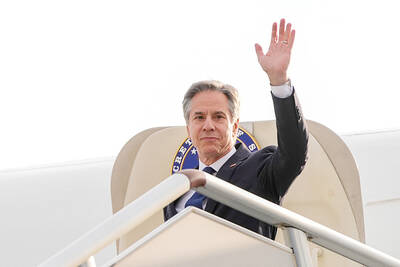
‘IN A DIFFERENT PLACE’: The envoy first visited Shanghai, where he attended a Chinese basketball playoff match, and is to meet top officials in Beijing tomorrow US Secretary of State Antony Blinken yesterday arrived in China on his second visit in a year as the US ramps up pressure on its rival over its support for Russia while also seeking to manage tensions with Beijing. The US diplomat tomorrow is to meet China’s top brass in Beijing, where he is also expected to plead for restraint as Taiwan inaugurates president-elect William Lai (賴清德), and to raise US concerns on Chinese trade practices. However, Blinken is also seeking to stabilize ties, with tensions between the world’s two largest economies easing since his previous visit in June last year. At the
Nearly half of China’s major cities are suffering “moderate to severe” levels of subsidence, putting millions of people at risk of flooding, especially as sea levels rise, according to a study of nationwide satellite data released yesterday. The authors of the paper, published by the journal Science, found that 45 percent of China’s urban land was sinking faster than 3mm per year, with 16 percent at more than 10mm per year, driven not only by declining water tables, but also the sheer weight of the built environment. With China’s urban population already in excess of 900 million people, “even a small portion

UNSETTLING IMAGES: The scene took place in front of TV crews covering the Trump trial, with a CNN anchor calling it an ‘emotional and unbelievably disturbing moment’ A man who doused himself in an accelerant and set himself on fire outside the courthouse where former US president Donald Trump is on trial has died, police said yesterday. The New York City Police Department (NYPD) said the man was declared dead by staff at an area hospital. The man was in Collect Pond Park at about 1:30pm on Friday when he took out pamphlets espousing conspiracy theories, tossed them around, then doused himself in an accelerant and set himself on fire, officials and witnesses said. A large number of police officers were nearby when it happened. Some officers and bystanders rushed
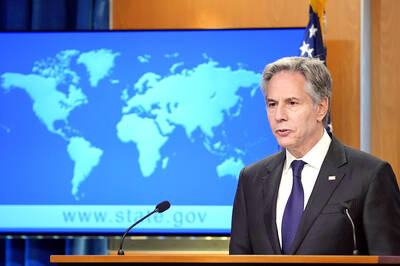
Beijing is continuing to commit genocide and crimes against humanity against Uyghurs and other Muslim minorities in its western Xinjiang province, U.S. Secretary of State Antony Blinken said in a report published on Monday, ahead of his planned visit to China this week. The State Department’s annual human rights report, which documents abuses recorded all over the world during the previous calendar year, repeated language from previous years on the treatment of Muslims in Xinjiang, but the publication raises the issue ahead of delicate talks, including on the war in Ukraine and global trade, between the top U.S. diplomat and Chinese


 RSS
RSS