


A government-appointed truth commission said in a report issued on Thursday that more than 69,000 people were killed or disappeared between 1980 and 2000, more than twice than earlier estimates of the death toll for the period of war and dictatorship.
The report by the Truth and Reconciliation Commission concluded that Maoist rebels, chiefly the Shining Path, were responsible for more than half the deaths. But the commission also blamed three governments, two of them considered democratic, for widespread human rights abuses.
The commission said that three of every four people who died or disappeared during the period were Quechua-speaking Indians, civilians who were caught between the military and guerrillas intent on toppling the government.
"Our report lets the whole country know the history of the thousands of human rights violations committed in the last two decades, crimes against humanity practiced by subversive organizations against society and the Peruvian state or by the Peruvian state through members of the security forces," Salomon Lerner, the commission president, said in a ceremony in which the report was presented to President Alejandro Toledo.
The commission's report, the result of a two-year investigation based on nearly 17,000 individual testimonies in 530 villages, said that most victims died during the governments of Fernando Belaunde and Alan Garcia in the 1980s, two administrations widely viewed as democratic. Those governments were blamed for giving too much power to the military and then failing to stem abuses as some military units conducted a scorched-earth campaign in Peru's isolated highlands.
But President Alberto Fujimori, whose 10-year rule ended in a corruption scandal in 2000, is singled out for particularly harsh criticism. The report blamed his quasi-dictatorship for hijacking Peruvian democracy and implementing antiterrorism legislation that allowed his government to wage a dirty war. The intelligence service headed by Fujimori's spy chief, Vladimiro Montesinos, was accused of tortures and disappearances.
Though details of Peru's war with Shining Path and a smaller rebel group were generally known, the report on Thursday is the first to offer a comprehensive account of the conflict.
It is also considered crucial to Peru's fragile democracy, restored after Fujimori fled to Japan. Like other countries that have appointed truth commissions, Peru came to the conclusion that it was not practical or realistic to expect expensive, time-consuming trials. The commission was appointed by President Valentin Paniagua in 2001.
"We cannot open the door to the future without looking at the past," Toledo told the nation on Thursday.
The report's nine volumes, thousands of pages long, provide details about the massacres in Indian villages, the brutal crackdown on prison uprisings and the operation of a secret paramilitary unit called the Colina group. Commission workers said it also explains in detail the effects of the conflict on a poor, isolated people, victims of racism and indifference.
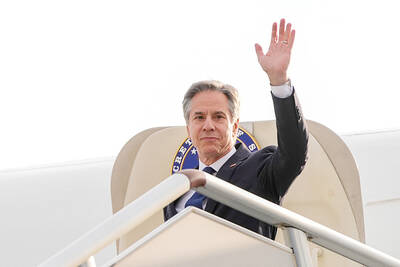
‘IN A DIFFERENT PLACE’: The envoy first visited Shanghai, where he attended a Chinese basketball playoff match, and is to meet top officials in Beijing tomorrow US Secretary of State Antony Blinken yesterday arrived in China on his second visit in a year as the US ramps up pressure on its rival over its support for Russia while also seeking to manage tensions with Beijing. The US diplomat tomorrow is to meet China’s top brass in Beijing, where he is also expected to plead for restraint as Taiwan inaugurates president-elect William Lai (賴清德), and to raise US concerns on Chinese trade practices. However, Blinken is also seeking to stabilize ties, with tensions between the world’s two largest economies easing since his previous visit in June last year. At the

UNSETTLING IMAGES: The scene took place in front of TV crews covering the Trump trial, with a CNN anchor calling it an ‘emotional and unbelievably disturbing moment’ A man who doused himself in an accelerant and set himself on fire outside the courthouse where former US president Donald Trump is on trial has died, police said yesterday. The New York City Police Department (NYPD) said the man was declared dead by staff at an area hospital. The man was in Collect Pond Park at about 1:30pm on Friday when he took out pamphlets espousing conspiracy theories, tossed them around, then doused himself in an accelerant and set himself on fire, officials and witnesses said. A large number of police officers were nearby when it happened. Some officers and bystanders rushed

Beijing is continuing to commit genocide and crimes against humanity against Uyghurs and other Muslim minorities in its western Xinjiang province, U.S. Secretary of State Antony Blinken said in a report published on Monday, ahead of his planned visit to China this week. The State Department’s annual human rights report, which documents abuses recorded all over the world during the previous calendar year, repeated language from previous years on the treatment of Muslims in Xinjiang, but the publication raises the issue ahead of delicate talks, including on the war in Ukraine and global trade, between the top U.S. diplomat and Chinese
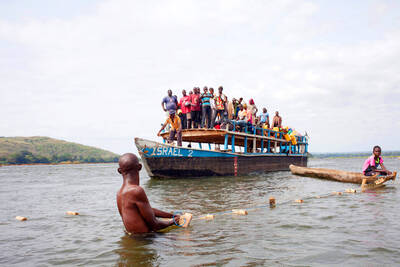
RIVER TRAGEDY: Local fishers and residents helped rescue people after the vessel capsized, while motorbike taxis evacuated some of the injured At least 58 people going to a funeral died after their overloaded river boat capsized in the Central African Republic’s (CAR) capital, Bangui, the head of civil protection said on Saturday. “We were able to extract 58 lifeless bodies,” Thomas Djimasse told Radio Guira. “We don’t know the total number of people who are underwater. According to witnesses and videos on social media, the wooden boat was carrying more than 300 people — some standing and others perched on wooden structures — when it sank on the Mpoko River on Friday. The vessel was heading to the funeral of a village chief in


 RSS
RSS