


Thousands gathered in the holy city of Najaf yesterday for the funerals of three men killed in an assassination attempt on a leading Shiite Muslim cleric, as the top US general admitted his forces were stretched thin but that he could find more troops if needed.
Meanwhile, a Brazilian air force plane carrying the body of the slain UN envoy to Iraq, Sergio Vieira de Mello, arrived in Geneva, a day after a memorial ceremony in his hometown of Rio de Janeiro.

PHOTO: AP
And Iraq's US-appointed Governing Council has taken its quest for international legitimacy to Egypt before heading on to Jordan.
The three men who died Sunday in a bomb attack in Najaf were employees of one of Iraq's most influential Shiite clerics, Grand Ayatollah Seyed Mohammed Said al-Hakim.
"Two bodyguards and one employee of the house were killed. His holiness al-Hakim and his son were both in the room next to the bomb. Thank God they're both safe," said the ayatollah's spokesman, Abdul Hussein al-Kadi.
Hakim is one of the four top clerics in the Hawza, the highest religious authority of Iraq's Shiite community, which makes up some 60 percent of the 25-million population and was systematically oppressed by former Iraqi president Saddam Hussein's Sunni Muslim elite.
Kadi said bodyguards protecting Hakim's house saw four bearded men in a white car drop a cooking-gas bottle near the wall of Hakim's house in Najaf, 180km south of Baghdad.
The ensuing blast left a 1.5m hole in the side of the house.
Najaf, the power base of Iraq's Shiites, is locked in a battle between those prepared to cooperate with the US-led administration and those who champion resistance.
The struggle by supporters of firebrand cleric Moqtada Sadr to push the religious hierarchy into a more antagonistic approach toward the Americans has seen three attacks on mainstream clerics in recent weeks.
But Hakim's office has insisted that the Hawza will not change its policy, stressing that the hierarchy continued to favor talks as the best way of ending the US-led occupation.
Amid mounting calls for more US troops in Iraq, General Richard Myers, chairman of the joint chiefs of staff, said Sunday: "We are stretched thin, but we have more troops to send. We have other ways to do that."
US and British forces in Iraq face mounting attacks as well as growing insecurity, highlighted by the suicide bomb attack on the UN offices in Baghdad last Tuesday that killed 23 people, including Vieira de Mello.
Myers insisted that the 150,000 US troops already in Iraq were adequate, but said that if US commanders requested more forces then reservists could be called up.
The general also echoed comments made this weekend by both President George W. Bush and Paul Bremer, the top US official in Baghdad, that Iraq had become a key battleground in the US war on terrorism.
"We are a nation at war," he said. "In my view, this is the biggest threat to our country's existence as far back as I can remember."
Bremer on Sunday told ABC television that hundreds of "international terrorists" had entered Iraq.
Iraq's transitional Governing Council, which is merely "welcomed" but not endorsed by the UN and which the Arab League has refused to recognize, brought its quest for legitimacy to the Egyptian capital.
Ibrahim Jafari, the council's boss, said in Cairo that Arab countries had granted the US-appointed body "clear recognition" by agreeing to hold talks with it.
But the Egyptian government and Arab League did not share his view.
Egyptian Foreign Minister Ahmed Maher said the formation of the council in July "was a step in the right direction" but insisted that an Iraqi government should be independent and elected in order to be legitimate.
Meanwhile, the International Committee of the Red Cross said in Baghdad it would reduce its foreign staff by more than half and cut some of its Iraq operations in light of threats against it.
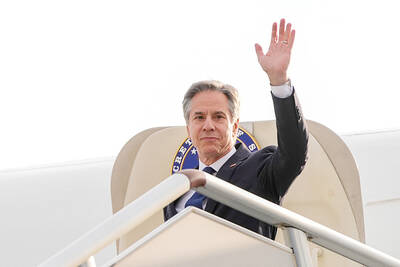
‘IN A DIFFERENT PLACE’: The envoy first visited Shanghai, where he attended a Chinese basketball playoff match, and is to meet top officials in Beijing tomorrow US Secretary of State Antony Blinken yesterday arrived in China on his second visit in a year as the US ramps up pressure on its rival over its support for Russia while also seeking to manage tensions with Beijing. The US diplomat tomorrow is to meet China’s top brass in Beijing, where he is also expected to plead for restraint as Taiwan inaugurates president-elect William Lai (賴清德), and to raise US concerns on Chinese trade practices. However, Blinken is also seeking to stabilize ties, with tensions between the world’s two largest economies easing since his previous visit in June last year. At the
Nearly half of China’s major cities are suffering “moderate to severe” levels of subsidence, putting millions of people at risk of flooding, especially as sea levels rise, according to a study of nationwide satellite data released yesterday. The authors of the paper, published by the journal Science, found that 45 percent of China’s urban land was sinking faster than 3mm per year, with 16 percent at more than 10mm per year, driven not only by declining water tables, but also the sheer weight of the built environment. With China’s urban population already in excess of 900 million people, “even a small portion

UNSETTLING IMAGES: The scene took place in front of TV crews covering the Trump trial, with a CNN anchor calling it an ‘emotional and unbelievably disturbing moment’ A man who doused himself in an accelerant and set himself on fire outside the courthouse where former US president Donald Trump is on trial has died, police said yesterday. The New York City Police Department (NYPD) said the man was declared dead by staff at an area hospital. The man was in Collect Pond Park at about 1:30pm on Friday when he took out pamphlets espousing conspiracy theories, tossed them around, then doused himself in an accelerant and set himself on fire, officials and witnesses said. A large number of police officers were nearby when it happened. Some officers and bystanders rushed
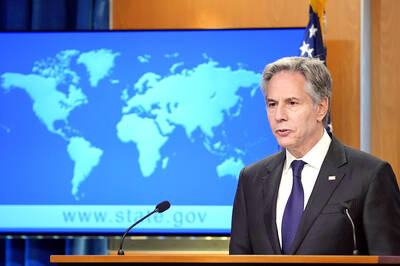
Beijing is continuing to commit genocide and crimes against humanity against Uyghurs and other Muslim minorities in its western Xinjiang province, U.S. Secretary of State Antony Blinken said in a report published on Monday, ahead of his planned visit to China this week. The State Department’s annual human rights report, which documents abuses recorded all over the world during the previous calendar year, repeated language from previous years on the treatment of Muslims in Xinjiang, but the publication raises the issue ahead of delicate talks, including on the war in Ukraine and global trade, between the top U.S. diplomat and Chinese


 RSS
RSS