


The vulnerability of the North American electric system was highlighted on Thursday as millions in North America lost their power on one of the hottest afternoons of the summer.
Industry officials have long warned that the North American power transmission system, which saw its greatest expansion in the years following World War Two, is groaning under the weight of the heavy loads it carries today.

PHOTO: AP
"We're a superpower with a third-world grid. We need a new grid," New Mexico Governor and former Energy Secretary Bill Richardson told the CNN television network. "The problem is that nobody is building enough transmission capacity."
According to the Electric Power Research Institute in Palo Alto, California, US power demand has surged 30 percent in the last decade, while transmission capacity grew a mere 15 percent.
And during muggy weather like the kind blanketing the Northeast on Thursday, air conditioning accounts for a hefty 30 percent of all power flowing over the lines, severely taxing an already overworked transmission network.
It was the biggest blackout in North American history, according to US power grid operators. It eclipsed the 1965 blackout in the US and Canada that affected about 30 million people.
It spread in a matter of seconds, tripping circuit breakers from the Great Lakes to New England to protect costly electrical equipment from a sudden voltage jolt.
The blackout was reminiscent of the infamous 1965 outage, triggered by a lightning strike on a high-voltage line running from Canada to New York, stranding about 30 million people without electricity along the populous New York-New England corridor.
The 1965 outage shocked the nation and gave birth to the North American Electric Reliability Council, a New Jersey-based industry group that works to ensure reliable service on the 800,000 km network of high-voltage lines that serve 270 million US and 31 million Canadian customers.
Despite the council's efforts, and hard work by utilities to maintain the system, it teeters on days when too many megawatts are crowded onto too few lines. It is constantly at the mercy of severe weather.
"Each time we have to learn more about the transmission system and we have the opportunities to take steps to prevent a reoccurrence," said Terry Winter, president and CEO of the California Independent System Operator, which manages the state's grid.
Winter said the nation's electric grid urgently needs to be upgraded. But efforts to do so typically face fierce opposition in communities seeking to keep transmission towers and cables out of their neighborhoods.
Efforts to build up the grid have also been stalled by a lack of incentive to invest in the tightly regulated power transmission business.
Asian and Australian electricity companies are unlikely to face the kind of widespread blackout that hit the northeastern power grid in the US and Canada on Thursday, according to power company representatives.
"Asian power interconnections are relatively limited, and the ones that are there can be readily detached," an Asian electricity analyst told reporters.
"If something went haywire in Guangdong, the Hong Kong utilities could close the connection to prevent it."

‘IN A DIFFERENT PLACE’: The envoy first visited Shanghai, where he attended a Chinese basketball playoff match, and is to meet top officials in Beijing tomorrow US Secretary of State Antony Blinken yesterday arrived in China on his second visit in a year as the US ramps up pressure on its rival over its support for Russia while also seeking to manage tensions with Beijing. The US diplomat tomorrow is to meet China’s top brass in Beijing, where he is also expected to plead for restraint as Taiwan inaugurates president-elect William Lai (賴清德), and to raise US concerns on Chinese trade practices. However, Blinken is also seeking to stabilize ties, with tensions between the world’s two largest economies easing since his previous visit in June last year. At the
Nearly half of China’s major cities are suffering “moderate to severe” levels of subsidence, putting millions of people at risk of flooding, especially as sea levels rise, according to a study of nationwide satellite data released yesterday. The authors of the paper, published by the journal Science, found that 45 percent of China’s urban land was sinking faster than 3mm per year, with 16 percent at more than 10mm per year, driven not only by declining water tables, but also the sheer weight of the built environment. With China’s urban population already in excess of 900 million people, “even a small portion

UNSETTLING IMAGES: The scene took place in front of TV crews covering the Trump trial, with a CNN anchor calling it an ‘emotional and unbelievably disturbing moment’ A man who doused himself in an accelerant and set himself on fire outside the courthouse where former US president Donald Trump is on trial has died, police said yesterday. The New York City Police Department (NYPD) said the man was declared dead by staff at an area hospital. The man was in Collect Pond Park at about 1:30pm on Friday when he took out pamphlets espousing conspiracy theories, tossed them around, then doused himself in an accelerant and set himself on fire, officials and witnesses said. A large number of police officers were nearby when it happened. Some officers and bystanders rushed
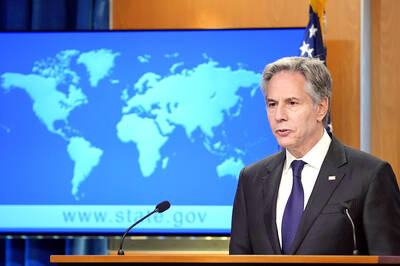
Beijing is continuing to commit genocide and crimes against humanity against Uyghurs and other Muslim minorities in its western Xinjiang province, U.S. Secretary of State Antony Blinken said in a report published on Monday, ahead of his planned visit to China this week. The State Department’s annual human rights report, which documents abuses recorded all over the world during the previous calendar year, repeated language from previous years on the treatment of Muslims in Xinjiang, but the publication raises the issue ahead of delicate talks, including on the war in Ukraine and global trade, between the top U.S. diplomat and Chinese


 RSS
RSS