


Johns Hopkins University surgeons performed three simultaneous kidney transplants in a complex piece of medical choreography that had nurses rushing organs in labeled coolers among six operating rooms.
Doctors believe the six synchronized operations -- three to remove the kidneys, three to implant them -- were a first.
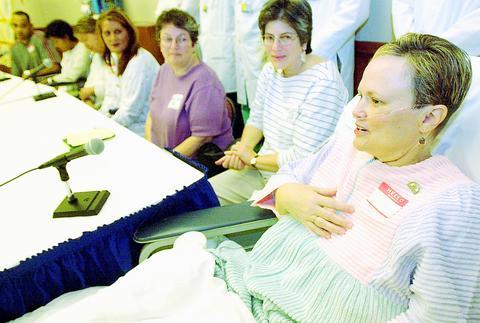
PHOTO: AP
The surgery became possible after an extraordinarily lucky, six-way organ match among the patients, their friends and their families. A woman from Miami, a woman from Pittsburgh and a teenager from Maryland, all of whom were on dialysis, had come to the Baltimore hospital with willing donors whose blood or tissue types didn't match their own.
All six patients were doing well after Monday's surgery. Each recipient met his or her donor for the first time on Friday.
"We each have a piece of each other inside us," recipient Germaine Allum said through tears at a hospital news conference.
The surgery lasted 11 hours, with two doctors, two nurses and two anesthesiologists in each operating room.
"It was truly a marathon," Dr. Robert Montgomery said.
The six operations were performed simultaneously, in part, "to avoid any possibility of anyone backing out, someone getting in a car accident, whatever," Montgomery said. "If all the operations start at the same time, it removes those variables."
Dr. Terry Strom, a professor of medicine at Harvard Medical School and the director of the division of immunology at Beth Israel Deaconess Medical Center in Boston, said the Hopkins surgeries were the first three-way simultaneous transplant he has heard of.
"It is unusual, indeed. There's an enormous shortfall in kidneys available for people in need," said Strom, who was not involved in the transplants. "To increase the size of the group of donors ... by creating scenarios like this is a very good idea."
Montgomery called the coordinated operations "logistically a monumental experience," and described the matching of each of the three transplant patients with a healthy stranger as a "eureka-type moment."
The process began last October, when Connie Dick offered to donate a kidney to her sister, Tracy Stahl.
Dick's kidney was not a good match, but during tests, nurses found that Julia Tower, who had originally wanted to donate her kidney to the teenage son of some friends, had a rare tissue type that was compatible with Stahl's.
The bond between Stahl and Tower "became the centerpiece of the whole exchange," Montgomery said. It also made a triple swap necessary, he said, because neither Dick nor Tower was a good match for 13-year-old Jeremy Weiser-Warschoff.
In Jeremy's case, a transplant kidney he received as a baby had begun to fail this year, Montgomery said.
Meanwhile, Paul Boissiere's blood was incompatible with his fiancee, Allum, but his tissue and blood matched Jeremy's, so he became the teen's donor. Dick had the same blood type as Allum and became her donor.
Montgomery said the patients had cleared the most dangerous time for transplant patients -- the first few days after an operation.
"It was really possible because these three donors desperately wanted to see their loved ones receive a kidney and were open to any possibility to make that happen," Montgomery said.

‘IN A DIFFERENT PLACE’: The envoy first visited Shanghai, where he attended a Chinese basketball playoff match, and is to meet top officials in Beijing tomorrow US Secretary of State Antony Blinken yesterday arrived in China on his second visit in a year as the US ramps up pressure on its rival over its support for Russia while also seeking to manage tensions with Beijing. The US diplomat tomorrow is to meet China’s top brass in Beijing, where he is also expected to plead for restraint as Taiwan inaugurates president-elect William Lai (賴清德), and to raise US concerns on Chinese trade practices. However, Blinken is also seeking to stabilize ties, with tensions between the world’s two largest economies easing since his previous visit in June last year. At the

UNSETTLING IMAGES: The scene took place in front of TV crews covering the Trump trial, with a CNN anchor calling it an ‘emotional and unbelievably disturbing moment’ A man who doused himself in an accelerant and set himself on fire outside the courthouse where former US president Donald Trump is on trial has died, police said yesterday. The New York City Police Department (NYPD) said the man was declared dead by staff at an area hospital. The man was in Collect Pond Park at about 1:30pm on Friday when he took out pamphlets espousing conspiracy theories, tossed them around, then doused himself in an accelerant and set himself on fire, officials and witnesses said. A large number of police officers were nearby when it happened. Some officers and bystanders rushed

Beijing is continuing to commit genocide and crimes against humanity against Uyghurs and other Muslim minorities in its western Xinjiang province, U.S. Secretary of State Antony Blinken said in a report published on Monday, ahead of his planned visit to China this week. The State Department’s annual human rights report, which documents abuses recorded all over the world during the previous calendar year, repeated language from previous years on the treatment of Muslims in Xinjiang, but the publication raises the issue ahead of delicate talks, including on the war in Ukraine and global trade, between the top U.S. diplomat and Chinese

RIVER TRAGEDY: Local fishers and residents helped rescue people after the vessel capsized, while motorbike taxis evacuated some of the injured At least 58 people going to a funeral died after their overloaded river boat capsized in the Central African Republic’s (CAR) capital, Bangui, the head of civil protection said on Saturday. “We were able to extract 58 lifeless bodies,” Thomas Djimasse told Radio Guira. “We don’t know the total number of people who are underwater. According to witnesses and videos on social media, the wooden boat was carrying more than 300 people — some standing and others perched on wooden structures — when it sank on the Mpoko River on Friday. The vessel was heading to the funeral of a village chief in


 RSS
RSS