


Prime Minister Hun Sen, whose party won nearly half the votes in Cambodia's general elections, yesterday asked a royalist party to join him in a coalition or face political "suicide."
According to preliminary results released by the government's National Election Committee, the ruling Cambodian People's Party has won 47.28 percent of the votes in Sunday's election.
The committee said on its Web site that the opposition Sam Rainsy Party came in second with 21.89 percent votes and the royalist Funcinpec party got 20.75 percent votes. The rest of the votes went to smaller parties or were declared invalid.
But the votes are not enough to allow the CPP to form a government on its own. The Funcinpec, CPP's coalition partner in the outgoing government, has said it will partner the CPP only if Hun Sen steps down as prime minister. The Sam Rainsy party also has the same condition.
If Funcinpec "becomes an opposition party, I can say that would be suicide," Hun Sen told reporters.
"They will become an opposition party that will be weaker than the current opposition [Sam Rainsy] party," he said. "So if they try to stay as a partner, the outcome won't be too mournful."
The NEC said its results are preliminary as discrepancies have to be investigated and disputes resolved. Also, under the proportional representation system followed by Cambodia, the committee will have to calculate how many seats each party will be allotted in the 123-member National Assembly based on the percentage of votes won in each of the 24 constituencies.
The final official results will be announced Aug. 8.
Hun Sen said Wednesday he expects the CPP to control up to 73 seats, nine short of the 82 it needs for a two-thirds majority to govern on its own.
A Sam Rainsy Party statement said yesterday it expects to win 28 seats and the CPP to get 70 seats. It said the Funcinpec would get 25 seats.
On Wednesday, Hun Sen rejected the two parties' demand that he step down, saying he will stay in office until a new government is formed, which under the Constitution must be within 60 days of elections.
This has threatened to create a political deadlock of the kind that occurred in 1998 when parties bargained for four months while the capital was rocked by violent demonstrations.
A delegation of EU poll monitors -- the largest group of foreign observers -- said Wednesday the elections were generally "the freest and the most democratic" ever in the country.
Other independent observers also said the elections were freer than previous ones, but still below international standards.

‘IN A DIFFERENT PLACE’: The envoy first visited Shanghai, where he attended a Chinese basketball playoff match, and is to meet top officials in Beijing tomorrow US Secretary of State Antony Blinken yesterday arrived in China on his second visit in a year as the US ramps up pressure on its rival over its support for Russia while also seeking to manage tensions with Beijing. The US diplomat tomorrow is to meet China’s top brass in Beijing, where he is also expected to plead for restraint as Taiwan inaugurates president-elect William Lai (賴清德), and to raise US concerns on Chinese trade practices. However, Blinken is also seeking to stabilize ties, with tensions between the world’s two largest economies easing since his previous visit in June last year. At the

UNSETTLING IMAGES: The scene took place in front of TV crews covering the Trump trial, with a CNN anchor calling it an ‘emotional and unbelievably disturbing moment’ A man who doused himself in an accelerant and set himself on fire outside the courthouse where former US president Donald Trump is on trial has died, police said yesterday. The New York City Police Department (NYPD) said the man was declared dead by staff at an area hospital. The man was in Collect Pond Park at about 1:30pm on Friday when he took out pamphlets espousing conspiracy theories, tossed them around, then doused himself in an accelerant and set himself on fire, officials and witnesses said. A large number of police officers were nearby when it happened. Some officers and bystanders rushed
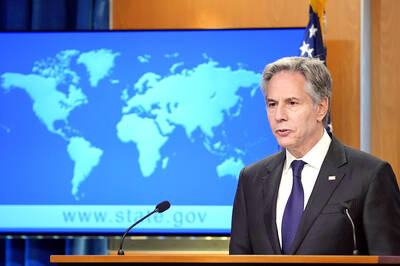
Beijing is continuing to commit genocide and crimes against humanity against Uyghurs and other Muslim minorities in its western Xinjiang province, U.S. Secretary of State Antony Blinken said in a report published on Monday, ahead of his planned visit to China this week. The State Department’s annual human rights report, which documents abuses recorded all over the world during the previous calendar year, repeated language from previous years on the treatment of Muslims in Xinjiang, but the publication raises the issue ahead of delicate talks, including on the war in Ukraine and global trade, between the top U.S. diplomat and Chinese

RIVER TRAGEDY: Local fishers and residents helped rescue people after the vessel capsized, while motorbike taxis evacuated some of the injured At least 58 people going to a funeral died after their overloaded river boat capsized in the Central African Republic’s (CAR) capital, Bangui, the head of civil protection said on Saturday. “We were able to extract 58 lifeless bodies,” Thomas Djimasse told Radio Guira. “We don’t know the total number of people who are underwater. According to witnesses and videos on social media, the wooden boat was carrying more than 300 people — some standing and others perched on wooden structures — when it sank on the Mpoko River on Friday. The vessel was heading to the funeral of a village chief in


 RSS
RSS