


Islamists and supporters of the royal-led Cabinet kept their grip on Kuwait's parliament in weekend elections while Westernized liberals suffered major losses, according to results released yesterday.
Fundamentalist Muslims who call for the full implementation of Islamic law added one seat for a total of 21. Pro-Cabinet members jumped two to 14 of the house's 50 seats.
Liberals and their supporters -- urging voting rights for women -- won just three seats, down from 14 in the outgoing parliament. The remaining 12 went to independents, an increase from four in the last house.
Under Kuwait's system, the emir has the final say, with the ability to dissolve the legislature. Still, the parliament does have significant influence: It must approve all legislation and has in the past blocked the royal ruler's attempts to give women the vote.
There are no political parties in Kuwait, with many fearing this would bring political strife. Candidates run as representative of three fundamentalist and two liberal "movements," or as independents.
In the first government comment on the vote, Kuwait Television quoted the deputy prime minister, Sheik Sabah Al Ahmed Al Sabah, as saying the Kuwaiti people had "proven political awareness and responsibility" in the elections.
He said he was "absolutely optimistic" that parliament would have "more achievements to offer."
In campaign rallies, liberal candidates called for political reform and complained about a system in which only men over 21 can cast ballots.
Most liberal supporters traditionally come from Kuwait City and its suburbs. Outer tribal areas usually elect pro-government or Islamist lawmakers.
Many liberals had hoped that success in Saturday's election would lead the legislature to agree to female suffrage in this small oil-rich state. That seemed less likely after their poor showing, unless the Cabinet puts its weight behind the issue and pressures parliament.
Other candidates had also accused the outgoing house of failing to deal with major economic issues such as privatization of an economy that depends on oil revenues and government spending.
However, drastic change did not come in an election marked by accusations of vote-buying, and charges that many voters cast ballots according to allegiances to tribes and religious sects.
But the big losers were the liberals, with long-serving leaders Ahmed al-Rubei and Abdullah al-Naibari among those who lost races. As for the independents, these many new faces often have undeclared political affiliations, with some elected based more on local loyalties than ideology.
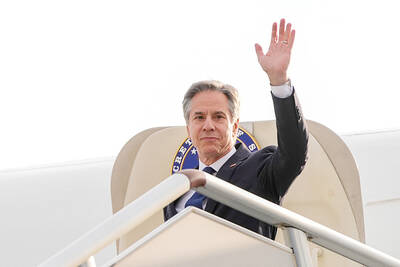
‘IN A DIFFERENT PLACE’: The envoy first visited Shanghai, where he attended a Chinese basketball playoff match, and is to meet top officials in Beijing tomorrow US Secretary of State Antony Blinken yesterday arrived in China on his second visit in a year as the US ramps up pressure on its rival over its support for Russia while also seeking to manage tensions with Beijing. The US diplomat tomorrow is to meet China’s top brass in Beijing, where he is also expected to plead for restraint as Taiwan inaugurates president-elect William Lai (賴清德), and to raise US concerns on Chinese trade practices. However, Blinken is also seeking to stabilize ties, with tensions between the world’s two largest economies easing since his previous visit in June last year. At the
Nearly half of China’s major cities are suffering “moderate to severe” levels of subsidence, putting millions of people at risk of flooding, especially as sea levels rise, according to a study of nationwide satellite data released yesterday. The authors of the paper, published by the journal Science, found that 45 percent of China’s urban land was sinking faster than 3mm per year, with 16 percent at more than 10mm per year, driven not only by declining water tables, but also the sheer weight of the built environment. With China’s urban population already in excess of 900 million people, “even a small portion

UNSETTLING IMAGES: The scene took place in front of TV crews covering the Trump trial, with a CNN anchor calling it an ‘emotional and unbelievably disturbing moment’ A man who doused himself in an accelerant and set himself on fire outside the courthouse where former US president Donald Trump is on trial has died, police said yesterday. The New York City Police Department (NYPD) said the man was declared dead by staff at an area hospital. The man was in Collect Pond Park at about 1:30pm on Friday when he took out pamphlets espousing conspiracy theories, tossed them around, then doused himself in an accelerant and set himself on fire, officials and witnesses said. A large number of police officers were nearby when it happened. Some officers and bystanders rushed
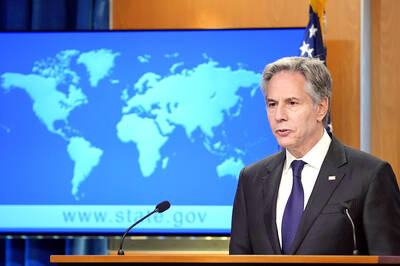
Beijing is continuing to commit genocide and crimes against humanity against Uyghurs and other Muslim minorities in its western Xinjiang province, U.S. Secretary of State Antony Blinken said in a report published on Monday, ahead of his planned visit to China this week. The State Department’s annual human rights report, which documents abuses recorded all over the world during the previous calendar year, repeated language from previous years on the treatment of Muslims in Xinjiang, but the publication raises the issue ahead of delicate talks, including on the war in Ukraine and global trade, between the top U.S. diplomat and Chinese


 RSS
RSS