


A steel propaganda tower stood forlorn, a symbol of North Korean anachronism. Paint peeling off, it carried a slogan that bears little connection with the reality of the impoverished country: "Let's revamp our lives with our own strength!"
A kilometer away, communist authorities welcomed a swarm of capitalist investors from South Korea. Young North Korean women, their tan rugged faces softened by cheap cosmetics, smiled and danced with regimented grace. A sound system blared a high-pitched song: "Good to see you!"
"Yes, I am glad to see you too," an old South Korean entrepreneur said to a shy North Korean woman handing him a flower.
The groundbreaking ceremony Monday for a joint industrial park near the inter-Korean border revealed a country at odds with itself, a totalitarian regime striving to rebuild its shattered economy with outside help while keeping up its harsh tone on its suspected nuclear weapons program. Contradictions abounded in Kaesong, an ancient city just north of the border.
Nation of slogans
Red-and-white catch-phrases called for loyalty to leader Kim Jong-il, "the sun of the 21st century," and urged people to "defend our way of living with our lives." Muscled soldiers and workers in roadside murals brandished bayonets to "beat the US imperialists, our sworn enemy!"
At each tourist stop, however, Kaesong people were eager to make a few American dollars.
They displayed ginseng, porcelain, traditional paintings, and even "adder liquor" -- a bottle of fiery whiskey with a coiled, discolored snake in it. When a clerk lifted a bottle by its neck, the cap came loose. She calmly replaced it and put the bottle back on display.
Kaesong
Kaesong was once Korea's capital and commercial hub. Its traders were the first Koreans to practice bookkeeping. Today, communist clerks armed with electronic calculators handled US dollars, euros and even South Korean won as deftly as a department store clerk in Seoul.
Kaesong, a shade below the 38th Parallel, was part of South Korea before the 1950-to-1953 Korean War. When a new border was drawn at the end of the war, it became part of North Korea.
Before Korea was divided at the end of World War II, the city produced 60 percent of the country's ginseng, exporting it to far-flung markets such as the Middle East, an occasional destination of North Korean missile parts.
Now the city hopes to attract South Korean investors and tourists -- a dream vulnerable to nuclear tensions on the divided peninsula.
"In this old Korean center of trade, we hope to open a new chapter of prosperity together with South Korea," said Choe Hyun-gu, a North Korean trade and commerce official.
Communist authorities have turned an ancient Confucian temple into a museum and planned to open its oldest neighborhoods to Southern tourists. A middle-aged female guide said she once escorted leader Kim Jong-il's late father, President Kim Il-sung, through the museum, and it remained her "happiest memory."
From a hill, a shining bronze statue of the senior Kim, the North's demigod, stood overlooking streets lined with old oak and ginkgo trees.
Although Kaesong is a major provincial city, it had few cars -- a cultural shock for day-trippers from traffic-congested Seoul. Shops kept their doors closed and few people were seen inside.
Impoverished yet heavily militarized, the country describes every aspect of daily life as a "heroic struggle." A large slogan on a building called it "battlefield." A smaller sign said it really was a pepper-paste factory.
All people walked, men in their dark brown Mao-style khaki attire and women in baggy pants and nylon shirts with flower decorations. School children wore red scarfs and walked as if marching. Without electricity, men fought the summer heat by keeping windows open and staying topless. Many waved at the air-conditioned South Korean tourist buses.
A small girl in rags digging in a roadside ditch stood awe-struck by the buses coming her way.
Closer to the border, North Korea built a propaganda village, Kijong-dong, with clean apartment buildings. But a kilometer behind it, low-slung, identical huts of cinderblocks and gray tiles clustered on hills shorn of trees. Sunken roofs were patched with plastic sheets.
Rust and decay
Army barracks were tidy and decorated with slogans, but their roofs were covered with rice thatch. The front-line fences carried signs of "High Voltage Electricity!" but lines were rusty or missing.
Old Soviet-built cranes stood abandoned and rusting. New Hyundai earth-movers, lent by the South, were doing all the work to build a cross-border road that will eventually link Seoul and Kaesong.
The fact that North Korea is allowing South Koreans to see the embarrassing foibles of its system shows its eagerness for economic help.
Newly built front-line billboards near concrete tank traps showed a cherubic boy and girl and exhorted: "Let's leave a unified Korea to our offspring!"
Expat's prices
At the end of the tour day, South Koreans found there was more than one price system in North Korea. One reporter bought a bottle of red ginseng whiskey for eight euros and hours later he found another shop selling it for just five euros.
When he complained to a North Korean minder who rode with journalists, the North Korean laughed and said: "Well, when the market nears the end of its business, you have to dump your unsold goods."

‘IN A DIFFERENT PLACE’: The envoy first visited Shanghai, where he attended a Chinese basketball playoff match, and is to meet top officials in Beijing tomorrow US Secretary of State Antony Blinken yesterday arrived in China on his second visit in a year as the US ramps up pressure on its rival over its support for Russia while also seeking to manage tensions with Beijing. The US diplomat tomorrow is to meet China’s top brass in Beijing, where he is also expected to plead for restraint as Taiwan inaugurates president-elect William Lai (賴清德), and to raise US concerns on Chinese trade practices. However, Blinken is also seeking to stabilize ties, with tensions between the world’s two largest economies easing since his previous visit in June last year. At the

UNSETTLING IMAGES: The scene took place in front of TV crews covering the Trump trial, with a CNN anchor calling it an ‘emotional and unbelievably disturbing moment’ A man who doused himself in an accelerant and set himself on fire outside the courthouse where former US president Donald Trump is on trial has died, police said yesterday. The New York City Police Department (NYPD) said the man was declared dead by staff at an area hospital. The man was in Collect Pond Park at about 1:30pm on Friday when he took out pamphlets espousing conspiracy theories, tossed them around, then doused himself in an accelerant and set himself on fire, officials and witnesses said. A large number of police officers were nearby when it happened. Some officers and bystanders rushed
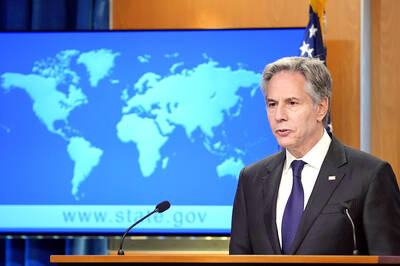
Beijing is continuing to commit genocide and crimes against humanity against Uyghurs and other Muslim minorities in its western Xinjiang province, U.S. Secretary of State Antony Blinken said in a report published on Monday, ahead of his planned visit to China this week. The State Department’s annual human rights report, which documents abuses recorded all over the world during the previous calendar year, repeated language from previous years on the treatment of Muslims in Xinjiang, but the publication raises the issue ahead of delicate talks, including on the war in Ukraine and global trade, between the top U.S. diplomat and Chinese
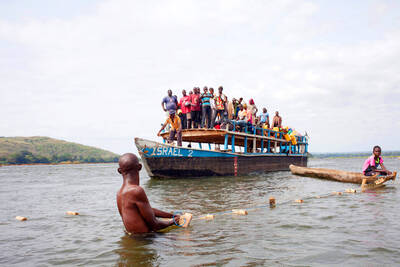
RIVER TRAGEDY: Local fishers and residents helped rescue people after the vessel capsized, while motorbike taxis evacuated some of the injured At least 58 people going to a funeral died after their overloaded river boat capsized in the Central African Republic’s (CAR) capital, Bangui, the head of civil protection said on Saturday. “We were able to extract 58 lifeless bodies,” Thomas Djimasse told Radio Guira. “We don’t know the total number of people who are underwater. According to witnesses and videos on social media, the wooden boat was carrying more than 300 people — some standing and others perched on wooden structures — when it sank on the Mpoko River on Friday. The vessel was heading to the funeral of a village chief in


 RSS
RSS