


President-elect Nestor Kirchner, one week away from taking office, met Saturday with advisors to discuss the direction of his new government.
Meanwhile, the country's outgoing leader, Eduardo Duhalde, urged opponents to refrain from unnecessary criticism of the new president during his first year in office as he seeks to lift Argentina from a deep economic slump.
Kirchner would have been competing with former President Carlos Menem in an election runoff yesterday, but the vote was canceled after Menem -- far behind in the polls -- pulled out of the race. In the first round, Menem just beat Kirchner by 24 percent to 22 percent.
Kirchner met with his advisors near the Glaciers Naional Park in southern Argentina. Afterward he took a boat ride on a lake in the park and said he looked forward to tackling the economic recovery.
He said he would seek to ensure the Argentine currency holds stable at about 3 pesos per dollar. The peso has been trading at just under 3 pesos in recent weeks.
"A peso at three to the dollar seems reasonable to me," said Kirchner, who nonetheless gave no hint of policies he would deploy.
He also had no comment on his Cabinet choices, though current Economic Minister Roberto Lavagna is expected to remain on when Kirchner takes office on May 25.
An announcement of the full Cabinet is expected early next week.
Kirchner has been accused by two of his first round opponents of a heavy-handed style while governor of the southern province of Santa Cruz.
Duhalde, who backed Kirchner in the race for the presidency, dismissed the criticism and said the opposition should put aside differences and rally behind the brand new government.
"The opposition should be more prudent and avoid criticism for at least this year," Duhalde said.
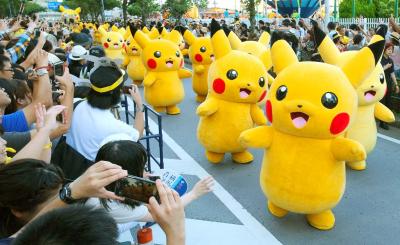
China’s military news agency yesterday warned that Japanese militarism is infiltrating society through series such as Pokemon and Detective Conan, after recent controversies involving events at sensitive sites. In recent days, anime conventions throughout China have reportedly banned participants from dressing as characters from Pokemon or Detective Conan and prohibited sales of related products. China Military Online yesterday posted an article titled “Their schemes — beware the infiltration of Japanese militarism in culture and sports.” The article referenced recent controversies around the popular anime series Pokemon, Detective Conan and My Hero Academia, saying that “the evil influence of Japanese militarism lives on in
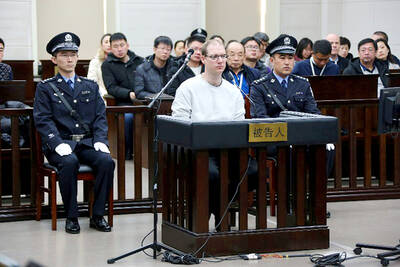
DIPLOMATIC THAW: The Canadian prime minister’s China visit and improved Beijing-Ottawa ties raised lawyer Zhang Dongshuo’s hopes for a positive outcome in the retrial China has overturned the death sentence of Canadian Robert Schellenberg, a Canadian official said on Friday, in a possible sign of a diplomatic thaw as Canadian Prime Minister Mark Carney seeks to boost trade ties with Beijing. Schellenberg’s lawyer, Zhang Dongshuo (張東碩), yesterday confirmed China’s Supreme People’s Court struck down the sentence. Schellenberg was detained on drug charges in 2014 before China-Canada ties nosedived following the 2018 arrest in Vancouver of Huawei chief financial officer Meng Wanzhou (孟晚舟). That arrest infuriated Beijing, which detained two Canadians — Michael Spavor and Michael Kovrig — on espionage charges that Ottawa condemned as retaliatory. In January

A sign hanging from a rusty ice-green shipping container installed by Thai forces on what they say is the border with Cambodia reads: “Cambodian citizens are strictly prohibited from entering this area.” On opposite sides of the makeshift barricade, fronted by coils of barbed wire, Cambodians lamented their lost homes and livelihoods as Thailand’s military showed off its gains. Thai forces took control of several patches of disputed land along the border during fighting last year, which could amount to several square kilometers in total. Cambodian Kim Ren said her house in Chouk Chey used to stand on what is now the Thai
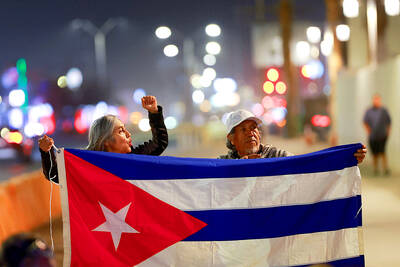
NEW RULES: There would be fewer school days, four-day workweeks, and a reduction in transportation services as the country battles a crisis exacerbated by US pressure The Cuban government on Friday announced emergency measures to address a crippling energy crisis worsened by US sanctions, including the adoption of a four-day work week for state-owned companies and fuel sale restrictions. Cuban Deputy Prime Minister Oscar Perez-Oliva Fraga blamed Washington for the crisis, telling Cuban television the government would “implement a series of decisions, first and foremost to guarantee the vitality of our country and essential services, without giving up on development.” “Fuel will be used to protect essential services for the population and indispensable economic activities,” he said. Among the new measures are the reduction of the working week in


 RSS
RSS