


In the first stunned moments when the horror of the planes crashing into the World Trade Center slowly registered on the people in lower Manhattan, Madhavan Ramaswamy found something that would later be in very short supply: a taxicab.
Ramaswamy, a manager for international money transfer at the American Express Bank who works at 7 World Trade Center, was a little late for a meeting there when he saw flames atop the twin towers. Jumping into a cab with three colleagues, he told the driver to head to the bank's backup center, never before used, just over the Hudson River in New Jersey. (American Express, nervous about security, asked that its exact location not be disclosed.) The Lincoln and Holland Tunnels were already closed, but Ramaswamy's group was able to catch a ferry, and by 2pm he arrived in the bank's three narrow rooms.
With most of the bank's employees scattered around the city -- all, it would turn out, thankfully alive -- Ramaswamy's group met three more colleagues from a New Jersey office, pulled the plastic drop cloths from rows of computers and began rerouting communications from the international banking networks.
By late Tuesday, they were able to process about 19,000 transfers for a total of US$14.3 billion, roughly 70 percent of the transactions its customers had entered.
It was a testament to the sort of contingency planning that finger-wagging regulators urge on companies, but that only some do. American Express had established the backup site as part of its preparations for the computer crisis that never came on Jan. 1, 2000.
Yet, as the week went on and the number of employees taxing the air-conditioning of the three rooms grew to about 90, it became clear that the disaster plan had not anticipated the scale of this disaster. The contingency plan had predicted a need to use the backup site for two weeks; now the company will make its home in New Jersey indefinitely, not just for computer operators but for sales representatives, lawyers and a host of other staff members.
Even some of the most basic elements of the bank's plan did not anticipate the scope of this disruption. Employees had been told that if their building was evacuated, they should reunite at a nearby public school. But on Tuesday that site seemed perilously close, and most joined the mass of dazed refugees streaming north away from the trade center.
William J. Blomquist, the managing director of the bank's Financial Institutions Group, was about to convene a staff meeting in his office in the American Express headquarters tower, in the World Financial Center just across West Street from the trade center, when he heard the explosion of the first plane crash.
"It's hard to stay calm when you see people starting to jump out of windows," Blomquist said on Thursday.
After the second crash, the American Express tower was evacuated, and Blomquist bumped into Farhad Subjally, another bank executive, who had recently left the bank's operations center in 7 World Trade.
"I fully thought we would be able to go back into our building in half an hour," Subjally said. "So I was heading over to the World Financial Center to make phone calls."
Instead, the executives marched north, finding other bank employees as they went along.
Meanwhile, workers from Electronic Data Systems, the big computer company that operates the bank's systems, were busy trying to get the computer system at the backup center up and running.
These days, Amex's international payments are so routine that many can be handled without human involvement. These were processed automatically by the main American Express Bank computer at an EDS center in Britain throughout Tuesday. But by 7pm, when Ramaswamy and colleagues finally had the computers in New Jersey linked back to the mainframe in Britain, thousands of transfers that did need human authorization had piled up. Working until 11pm, the team processed all those transactions.
Although the backup center in New Jersey was equipped with the advanced communication and security equipment needed to transfer huge amounts of money, it was cut off from all other information. There was no television, radio or Internet browser. The backup site was set up to receive email, but the e-mail server in 7 World Trade had been destroyed Tuesday afternoon when that building collapsed.
"I was totally cut off and didn't know anything other than something bad had happened," Ramas-wamy said. His only information came from telephone calls, when the land lines or cell phones were working. "I was on the phone with a guy in Singapore when he said that he was seeing our office falling on CNN. It was terrible."
Now that the basic systems are in place, even harder work is beginning to turn what had been meant as a temporary setup into the bank's home for many months ahead.
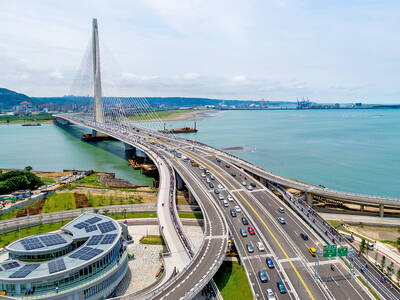
The Ministry of Transportation and Communications yesterday inaugurated the Danjiang Bridge across the Tamsui River in New Taipei City, saying that the structure would be an architectural icon and traffic artery for Taiwan. Feted as a major engineering achievement, the Danjiang Bridge is 920m long, 211m tall at the top of its pylon, and is the longest single-pylon asymmetric cable-stayed bridge in the world, the government’s Web site for the structure said. It was designed by late Iraqi-British architect Zaha Hadid. The structure, with a maximum deck of 70m, accommodates road and light rail traffic, and affords a 200m navigation channel for boats,
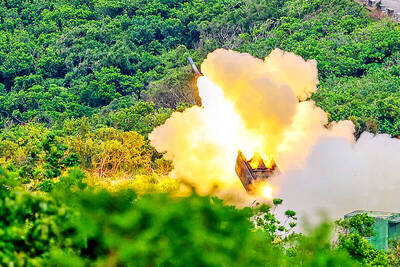
PRECISION STRIKES: The most significant reason to deploy HIMARS to outlying islands is to establish a ‘dead zone’ that the PLA would not dare enter, a source said A High Mobility Artillery Rocket System (HIMARS) would be deployed to Penghu County and Dongyin Island (東引) in Lienchiang County (Matsu) to force the Chinese military to retreat at least 100km from the coastline, a military source said yesterday. Taiwan has been procuring HIMARS and Army Tactical Missile Systems (ATACMS) from the US in batches. Once all batches have been delivered, Taiwan would possess 111 HIMARS units and 504 ATACMS, which have a range of 300km. Considering that “offense is the best defense,” the military plans to forward-deploy the systems to outlying islands such as Penghu and Dongyin so that

‘CLEAR MESSAGE’: The bill would set up an interagency ‘tiger team’ to review sanctions tools and other economic options to help deter any Chinese aggression toward Taiwan US Representative Young Kim has introduced a bill to deter Chinese aggression against Taiwan, calling for an interagency “tiger team” to preplan coordinated sanctions and economic measures in response to possible Chinese military or political action against Taiwan. “[Chinese President] Xi Jinping [習近平] has directed the People’s Liberation Army to be ready to invade Taiwan by 2027. China has a plan. America should have one too,” Kim said in a news release on Thursday last week. She introduced the “Deter PRC [People’s Republic of China] aggression against Taiwan act” to “ensure the US has a coordinated sanctions strategy ready should

TAIWAN ISSUE: US treasury secretary Scott Bessent said on the first day of meetings that ‘it wouldn’t be a US-China summit without the Taiwan issue coming up’ There were no surprises on the first day of the summit between US President Donald Trump and Chinese President Xi Jinping (習近平), the Mainland Affairs Council (MAC) said yesterday, as the government reiterated that cross-strait stability is crucial to the Asia-Pacific region, as well as the world. As the two presidents met for a highly anticipated summit yesterday, Chinese state media reported that Xi warned Trump that missteps regarding Taiwan could push their two countries into “conflict.” Trump arrived in China with accolades for his host, calling Xi a “great leader” and “friend,” and extending an invitation to visit the White House


 RSS
RSS