


Labor unions yesterday protested in front of the Straits Exchange Foundation (SEF,
The firm, Continental Carbon Company, is based in Houston, Texas, and is part of Koo's global business network, which includes telecommunications, hotels, biotechnology, chemicals, insurance, and banking.
Yesterday's event was staged to coincide with the first anniversary of what the US employees involved have termed a "lockout" of workers by Continental Carbon at one of its plants in Ponca City, Oklahoma.
The company allegedly dismissed more than 80 workers a year ago and breached an agreement with the employees' union to continue to provide health insurance for former employees for 18 months after they leave the company.
It did so, the US employees say, because they refused to accept cuts in wages and benefits of between US$10,000 and US$15,000 per year when renewing their contracts last year.
According to a report by the US-based Paper, Allied-Industrial, Chemical, and Energy Workers International Union (PACE), after the lockout, the 86 workers and their families were thrown into financial hardship and denied health insurance.
Organized by the Taiwan Confederation of Trade Unions (TCTU,
Representatives of the workers and leaders of PACE came to Taiwan in March for a joint demonstration in front of the Taiwan Cement building. Taiwan Cement and Taiwan Synthetic Rubber Corporation are Koo's Group-owned companies that bought Continental Carbon in 1995.
"We had protests in Taiwan involving US union leaders in March," said Robert Kuo (
"Unfortunately, no one from the Koo family has ever responded. That is why we chose to approach the head of the Koo's Group and president of the SEF, in the hopes of getting some positive feedback from the group."
The protesters planned yesterday to present Koo with a letter detailing alleged malpractice on the part of the management of Continental Carbon and a giant styrofoam key with the words "anti-lockout" on the front.
In fact, Koo was out of the country and an SEF department head, Lin Jau-tsan (
He refused, however, to accept the letter or the key from the protesters, saying, "We [the foundation] are unfamiliar with the background of the dispute and have no authority over the matter," he said.
"The foundation really has nothing to do with it. They are ringing the wrong bell," Lin told the Taipei Times.
Yesterday's protest was also attended by environmental activists, who protested about Continental Carbon's alleged illegal discharge of waste-water in the local Ponca City community and the failure to take appropriate measures to protect workers from potentially carcinogenic carbon black oil.
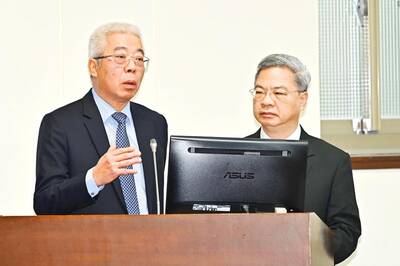
Taiwan has arranged for about 8 million barrels of crude oil, or about one-third of its monthly needs, to be shipped from the Red Sea this month to bypass the Strait of Hormuz and ease domestic supply pressures, CPC Corp, Taiwan (CPC, 台灣中油) said yesterday. The state-run oil company has worked with Middle Eastern suppliers to secure routes other than the Strait of Hormuz, through which about 20 percent of the world’s oil and liquefied natural gas typically passes, CPC chairman Fang Jeng-zen (方振仁) said at a meeting of the legislature’s Economics Committee in Taipei. Suppliers in Saudi Arabia have indicated they
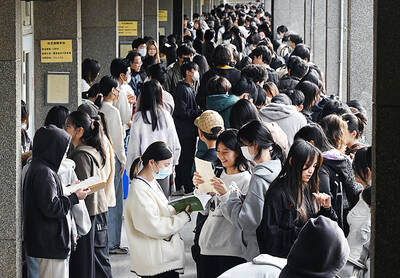
A global survey showed that 60 percent of Taiwanese had attained higher education, second only to Canada, the Ministry of the Interior said. Taiwan easily surpassed the global average of 43 percent and ranked ahead of major economies, including Japan, South Korea and the US, data from the Organisation for Economic Co-operation and Development (OECD) for 2024 showed. Taiwan has a high literacy rate, data released by the ministry showed. As of the end of last year, Taiwan had 20.617 million people aged 15 or older, accounting for 88.5 percent of the total population, with a literacy rate of 99.4 percent, the data
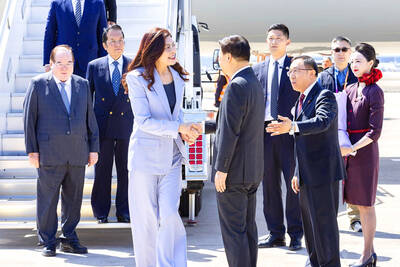
CCP ‘PAWN’? Beijing could use the KMT chairwoman’s visit to signal to the world that many people in Taiwan support the ‘one China’ principle, an academic said Chinese Nationalist Party (KMT) Chairwoman Cheng Li-wun (鄭麗文) yesterday arrived in China for a “peace” mission and potential meeting with Chinese President Xi Jinping (習近平), while a Taiwanese minister detailed the number of Chinese warships currently deployed around the nation. Cheng is visiting at a time of increased Chinese military pressure on Taiwan, as the opposition-dominated Legislative Yuan stalls a government plan for US$40 billion in extra defense spending. Speaking to reporters before going to the airport, Cheng said she was going on a “historic journey for peace,” but added that some people felt uneasy about her trip. “If you truly love Taiwan,

NEW LOW: The council in 2024 based predictions on a pessimistic estimate for the nation’s total fertility rate of 0.84, but last year that rate was 0.69, 17 percent lower An expected National Development Council (NDC) report expects the nation’s population to drop below 12 million by 2065, with the old-age dependency ratio to top 100 percent sooner than 2070, sources said yesterday. The council is slated to release its latest population projections in August, using an ultra-low fertility model, the sources said. The previous report projected that Taiwan’s population would fall to 14.37 million by 2070, but based on a new estimate of the total fertility rate (TFR) — the average number of children born to a woman over her lifetime — the population is expected to reach 12 million by


 RSS
RSS