


Sewing machines and batik pillows are in. So are Lego construction sets and scrapbooks, along with bowling and brownies.
While most economists' attention has focused on what people are avoiding in the aftermath of last month's terrorist attacks and the first waves of retaliatory bombings in Afghanistan -- traveling on airplanes, making luxury purchases, going to expensive restaurants -- business executives and store data suggest a pattern of what people are doing instead. Americans are seeking solace, it seems, in mundane and homey activities and purchases.
Businesses are understandably loath to talk much about benefiting from a horrible human tragedy, but it is clear that consumers are crowding into stores that promote old-fashioned crafts like quilting and knitting. And whereas retail as a whole is hurting -- sales ending the week of Oct. 6 were down 1.3 percent from the same week last year according, to Instinet Research Redbook Average -- products associated with "cocooning," like candles and DVD players, are experiencing a spike in popularity. And fast foods and comfort foods are selling well.
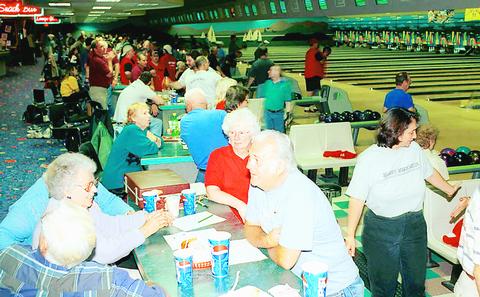
PHOTO: NY TIMES
The need for basic things
"People want to sew, create and get back to basics," said Judi Appel, who runs a fabric and home decor store in Morro Bay, Calif. Appel said customers began to stream into her store, the Cotton Ball, within hours of the attacks. They nestled into the plush purple chenille-covered sofas, cradled mugs of coffee and then bought things -- small things like red-white-and-blue fabric for flags, and big things like US$1,500 sewing machines. By the end of the day her sales were roughly one-third above a normal day and they have remained as strong in the weeks since.
The Cotton Ball is not alone. Arts-and-crafts stores nationwide are reporting lines out the door. Michaels, an arts-and-crafts chain with nearly 700 stores, announced this week that it expected sales to rise 8 percent to 10 percent this year, compared with a previous forecasts of 6 percent to 8 percent.
"We are an industry people go to in times of trouble," said Susan Brandt, director of communications at the Hobby Industry Association. "They take solace in staying busy and doing things with their hands."
Another bit of old-fashioned Americana that appears to be making a comeback is bowling. In recent weeks many bowling center operators are reporting a increased interest in the sport as families look for activities to bond over.
Dick Corley, chief executive of Bowl New England, which operates 13 centers in seven states, saw non-league play rise two weekends in a row at the end of September as parents and children jammed his facilities. "After the terrible tragedy in New York people want to be with other people," he said. "The family thing is huge."
Marge Bergeson said she is usually exhausted when she ends her shift at the Holiday Bowl, a bowling center in Groton, Connecticut But on the past two Tuesdays, she has received a call from her daughter Jennifer, 23, who wanted to organize a family bowling night. Bergeson complied, suspecting a link to the terror attacks. "My daughter told me how important her father and I are now," she recalled. "She wants to be around us more."
When parents aren't doing activities with children, they are buying them things to comfort and reassure them. The movie featuring Harry Potter, the bespectacled boy wizard, will premiere in November, and retailers were worried earlier this year that the film's merchandise might not sell. But that has all changed.
Harry potter to the rescue
"There is a rush to foster play patterns that are safe and Harry Potter is a known character," said Michael McNally, spokesman for Lego, which has temporarily sold out of many of its Harry Potter construction kits. "He is the kind of safe role model parents are looking for, and Harry Potter is also an individual kids can relate to."
Parents are also buying Quidditch racing sets, stuffed Harry Potter dolls and electronic databases of spells, said David Niggli, the chief operating officer of the toy retailer FAO Schwarz.
Looming economic uncertainty and concerns about overseas fighting have also aroused American's urge to nest.
"We had a great weekend after the 11th and had an incredible weekend after that: traffic, sales and transaction size were all up," said Marvin Girouard, chairman and chief executive of Pier I Imports, whose 800-plus stores specialize in items for the home. He said he is even optimistic that sales will hold up through the holidays. "Hey, people may not buy a new car or new computer, but they will buy ornaments, wreathes, and place-mats," he said. "And that serves us really well."
Large consumer electronics are ordinarily the first kind of luxury to stop selling in a slowing economy, but NPD, a market research firm, has raised its estimate for sales of DVD players to 13 million from 11.4 million since the attacks.
Dave Powers, a 34-year-old Manhattan resident, spent the first weeks after the attacks seeking the company of friends at New York bars. But last week he was at Circuit City in Union Square looking at DVD players and thinking about buying a wide-screen television and sound system.
The urge to curl up and escape
It's partially escapism," he said. "There is not really anything anyone can do now, besides make a donation. Now I feel like I want to pull myself in."
The need to find comfort has, of course, powerfully affected what Americans are eating. Fancy restaurateurs may be dusting empty wineglasses right now, but the makers of the fast and the fattening have been nourishing the nation's neuroses at a swift pace. Sales at quick service restaurants like McDonald's and Taco Bell have been higher during the last three weeks, compared to the comparable period a year earlier, according to NPD.
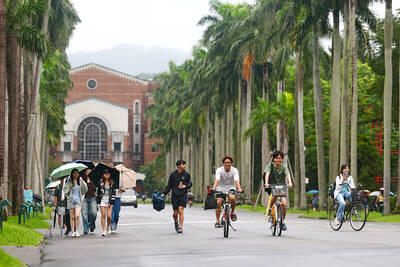
National Taiwan University (NTU) yesterday said it disqualified a person from an entrance examination for using AI smart glasses to cheat, along with two others for making untruthful statements in their curriculum vitae. The three applicants were given null scores, Taiwan’s highest-ranked university said, calling on prospective students to be honest in the admissions process. NTU registrar Lee Hung-sen (李宏森) said that the cheating applicant wore a hat and thick-rimmed glasses to the second written exam for medical school, claiming that they felt cold. Suspicions were aroused when the applicant stared oddly at the test for long stretches while steadily bringing the paper
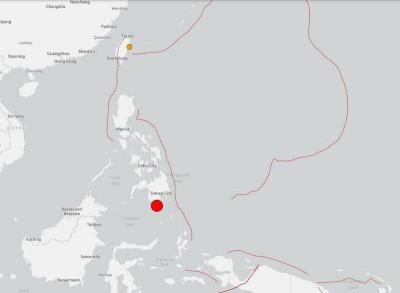
A magnitude 7.8 earthquake struck off the southern coast of Mindanao in the Philippines at 7:38am today, prompting the US Tsunami Warning System to issue an alert for neighboring countries, including Taiwan. The system issued a purple alert indicating a "tsunami threat." The potential threat zone includes Taiwan, the Philippines, Papua New Guinea, Yap and Palau. Philippine authorities were assessing the damage from the quake, with the office of civil defense seeking to verifying initial reports that 15 people had been killed and 129 injured in the region, mostly from falling debris. Arlene Hollero, disaster chief of Maasim town in the Philippines' Sarangani Province,

‘GRAY ZONE’ PRESSURE: Beijing’s activities are intended to create the deceitful impression that China has jurisdiction over the area around Taiwan, the CGA said Taiwan’s rights over its territorial waters and exclusive economic zone must not be violated by any country, the Mainland Affairs Council said yesterday, adding that it will not accept any unprovoked actions. The council issued the remarks in response to the China Coast Guard conducting maritime enforcement drills near eastern Taiwan and claiming to fully exercise China’s maritime administrative law enforcement authority. The Coast Guard Administration (CGA) has been closely monitoring the situation and is taking concrete steps to defend the nation’s sovereignty and secure its waters, the council said. China has no sovereign rights over the waters off eastern
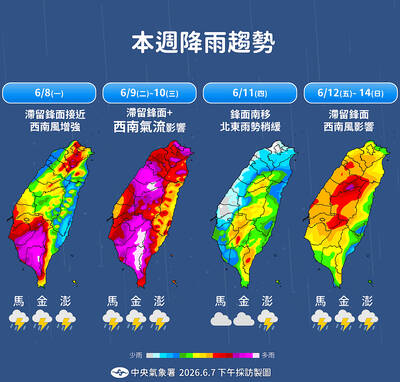
Heavy rain is expected to affect parts of Taiwan this week, the Central Weather Administration (CWA) said yesterday as a meteorologist said the active part of the annual plum rain season has started. A stationary plum rain front and southwesterly winds would bring unstable weather and abundant moisture to Taiwan from today for about a week, with the heaviest rainfall forecast for tomorrow and Wednesday, the CWA said. The agency said western and northeastern Taiwan, and mountainous areas in the east and southeast, could expect showers or thunderstorms on those two days, with localized heavy rain possible. Other parts of


 RSS
RSS