


Even as winter temperatures set in, sightings of people doffing the "bian mao" are growing rarer.
And no wonder. Popularity of the dark green woolen hat -- named after President Chen Shui-bian (
Chen's popularity has dropped from an approval rating of 73 percent on March 30, when his DPP won the presidential election, to today's 38 percent. Dissatisfaction with Chen's performance as president has risen from 8 percent to 48 percent, according to a China Times poll last week.
Prior to the March election, the "bian mao" sold like hotcakes with sales in spring of last year topping 300,000 units from the now defunct Bian Mao Factory (
Earlier this week, a study by Business Weekly magazine rated Chen Shui-bian products as one of the top 10 "trendiest commodity concepts" of 2000.
According to the magazine, Chen's likeness was heavily marketed by local businesses earlier this year via the print media and in television commercials, stuffed dolls and other spin-offs, due to the "political star" status he received in being the first opposition leader to become president, the report says.
But as Chen's popularity has waned, so has the public's acceptance of the products.
In the six-month period since the Chen administration took office, the stock market has drastically fallen, banks appear ready to bust wide open with bad debts, and many industries -- short on cash and business -- teeter on the brink of collapse.
One pundit says that even though he did turn a dollar or two during the peak of the hat craze, he wouldn't recommend investing in any A-bian get-rich-quick schemes in the current climate.
"It's a bad time to talk about any products related to President Chen Shui-bian, especially with the unfavorable situation and bad economy," said Lee Shui-yin (李淑尹), Bian Hat Factory (扁帽工廠) assistant manager.
One advertising pundit also advised against investing in the "A-bian image."
"It's not suitable to use A-bian's image anymore ... it doesn't make any sense. The whole situation [the economy] is a mess and the continued use of his image is a joke," said Huang Cheng-pin (黃政斌), a manager at Kuohua Advertising Company (國華廣告公司網路溝通部經理).
"A-Bian products have fallen from favor all over Taiwan," said Huang.
But another company who tried to profit from the A-bian craze may now be wishing they had stuck to their core business.
Makoto Bank (
Makoto Bank, authorized by Chen to use his image, introduced the cards in May for an unspecified period of time.
But souvenir A-bian credit cards, like the hats, have met with poor public reaction. The first card in the series, a hand-sketched caricature of the president, is currently being replaced with a cartoon doll that bears little resemblance to the embattled Chen. According to a bank official, while the cards were popular in the first few months of the new president's term of office, consumers have lately shunned the product and are requesting "cuter designs," a Makato Bank employee said.
"The reasoning behind introducing the [cuter] A-bian credit cards is because of consumer feedback ... but actually the bank is working on other new credit cards ideas now," said Ms Chuang, a Makoto Bank Credit Cards Center supervisor (企劃部專員) who declined to give her full name.
With a large number of cards having already been made with A-bian's image on them, the bank continues to push forward with the plan.
"There is no deadline from using A-bian's image because the board of Makoto Bank has a special relationship with Chen, " said Makoto Bank Sales Marketing Supervisor, Ben Chen (陳昭豪).
Special indeed. Stuck with the image of an unpopular political figure smack dab in the middle a major corporate promotion, they had to salvage a poor business idea and at the same time not show disrespect to their "special friend" by canceling the product.
According to another advertising executive, using A-bian or other politicians to promote any new product is a bad idea.
"It's risky to use politicians or celebrities to promote new products, so we won't consider it unless the client makes a special request," said Winnie Lan (
While the bank may be stuck with a cache of the unpopular cards, they may not be alone. Producers of fake A-bian hats are said to also be having a tough time flogging their wares these days.
The bank came up with an innovative way of dispersing the cards: it required all employees to apply for one.
But at least one staff member -- who declined to be identified -- balked at the order. " I have one ... the bank made me apply for one, but I'm not a supporter of the card nor A-bian," she said.

The nation’s fastest supercomputer, Nano 4 (晶創26), is scheduled to be launched in the third quarter, and would be used to train large language models in finance and national defense sectors, the National Center for High-Performance Computing (NCHC) said. The supercomputer, which would operate at about 86.05 petaflops, is being tested at a new cloud computing center in the Southern Taiwan Science Park in Tainan. The exterior of the server cabinet features chip circuitry patterns overlaid with a map of Taiwan, highlighting the nation’s central position in the semiconductor industry. The center also houses Taiwania 2, Taiwania 3, Forerunner 1 and
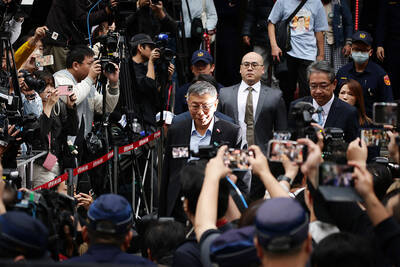
FIRST TRIAL: Ko’s lawyers sought reduced bail and other concessions, as did other defendants, but the bail judge denied their requests, citing the severity of the sentences Former Taipei mayor Ko Wen-je (柯文哲) was yesterday sentenced to 17 years in prison and had his civil rights suspended for six years over corruption, embezzlement and other charges. Taipei prosecutors in December last year asked the Taipei District Court for a combined 28-year, six-month sentence for the four cases against Ko, who founded the Taiwan People’s Party (TPP). The cases were linked to the Core Pacific City (京華城購物中心) redevelopment project and the mismanagement of political donations. Other defendants convicted on separate charges included Chinese Nationalist Party (KMT) Taipei City Councilor Angela Ying (應曉薇), who was handed a 15-year, six-month sentence; Core Pacific
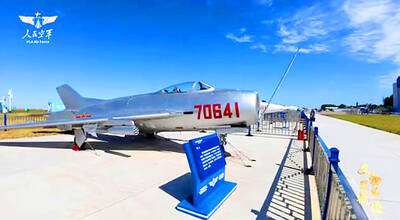
J-6 REMODEL: The converted drones are part of Beijing’s expanding mix of airpower weapons, including bombers with stand-off missiles and UAV swarms, the report said China has stationed obsolete supersonic fighters converted to attack drones at six air bases close to the Taiwan Strait, a report published this month by the Arlington, Virginia-based Mitchell Institute for Aerospace Studies said. Satellite imagery of the airfields from the institute’s “China Airpower Tracker” shows what appear to be lines of stubby, swept-winged aircraft matching the shape of J-6 fighters that first flew with the Chinese People’s Liberation Army (PLA) Air Force in the 1960s. Since their conversion to drones, the aircraft have been identified at five bases in China’s Fujian Province and one in Guangdong Province, the report said. J.

China used fake LinkedIn profiles to harvest sensitive data from NATO and EU institutions by soliciting information from staff, a European security source said on Friday. The operation, allegedly orchestrated by the Chinese Ministry of State Security, targeted dozens of employees at the military alliance or EU organizations through fictitious accounts, the source said, confirming reports in French and Belgian media. Posing as recruiters on the online professional networking platform, Chinese spies would initially request paid reports before later soliciting non-public or even classified information. One particularly active fake profile used the name “Kevin Zhang,” claiming to be the head


 RSS
RSS