


Massive investment will earn Taiwan a 21 percent share of the global market for notebook LCD screens by 2001, but today's high profits will vanish as new entrants to the market begin mass production.
Uni-President Enterprises (
Several of the companies currently entering the market plan to set up three or even four production lines.
Kao Chin-yen, chairman of the US$2 billion a year group, told reporters that the smaller Kinpo Group (
For more than a year, the large LCD screens that make up more than 30 percent of the cost of the average notebook PC have been hard to find. Analysts estimate that just around 85 percent of demand is being met. As a result, LCD prices and profits have risen.
In addition, Japanese companies, which are no longer able to manufacture profitably on home soil, are increasingly willing to share LCD technology with Taiwan.
The lure of high profits, and the easy availability of technology, have led seven groups to set up notebook-sized LCD screen factories in Taiwan, with several more planning to join them. According to a recent report from Taiwan's Market Intelligence Center (MIC), six of the new LCD factories will have started mass production by the first quarter of next year.
Most of them plan to produce around 30,000 LCD panels per month initially. The MIC is a partially government-funded technology research organization.
Analysts agree that as the new manufacturers bring production lines up to speed, LCD prices will begin to slide, falling as much as 20 percent in 2001.
"No one wants to talk about it, but we believe there will be a price war after the end of next year," said an executive at one of the new LCD makers, who requested anonymity.
Taiwan has seen a similar pattern of massive investment followed by oversupply before, most notably in the DRAM market.
Manufacturers from traditional industries, such as Uni-President, are hurrying to diversify into high-tech fields, and are prepared to burn large amounts of capital in the process.
"We expect this, and we are prepared for it," the executive said.
Taiwan's earlier move into DRAM memory chip production was a particularly painful experience, exacerbated by the Asian financial crisis.
Most of the island's manufacturers entered the market at the beginning of a two-year slump from which prices are only just beginning to recover.
Deep pockets saw most through lean times, and today, Taiwan claims a 12 percent share of the global DRAM market, compared to less than 2 percent five years ago.
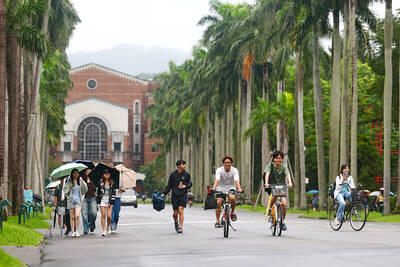
National Taiwan University (NTU) yesterday said it disqualified a person from an entrance examination for using AI smart glasses to cheat, along with two others for making untruthful statements in their curriculum vitae. The three applicants were given null scores, Taiwan’s highest-ranked university said, calling on prospective students to be honest in the admissions process. NTU registrar Lee Hung-sen (李宏森) said that the cheating applicant wore a hat and thick-rimmed glasses to the second written exam for medical school, claiming that they felt cold. Suspicions were aroused when the applicant stared oddly at the test for long stretches while steadily bringing the paper
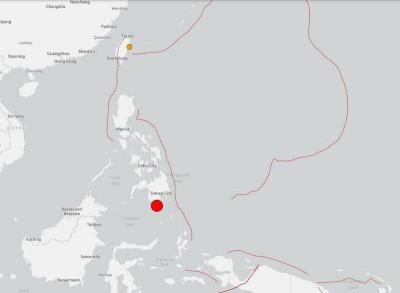
A magnitude 7.8 earthquake struck off the southern coast of Mindanao in the Philippines at 7:38am today, prompting the US Tsunami Warning System to issue an alert for neighboring countries, including Taiwan. The system issued a purple alert indicating a "tsunami threat." The potential threat zone includes Taiwan, the Philippines, Papua New Guinea, Yap and Palau. Philippine authorities were assessing the damage from the quake, with the office of civil defense seeking to verifying initial reports that 15 people had been killed and 129 injured in the region, mostly from falling debris. Arlene Hollero, disaster chief of Maasim town in the Philippines' Sarangani Province,
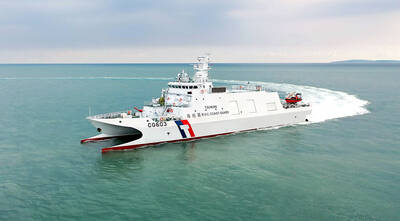
‘GRAY ZONE’ PRESSURE: Beijing’s activities are intended to create the deceitful impression that China has jurisdiction over the area around Taiwan, the CGA said Taiwan’s rights over its territorial waters and exclusive economic zone must not be violated by any country, the Mainland Affairs Council said yesterday, adding that it will not accept any unprovoked actions. The council issued the remarks in response to the China Coast Guard conducting maritime enforcement drills near eastern Taiwan and claiming to fully exercise China’s maritime administrative law enforcement authority. The Coast Guard Administration (CGA) has been closely monitoring the situation and is taking concrete steps to defend the nation’s sovereignty and secure its waters, the council said. China has no sovereign rights over the waters off eastern
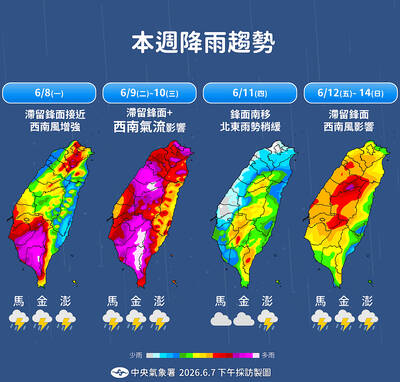
Heavy rain is expected to affect parts of Taiwan this week, the Central Weather Administration (CWA) said yesterday as a meteorologist said the active part of the annual plum rain season has started. A stationary plum rain front and southwesterly winds would bring unstable weather and abundant moisture to Taiwan from today for about a week, with the heaviest rainfall forecast for tomorrow and Wednesday, the CWA said. The agency said western and northeastern Taiwan, and mountainous areas in the east and southeast, could expect showers or thunderstorms on those two days, with localized heavy rain possible. Other parts of


 RSS
RSS