


Orders for online mask purchases can be placed starting tomorrow, the Central Epidemic Command Center (CECC) said yesterday, one day after it announced it was testing an online system for buying masks.
People would be able to order their weekly ration of masks online and pick up their purchase at convenience stores, in addition to the options of buying them at National Health Insurance (NHI)-contracted pharmacies or public health centers, said Minister of Health and Welfare Chen Shih-chung (陳時中), who is also head of the center.
People would need their NHI card or Citizen Digital Certificate to log on to the system, or use the National Health Insurance Administration’s mobile app (全民健保行動快易通) to order masks, Chen said, without specifying the Web site that is to be used for the orders.
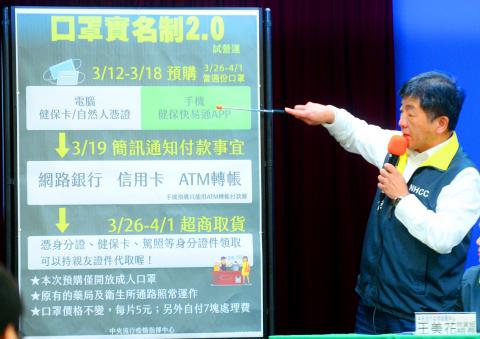
Photo: Wang Yi-sung, Taipei Times
The first round of orders, from tomorrow to Wednesday next week, would serve as a trial run for the program, he said.
People who place an order during that period would be sent a confirmation text message to their cellphone with payment instructions, and once they have paid through automatic teller machines (ATM), Internet banking or credit cards online, they would be able to pick up their orders between March 26 and April 1, he said.
Each mask costs NT$5 and a handling fee of NT$7 would be charged per order, he said.
“People do not have to worry about having to ‘snap up’ masks as if they are buying tickets,” Chen said.
People would need to present their confirmation text message, along with either their NHI card, national identification card or driver’s license, to pick up their masks, the CECC said.
Vice Minister of Economic Affairs Wang Mei-hua (王美花) said if the number of orders in the first round exceeds the number of masks allocated for the online sales, a lottery would be held to determine who would get the masks.
The Executive Yuan launched a rationing policy on Feb. 6, restricting Taiwanese and foreign residents to buying masks at NHI-contracted pharmacies or public health centers with their NHI cards or Alien Resident Certificates, with a weekly ration of three masks for adults and five masks for children.
The CECC found that many younger people with daytime jobs were unable to buy masks because they were not able to take the time to line up at pharmacies, so they decided to expand the purchase methods, Wang said.
However, the number of masks sold at pharmacies would remain the same, he said.
Packaging of masks would be done at distribution centers prior to shipping to the four major convenience store brand outlets, he added.
The real-name mask purchasing system would be reviewed weekly and modified if necessary to meet the public’s needs, Wang said.
In other developments, Deputy Minister of the Interior Chen Tsung-yen (陳宗彥) yesterday said that starting today, people placed under mandatory home quarantine upon arrival at the nation’s airports would be fined if they take public transportation to reach their homes or if they travel by a method other than what they had told authorities.
The move came after the CECC on Wednesday last week launched an airport-to-home transport service for people subject to mandatory home quarantine.
Those who take public transportation could be fined between NT$100,000 and NT$1 million (US$3,329 and US$33,293), and between NT$10,000 and NT$150,000 if they return home by a method other than the one they reported, Chen Tsung-yen said.
The transport service was used by 24 percent of those placed under home quarantine the first day it was offered, and by Monday the number had increased to 39 percent, he said.
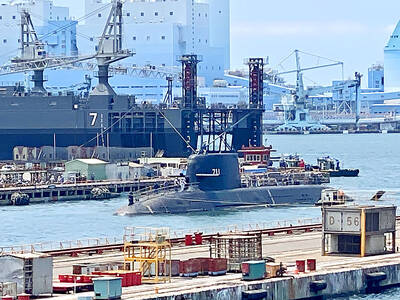
AGING: While Japan has 22 submarines, Taiwan only operates four, two of which were commissioned by the US in 1945 and 1946, and transferred to Taiwan in 1973 Taiwan would need at least 12 submarines to reach modern fleet capabilities, CSBC Corp, Taiwan chairman Chen Cheng-hung (陳政宏) said in an interview broadcast on Friday, citing a US assessment. CSBC is testing the nation’s first indigenous defense submarine, the Hai Kun (海鯤, Narwhal), which is scheduled to be delivered to the navy next month or in July. The Hai Kun has completed torpedo-firing tests and is scheduled to undergo overnight sea trials, Chen said on an SET TV military affairs program. Taiwan would require at least 12 submarines to establish a modern submarine force after assessing the nation’s operational environment and defense

A white king snake that frightened passengers and caused a stir on a Taipei MRT train on Friday evening has been claimed by its owner, who would be fined, Taipei Rapid Transit Corp (TRTC) said yesterday. A person on Threads posted that he thought he was lucky to find an empty row of seats on Friday after boarding a train on the Bannan (Blue) Line, only to spot a white snake with black stripes after sitting down. Startled, he jumped up, he wrote, describing the encounter as “terrifying.” “Taipei’s rat control plan: Release snakes on the metro,” one person wrote in reply, referring
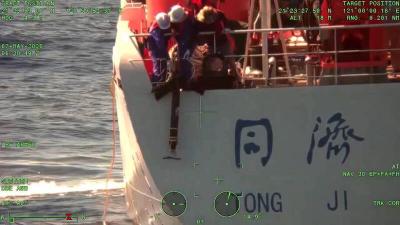
The coast guard today said that it had disrupted "illegal" operations by a Chinese research ship in waters close to the nation and driven it away, part of what Taipei sees a provocative pattern of China's stepped up maritime activities. The coast guard said that it on Thursday last week detected the Chinese ship Tongji (同濟號), which was commissioned only last year, 29 nautical miles (54km) southeast of the southern tip of Taiwan, although just outside restricted waters. The ship was observed lowering ropes into the water, suspected to be the deployment of scientific instruments for "illegal" survey operations, and the coast

Taiwan’s two cases of hantavirus so far this year are on par with previous years’ case numbers, and the government is coordinating rat extermination work, so there should not be any outbreaks, Centers for Disease Control (CDC) Director-General Philip Lo (羅一鈞) said today in an interview with the Liberty Times (the Taipei Times’ sister newspaper). An increase in rat sightings in Taipei and New Taipei City has raised concerns about the spread of hantavirus, as rats can carry the disease. In January, a man in his 70s who lived in Taipei’s Daan District (大安) tested positive posthumously for hantavirus, Taiwan’s


 RSS
RSS