


It is “not necessarily a bad thing” that newly elected Chinese Nationalist Party (KMT) Chairman Johnny Chiang (江啟臣) has not yet received a congratulatory telegram from Beijing, a KMT legislator who asked to remain anonymous said yesterday.
Chiang was elected chairman on Saturday in a by-election in which he received 84,860 votes to beat his sole opponent, former Taipei mayor Hau Lung-bin (郝龍斌), who received 38,483 votes.
In the past, the Chinese president — in his capacity as chairman of the Chinese Communist Party (CCP) — would send a congratulatory telegram whenever a KMT chairperson was elected, the KMT legislator said.
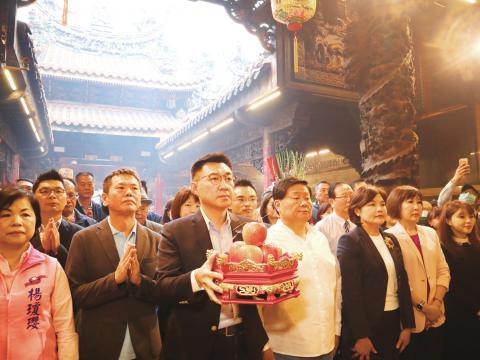
Photo: Ou Su-mei, Taipei Times
However, not receiving a telegram from Chinese President Xi Jinping (習近平) was “not necessarily a bad thing” for Chiang, as it meant the outcome of the chairperson election would more likely have the support of Taiwanese, the legislator said.
The party should focus on reform and should be more “localized,” the legislator said.
China’s Taiwan Affairs Office on Saturday acknowledged the election of Chiang in a news release issued by Zhu Fenglian (朱鳳蓮), deputy director of the office’s news department.
The office hoped that Chiang would “cherish and protect the mutual trust between the CPP and the KMT on the foundation of the 1992 consensus,” the statement said.
It called on Chiang to “actively promote the peaceful development of cross-strait relations, and advance the interests and well-being of the people on both sides of the Taiwan Strait.”
During a policy debate prior to the election, Chiang had said he felt that the “1992 consensus” was “a little bit outdated.”
The so-called “1992 consensus,” a term former Mainland Affairs Council chairman Su Chi (蘇起) in 2006 admitted making up in 2000, refers to a tacit understanding between the KMT and the Chinese government that both sides of the Strait acknowledge there is “one China,” with each side having its own interpretation of what “China” means.
Chiang yesterday said that not receiving a telegram from Xi would not affect his promotion of reforms.
“Perhaps my election will not only give Taiwanese a new concept of things, but will also do the same for those in the mainland,” he said.
Separately, KMT caucus convener Lin Wei-chou (林為洲) yesterday said that he expects better cooperation between KMT headquarters and the party’s caucus following Chiang’s election.
The party would ensure there is a certain ratio of city and county officials in the KMT Central Standing Committee so that it is in touch with popular will, he said, adding that he also expects better communication between the KMT and other parties.
Meanwhile, the Democratic Progressive Party yesterday released a statement congratulating Chiang.
“We expect the new KMT chairman, Chiang, to open up a new era... People look forward to good interaction and cooperation between the ruling party and opposition parties, and for them to work together to advance Taiwan’s democracy and achieve major reforms that benefit the nation,” it said.
New Power Party Chairman Hsu Yung-ming (徐永明), who was a former colleague of Chiang’s at Soochow University, also passed on his congratulations.
Additional reporting by Chung Li-hua and Jason Pan
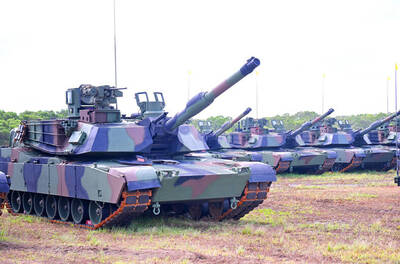
The manufacture of the remaining 28 M1A2T Abrams tanks Taiwan purchased from the US has recently been completed, and they are expected to be delivered within the next one to two months, a source said yesterday. The Ministry of National Defense is arranging cargo ships to transport the tanks to Taiwan as soon as possible, said the source, who is familiar with the matter. The estimated arrival time ranges from late this month to early next month, the source said. The 28 Abrams tanks make up the third and final batch of a total of 108 tanks, valued at about NT$40.5 billion
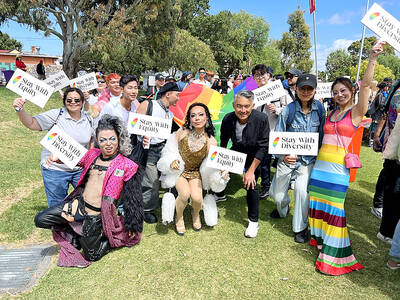
A group from the Taiwanese Designers in Australia association yesterday represented Taiwan at the Midsumma Pride March in Melbourne. The march, held in the St. Kilda suburb, is the city’s largest LGBTQIA+ parade and the flagship event of the annual Midsumma Festival. It attracted more than 45,000 spectators who supported the 400 groups and 10,000 marchers that participated this year, the association said. Taiwanese Designers said they organized a team to march for Taiwan this year, joining politicians, government agencies, professionals and community organizations in showing support for LGBTQIA+ people and diverse communities. As the first country in Asia to legalize same-sex
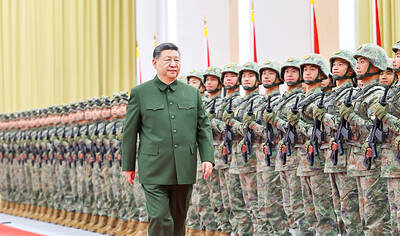
MOTIVES QUESTIONED The PLA considers Xi’s policies toward Taiwan to be driven by personal considerations rather than military assessment, the Epoch Times reports Chinese President Xi Jinping’s (習近平) latest purge of the Chinese People’s Liberation Army (PLA) leadership might have been prompted by the military’s opposition to plans of invading Taiwan, the Epoch Times said. The Chinese military opposes waging war against Taiwan by a large consensus, putting it at odds with Xi’s vision, the Falun Gong-affiliated daily said in a report on Thursday, citing anonymous sources with insight into the PLA’s inner workings. The opposition is not the opinion of a few generals, but a widely shared view among the PLA cadre, the Epoch Times cited them as saying. “Chinese forces know full well that
Travel agencies in Taiwan are working to secure alternative flights for travelers bound for New Zealand for the Lunar New Year holiday, as Air New Zealand workers are set to strike next week. The airline said that it has confirmed that the planned industrial action by its international wide-body cabin crew would go ahead on Thursday and Friday next week. While the Auckland-based carrier pledged to take reasonable measures to mitigate the impact of the workers’ strike, an Air New Zealand flight arriving at Taipei from Auckland on Thursday and another flight departing from Taipei for Auckland on Saturday would have to


 RSS
RSS