


Parents should talk with their children about using mobile devices, and stop stigmatizing them by saying they have an “Internet addiction,” a clinical psychologist said.
According to data from Taipei health officials, 5 to 10 percent of suicides among teenagers involved conflicts related to the use of smartphones or other Internet-connected devices.
Psychologist Chiu Yung-lin (邱永林) said that parents should remain calm and communicate with their children when addressing issues related to excessive use of Internet-connected devices, instead of abruptly shutting off Internet access or taking away the device.
Lin said that he often encounters parents who worry about their children spending too much time online or playing on their smartphone, which parents say negatively affects their child’s academic performance.
“The children, in return, often say they became distraught and frustrated, and their self-confidence was damaged when they were scolded for going online, or when parents cut off their Internet or confiscated their cellphones,” Chiu said.
Children and teens often say they feel hurt and their self-image is affected negatively when parents say that they have an “Internet addiction” or call them an otaku — a Japanese term often used pejoratively to mean geek or nerd — or a “loner that doesn’t leave the home,” he said.
“This can lead to stress and conflict in the parent-children relationship, and causes children to resent their parents or have a lower tolerance for handling stress. Then when they feel frustrated or are in a conflict, they might resort to self-harm, or even contemplate suicide,” he said.
Chiu said that when children and teens use mobile devices excessively or isolate themselves from personal relationships or social situations, parents should respond sensibly.
“If parents just scold or disparage their children, then they might feel they are not being accepted, and they will refuse to express their true feelings. This might lead them to believe that they can only find support and appreciation from the Internet,” Chiu said.
“When the parents are too strict on limiting Internet time or time to play on their cellphone, it will cause stress in the family relationship, and might compel their children to go outside the home to play online, like at an Internet cafe,” he said
Sometimes, children might be using the Internet or playing on mobile devices or computers because they are bored, in which case parents should help them develop new interests or hobbies, he said.
If parents struggle to handle their children’s Internet or mobile device use, they can call a help hotline at 1999, extension 8858, where professional counselors can provide support and help parents find resources, Chiu said.
Additional reporting by Jason Pan

A magnitude 6.1 earthquake struck off the coast of Yilan County at 8:39pm tonight, the Central Weather Administration (CWA) said, with no immediate reports of damage or injuries. The epicenter was 38.7km east-northeast of Yilan County Hall at a focal depth of 98.3km, the CWA’s Seismological Center said. The quake’s maximum intensity, which gauges the actual physical effect of a seismic event, was a level 4 on Taiwan’s 7-tier intensity scale, the center said. That intensity level was recorded in Yilan County’s Nanao Township (南澳), Hsinchu County’s Guansi Township (關西), Nantou County’s Hehuanshan (合歡山) and Hualien County’s Yanliao (鹽寮). An intensity of 3 was
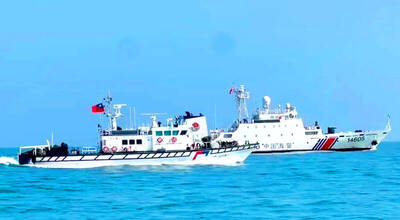
Instead of focusing solely on the threat of a full-scale military invasion, the US and its allies must prepare for a potential Chinese “quarantine” of Taiwan enforced through customs inspections, Stanford University Hoover fellow Eyck Freymann said in a Foreign Affairs article published on Wednesday. China could use various “gray zone” tactics in “reconfiguring the regional and ultimately the global economic order without a war,” said Freymann, who is also a nonresident research fellow at the US Naval War College. China might seize control of Taiwan’s links to the outside world by requiring all flights and ships entering or leaving Taiwan
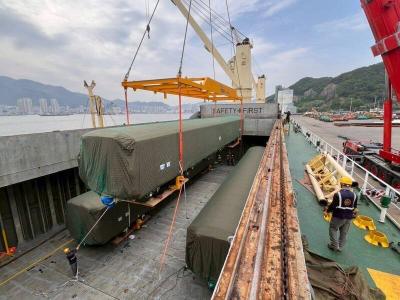
The first of 10 new high-capacity trains purchased from South Korea’s Hyundai Rotem arrived at the Port of Taipei yesterday to meet the demands of an expanding metro network, Taipei Rapid Transit Corp (TRTC) said yesterday. The train completed a three-day, 1,200km voyage from the Port of Masan in South Korea, the company said. Costing NT$590 million (US$18.79 million) each, the new six-carriage trains feature a redesigned interior based on "human-centric" transportation concepts, TRTC said. The design utilizes continuous longitudinal seating to widen the aisles and optimize passenger flow, while also upgrading passenger information displays and driving control systems for a more comfortable
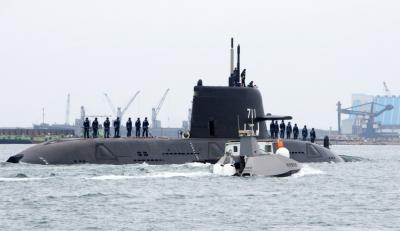
Taiwan's first indigenous defense submarine, the SS-711 Hai Kun (海鯤, or Narwhal), departed for its 13th sea trial at 7am today, marking its seventh submerged test, with delivery to the navy scheduled for July. The outing also marked its first sea deployment since President William Lai (賴清德) boarded the submarine for an inspection on March 19, drawing a crowd of military enthusiasts who gathered to show support. The submarine this morning departed port accompanied by CSBC Corp’s Endeavor Manta (奮進魔鬼魚號) uncrewed surface vessel and a navy M109 assault boat. Amid public interest in key milestones such as torpedo-launching operations and overnight submerged trials,


 RSS
RSS