


Confirmed cases of COVID-19 are only the tip of the iceberg, as some patients only exhibit mild or no symptoms, Vice President Chen Chien-jen (陳建仁) said yesterday, when sharing responses given in an interview with Japanese media.
Chen yesterday wrote on Facebook that he received interview questions on Wednesday at the Presidential Office Building in Taipei from the Japanese-language Sankei News about Taiwan’s experience in dealing with COVID-19, the nation’s push for participation in the WHO and his reaction to China’s response to the virus.
Taiwan has done a good job of containing the virus, said Chen, an epidemiologist by training who took office as minister of health in May 2003, during the SARS epidemic, and served until Feb. 1, 2005.
The nation’s confirmed cases can be traced to three sources: Chinese tourists visiting Taiwan, Taiwanese businesspeople returning from China and spreading the virus to family members, and Taiwanese travelers returning from China, Hong Kong and Macau, he said.
Taiwan has not developed cluster infections, such as the Shincheonji religious group in South Korea or the Grace Assembly church group in Singapore, he said.
Chen attributed Taiwan’s low number of COVID-19 cases to experience from the SARS epidemic.
“The Centers for Disease Control and the Central Epidemic Command Center have an experienced chain of command providing a swift response, as Taiwan will always be faced with the challenge of diseases coming from other nations,” he said.
With many Taiwanese working in China and due to a large number of Chinese tourists, the government was prepared to see a high number of COVID-19 patients entering the nation, like during the SARS epidemic, he said.
Asked about criticism that Taiwan is overreacting by asking travelers to pass through infrared fever screening systems, Chen said that there are many diseases and medical conditions that could spread.
“If travelers coming to Taiwan are healthy and we remain healthy, it will be a win-win situation for everyone,” Chen said.
Asked about China’s policy of locking down cities to contain the virus — which the WHO has highly praised — Chen said that the idea is not bad for quarantining infected people in a distinct location, but that it was hurriedly announced and became very complicated when many were not prepared.
“To be honest, we got very limited information about the so-called lockdown,” he said. “What was the situation before and the situation after the lockdown? We weren’t informed.”
The decision to lock down cities carries significant economic and security costs, Chen said, adding that it would be better to implement disease-prevention measures when there is an infection cluster, rather than locking down cities after an outbreak has become very serious.
Asked what suggestions he would offer the Japanese government, Chen said he believed that Japan has also handled the situation well, although the greatest challenge for Japan was the Diamond Princess cruise ship.
During the SARS epidemic, Taiwan maintained exchanges with Japan, while other countries would not collaborate with Taiwan because it was kept out of the WHO, he said.
“While Taiwan is not a member state of the WHO, it works harder than many of its members in advancing public healthcare,” he said.
Taiwan could have offered constructive advice early last month about the situation in Wuhan, China, if it was allowed to join the WHO, Chen added.
This story has been updated since it was first published.
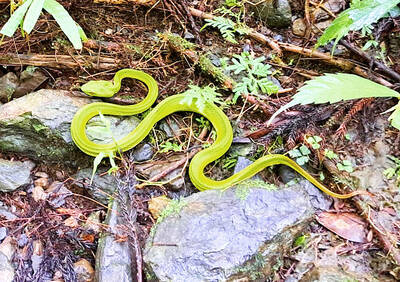
More than half of the bamboo vipers captured in Tainan in the past few years were found in the city’s Sinhua District (新化), while other districts had smaller catches or none at all. Every year, Tainan captures about 6,000 snakes which have made their way into people’s homes. Of the six major venomous snakes in Taiwan, the cobra, the many-banded krait, the brown-spotted pit viper and the bamboo viper are the most frequently captured. The high concentration of bamboo vipers captured in Sinhua District is puzzling. Tainan Agriculture Bureau Forestry and Nature Conservation Division head Chu Chien-ming (朱健明) earlier this week said that the
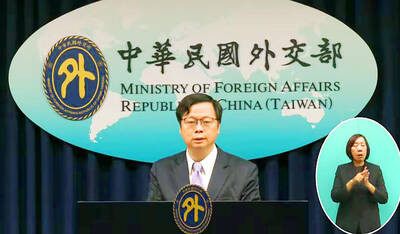
NAMING SPAT: The foreign ministry called on Denmark to propose an acceptable solution to the erroneous nationality used for Taiwanese on residence permits Taiwan has revoked some privileges for Danish diplomatic staff over a Danish permit that lists “Taiwan” as “China,” Eric Huang (黃鈞耀), head of the Ministry of Foreign Affairs’ Department of European Affairs, told a news conference in Taipei yesterday. Reporters asked Huang whether the Danish government had responded to the ministry’s request that it correct the nationality on Danish residence permits of Taiwanese, which has been listed as “China” since 2024. Taiwan’s representative office in Denmark continues to communicate with the Danish government, and the ministry has revoked some privileges previously granted to Danish representatives in Taiwan and would continue to review

Kenting National Park service technician Yang Jien-fon (楊政峰) won a silver award in World Grand Prix Photography Awards Spring Season for his photograph of two male rat snakes intertwined in combat. Yang’s colleagues at Kenting National Park said he is a master of nature photography who has been held back by his job in civil service. The awards accept entries in all four seasons across six categories: architectural and urban photography, black-and-white and fine art photography, commercial and fashion photography, documentary and people photography, nature and experimental photography, and mobile photography. Awards are ranked according to scores and divided into platinum, gold and
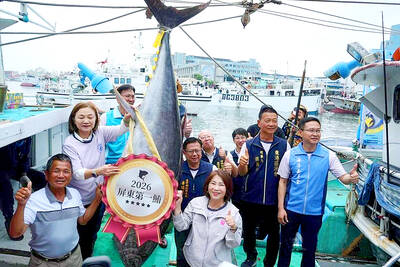
The first bluefin tuna of the season, brought to shore in Pingtung County and weighing 190kg, was yesterday auctioned for NT$10,600 (US$333.5) per kilogram, setting a record high for the local market. The auction was held at the fish market in Donggang Fishing Harbor, where the Siaoliouciou Island-registered fishing vessel Fu Yu Ching No. 2 delivered the “Pingtung First Tuna” it had caught for bidding. Bidding was intense, and the tuna was ultimately jointly purchased by a local restaurant and a local company for NT$10,600 per kilogram — NT$300 ,more than last year — for a total of NT$2.014 million. The 67-year-old skipper


 RSS
RSS