


The Ministry of Education on Friday gave awards to eight people and two groups for their contributions to promoting local languages.
Lee Hsiu-chien (李修鑑) — the 72-year-old son of Taiwanese lyricist Lee Lin-chiu (李臨秋) — was recognized for promoting Hoklo (also known as Taiwanese).
While receiving his award Lee Hsiu-chien said that to him, speaking Hoklo felt “like singing — it sounds nice and it moves people emotionally.”
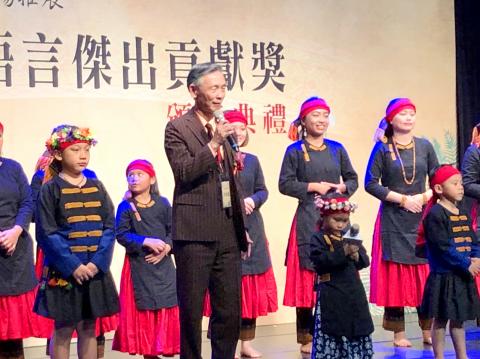
Photo: Lin Hsiao-yun, Taipei Times
YouTuber Tsai A-ga (蔡阿嘎), 36, was also recognized for promoting Hoklo, becoming the first person to receive the award for language contributions made through social media.
“I have spoken Hoklo as a habit since I was little. I hope many more people, young and old, can enjoy this language and share my passion for it,” he said.
Deputy Minister of Education Lin Teng-chiao (林騰蛟) said that Friday was significant, as it was International Mother Language Day, and the one-year anniversary of the National Languages Development Act (國家語言發展法).
The ministry has conferred language-contribution awards since 2008, and to date has given awards to 148 people and 35 groups, Lin said.
The ministry commended Tsai — whose real name is Tsai Wei-chia (蔡緯嘉) — for successfully fostering interest in Hoklo among young people.
Tsai, who makes videos on the everyday happenings of his life, has a unique talent through which he has aroused an interest among people in their mother language, it said.
“When I started making videos, I noticed that more and more young Taiwanese were strangers to Hoklo. Starting in 2011, I have made daily videos to teach Hoklo expressions,” Tsai said.
Tsai’s videos have been viewed more than 19 million times.
Lee Lin-chiu — who is best known for his lyrics to the song Longing for the Spring Breeze (望春風) — was heavily influenced by his own father’s passion for Hoklo and Taiwanese culture in general, Lee Hsiu-chien said.
Lee Lin-chiu helped bring back Taiwanese folk songs that had been popular during the 1930s, the ministry said.
The ministry this year also recognized children’s storybook writer Chang Chieh-ming (張捷明).
Chang, who has been called the “Hans Christian Andersen of Hakka children’s stories,” has had a significant effect on children’s education in Taiwan, the ministry said.
Hakka magazine manager and chief editor Chang Yi-pin (張義品) was also recognized, the ministry said, adding that Chang Yi-pin’s Hakka camps have helped a revival of the language in the past few decades.
Chien Shih-lang’s (簡史朗) research on the Thao language and culture was recognized as being crucial in the face of a dwindling Thao population, the ministry said.
It also recognized Sediq community school principal Chan Su-e (詹素娥) for her work in preserving and promoting the Sediq language, and for her work on a “Taiwanese Aboriginal Languages Wiki.”
Group awards were conferred on the Rotary Club of Taipei Metro East and Taipei Municipal Dali Elementary School, the ministry said.

LOUD AND PROUD Taiwan might have taken a drubbing against Australia and Japan, but you might not know it from the enthusiasm and numbers of the fans Taiwan might not be expected to win the World Baseball Classic (WBC) but their fans are making their presence felt in Tokyo, with tens of thousands decked out in the team’s blue, blowing horns and singing songs. Taiwanese fans have packed out the Tokyo Dome for all three of their games so far and even threatened to drown out home team supporters when their team played Japan on Friday. They blew trumpets, chanted for their favorite players and had their own cheerleading squad who dance on a stage during the game. The team struggled to match that exuberance on the field, with
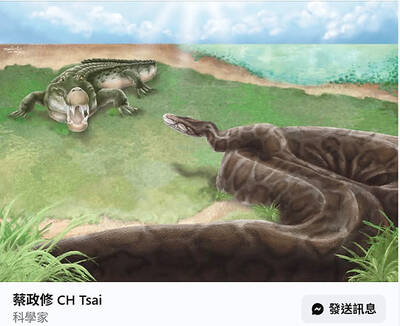
Taiwanese paleontologists have discovered fossil evidence that pythons up to 4m long inhabited Taiwan during the Pleistocene epoch, reporting their findings in the international scientific journal Historical Biology. National Taiwan University (NTU) Institute of Ecology and Evolutionary Biology associate professor Tsai Cheng-hsiu (蔡政修) led the team that discovered the largest snake fossil ever found in Taiwan. The single trunk vertebra was discovered in Tainan at the Chiting Formation, dated to between 400,000 and 800,000 years ago in the Middle Pleistocene, the paper said. The area also produced Taiwan’s first avian fossil, as well as crocodile, mammoth, saber-toothed cat and rhinoceros fossils, it said. Discoveries

Taiwanese paleontologists have discovered fossil evidence that pythons up to 4m long inhabited Taiwan during the Pleistocene epoch, reporting their findings in the international scientific journal Historical Biology. National Taiwan University (NTU) Institute of Ecology and Evolutionary Biology associate professor Tsai Cheng-hsiu (蔡政修) led the team that discovered the largest snake fossil ever found in Taiwan. A single trunk vertebra was discovered in Tainan at the Chiting Formation, dated to between 800,000 to 400,000 years ago in the Middle Pleistocene, the paper said. The area also produced Taiwan’s first avian fossil, as well as crocodile, mammoth, sabre-toothed cat and rhinoceros fossils, it said. Discoveries

Whether Japan would help defend Taiwan in case of a cross-strait conflict would depend on the US and the extent to which Japan would be allowed to act under the US-Japan Security Treaty, former Japanese minister of defense Satoshi Morimoto said. As China has not given up on the idea of invading Taiwan by force, to what extent Japan could support US military action would hinge on Washington’s intention and its negotiation with Tokyo, Morimoto said in an interview with the Liberty Times (sister paper of the Taipei Times) yesterday. There has to be sufficient mutual recognition of how Japan could provide


 RSS
RSS