


Desert locusts that have ravaged crops across East Africa and parts of the Middle East are unlikely to affect Taiwan, where the climate is unsuitable for their survival, the Council of Agriculture said yesterday.
Heavy rain and humid weather in East Africa last year created favorable conditions for the insects to reproduce, allowing them to feed on land along the Red Sea and invade Saudi Arabia, Yemen, Oman, Iran, Pakistan and India, the Bureau of Animal and Plant Health Inspection and Quarantine said.
The UN Food and Agriculture Organization on Friday said that swarms in Kenya, Ethiopia and Somalia remain alarming, while in Southwest Asia, the situation is relatively calm with some operations under way to control a few residual summer-bred swarms in India.
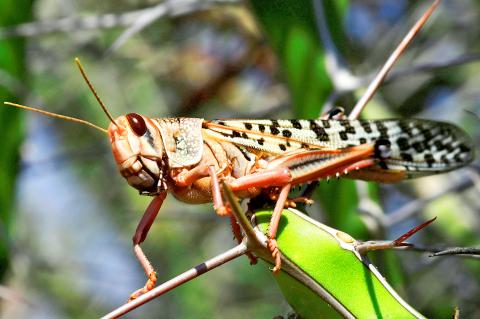
Photo: Reuters
Desert locusts rely on air currents for migration, former bureau director-general Feng Hai-tung (馮海東) said on Tuesday.
Although records have shown that they could cross the Atlantic Ocean, whether they would cause damage to an area depended on local weather and ecosystems, Feng said.
The pests eat almost everything green, but Taiwan’s climate is too cool, he said, adding that the insects are often found in regions near the equator or a desert.
There are locust species in Asia, but they have not caused any significant damage over the past thousand years, Feng said.
When locusts from the Philippines migrated to Taiwan a few decades ago, they were controlled through advanced agricultural management methods and insecticides, he added.
Experts at a bureau meeting on Friday said that the possibility of desert locusts entering Taiwan was extremely low, given there is no record of their existence in the nation and because its weather would not suit their survival.
The bureau said it would monitor the locust situation and patrol fields, while readying insecticides and control measures should the pests arrive.

LOUD AND PROUD Taiwan might have taken a drubbing against Australia and Japan, but you might not know it from the enthusiasm and numbers of the fans Taiwan might not be expected to win the World Baseball Classic (WBC) but their fans are making their presence felt in Tokyo, with tens of thousands decked out in the team’s blue, blowing horns and singing songs. Taiwanese fans have packed out the Tokyo Dome for all three of their games so far and even threatened to drown out home team supporters when their team played Japan on Friday. They blew trumpets, chanted for their favorite players and had their own cheerleading squad who dance on a stage during the game. The team struggled to match that exuberance on the field, with
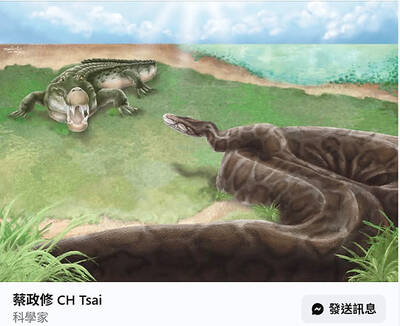
Taiwanese paleontologists have discovered fossil evidence that pythons up to 4m long inhabited Taiwan during the Pleistocene epoch, reporting their findings in the international scientific journal Historical Biology. National Taiwan University (NTU) Institute of Ecology and Evolutionary Biology associate professor Tsai Cheng-hsiu (蔡政修) led the team that discovered the largest snake fossil ever found in Taiwan. The single trunk vertebra was discovered in Tainan at the Chiting Formation, dated to between 400,000 and 800,000 years ago in the Middle Pleistocene, the paper said. The area also produced Taiwan’s first avian fossil, as well as crocodile, mammoth, saber-toothed cat and rhinoceros fossils, it said. Discoveries

Taiwanese paleontologists have discovered fossil evidence that pythons up to 4m long inhabited Taiwan during the Pleistocene epoch, reporting their findings in the international scientific journal Historical Biology. National Taiwan University (NTU) Institute of Ecology and Evolutionary Biology associate professor Tsai Cheng-hsiu (蔡政修) led the team that discovered the largest snake fossil ever found in Taiwan. A single trunk vertebra was discovered in Tainan at the Chiting Formation, dated to between 800,000 to 400,000 years ago in the Middle Pleistocene, the paper said. The area also produced Taiwan’s first avian fossil, as well as crocodile, mammoth, sabre-toothed cat and rhinoceros fossils, it said. Discoveries

Whether Japan would help defend Taiwan in case of a cross-strait conflict would depend on the US and the extent to which Japan would be allowed to act under the US-Japan Security Treaty, former Japanese minister of defense Satoshi Morimoto said. As China has not given up on the idea of invading Taiwan by force, to what extent Japan could support US military action would hinge on Washington’s intention and its negotiation with Tokyo, Morimoto said in an interview with the Liberty Times (sister paper of the Taipei Times) yesterday. There has to be sufficient mutual recognition of how Japan could provide


 RSS
RSS