


People should be on high alert as COVID-19 cases continue to be reported worldwide, health experts at National Taiwan University (NTU) said yesterday.
A lack of transparent and real-time data from China have caused “great difficulty” in providing estimates and the coronavirus presents a “greater threat” to Taiwan due to the nation’s close ties to China, said College of Public Health dean Chan Chang-chuan (詹長權).
COVID-19 “is already a global epidemic,” college vice dean Tony Chen (陳秀熙) said.
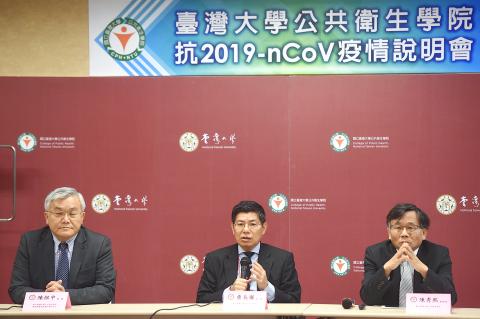
Photo: Chien Jung-fong, Taipei Times
Although much of the focus has been on the outbreak in China, the disease is bound to reach beyond Asia at significant levels if travel-related prevention measures are not bolstered, Chen said.
As cases have been reported in North America, Europe and Africa, “everyone in the world is indeed ... under a lot of pressure,” he said.
Variations in the fatality rate of COVID-19 in different parts of China indicate differences in healthcare supply and demand, and people’s attitudes toward seeking treatment, he said.
He urged people with symptoms to seek medical attention as quickly as possible.
Once the “golden period” for treatment passes, the virus could be fatal, especially for people with chronic conditions, Chen said.
Although the number of cases in China has begun to drop as a result of lockdown and quarantine measures, the fatality rate and transmission rates in China’s Hubei Province remain high, he said.
Epidemiologists are “most afraid of infectious diseases on cruises,” Chen said.
No one among those on the Diamond Princess docked in Yokohama, Japan, could have avoided exposure to the virus, he said.
The chance of infection on the ship is “relatively high,” Chen said.
The situation on the ship offers a “very important opportunity” to study COVID-19, he said.
Chan advised against “emotional” judgements as efforts to prevent the spread of COVID-19 continue.
Decisions should be “scientific,” “rational” and “calm,” he said. “Do what should be done.”
Separately, Taipei Mayor Ko Wen-je (柯文哲), who is a surgeon, said that local transmission of COVID-19 are bound to happen, but the goal should be to keep the cases sporadic and controlled.
He wears a mask out of politeness when he takes the bus and is in enclosed spaces with other people, but he does not wear one in his office, Ko said.
People should wear a mask depending on their evaluation of the risk of infection, he said.
Asked if he would consider imposing a lockdown in Taipei if there were a local outbreak, Ko said that if there are a cluster of cases, he would suggest moving people out of the community rather than locking the area down.
However, Taiwan has great healthcare capacity, so an out-of-control situation, such as in Wuhan — the Chinese city where the disease originated — is unlikely, he said.
Additional reporting by Lee I-chia

A magnitude 6.1 earthquake struck off the coast of Yilan County at 8:39pm tonight, the Central Weather Administration (CWA) said, with no immediate reports of damage or injuries. The epicenter was 38.7km east-northeast of Yilan County Hall at a focal depth of 98.3km, the CWA’s Seismological Center said. The quake’s maximum intensity, which gauges the actual physical effect of a seismic event, was a level 4 on Taiwan’s 7-tier intensity scale, the center said. That intensity level was recorded in Yilan County’s Nanao Township (南澳), Hsinchu County’s Guansi Township (關西), Nantou County’s Hehuanshan (合歡山) and Hualien County’s Yanliao (鹽寮). An intensity of 3 was
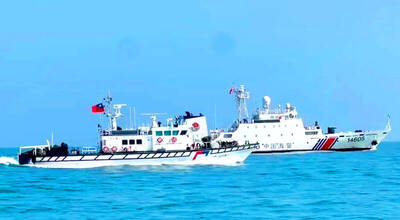
Instead of focusing solely on the threat of a full-scale military invasion, the US and its allies must prepare for a potential Chinese “quarantine” of Taiwan enforced through customs inspections, Stanford University Hoover fellow Eyck Freymann said in a Foreign Affairs article published on Wednesday. China could use various “gray zone” tactics in “reconfiguring the regional and ultimately the global economic order without a war,” said Freymann, who is also a nonresident research fellow at the US Naval War College. China might seize control of Taiwan’s links to the outside world by requiring all flights and ships entering or leaving Taiwan
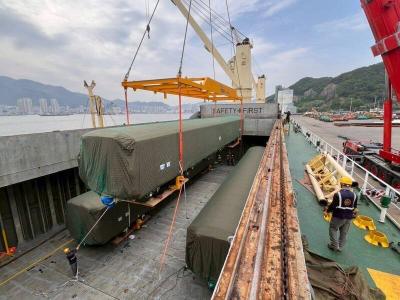
The first of 10 new high-capacity trains purchased from South Korea’s Hyundai Rotem arrived at the Port of Taipei yesterday to meet the demands of an expanding metro network, Taipei Rapid Transit Corp (TRTC) said yesterday. The train completed a three-day, 1,200km voyage from the Port of Masan in South Korea, the company said. Costing NT$590 million (US$18.79 million) each, the new six-carriage trains feature a redesigned interior based on "human-centric" transportation concepts, TRTC said. The design utilizes continuous longitudinal seating to widen the aisles and optimize passenger flow, while also upgrading passenger information displays and driving control systems for a more comfortable
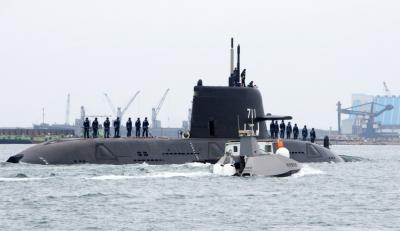
Taiwan's first indigenous defense submarine, the SS-711 Hai Kun (海鯤, or Narwhal), departed for its 13th sea trial at 7am today, marking its seventh submerged test, with delivery to the navy scheduled for July. The outing also marked its first sea deployment since President William Lai (賴清德) boarded the submarine for an inspection on March 19, drawing a crowd of military enthusiasts who gathered to show support. The submarine this morning departed port accompanied by CSBC Corp’s Endeavor Manta (奮進魔鬼魚號) uncrewed surface vessel and a navy M109 assault boat. Amid public interest in key milestones such as torpedo-launching operations and overnight submerged trials,


 RSS
RSS