


Using a rice cooker to “dry steam” surgical masks for three minutes can have a sterilizing effect, an experiment by Chung Shan Medical University Department of Occupational Safety and Health associate professor Lai Chane-yu (賴全裕) and his team showed.
However, after dry steaming, the mask would have a lower filter efficiency compared with new masks, Lai said on Monday, adding that the method should only be considered if there is an insufficient supply of masks or they need to be reused in an emergency.
The team conducted several tests for cleaning N95 respirators, and found that a 70 percent alcohol solution, bleach, high-pressure sterilization and rice cooker were all effective sterilization methods, Lai said.
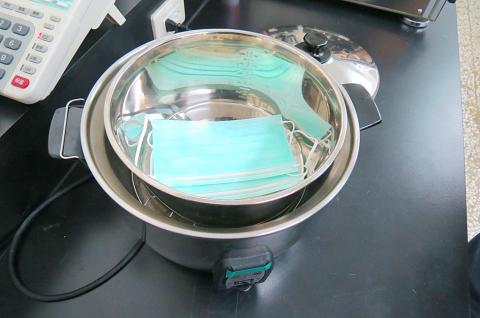
Photo: Su Meng-chuan, Taipei Times
Dry steaming masks for three minutes using a rice cooker can kill up to 99.7 percent of germs, he said, adding that this method lowered the mask’s filter quality by the least — about 10 percent.
Soaking masks in alcohol or bleach for 10 minutes could lower their filter quality to 70 to 80 percent, he said, adding that the study was published in Indoor Air in 2018.
Lai said he also conducted a study using surgical masks and found that dry steaming them using a rice cooker was also more efficient than using alcohol or high-pressure sterilization.
Dry steaming the same mask five times gradually reduced its filter efficiency to 10 percent, he said.
When heating a mask, do not place it at the bottom of the cooker, where temperatures are high, he said, advising people to use a rack to support the inner pot containing the mask.
Masks can only be sterilized and reused if they have not been used in a hospital, do not contain too much saliva or other bodily fluids and are not damaged, he added.
A mask’s filter efficiency needs to be more than 80 percent to qualify, he said.
Asked about the tests, the Food and Drug Administration (FDA) said that spraying alcohol or high-temperature drying might damage the structure of masks and affect their protective effect.
FDA researcher Wang Chao-yi (王兆儀) said that she had not seen the test data on high-
temperature drying and, as such, could not say whether the method was appropriate.
The FDA only reviews and approves masks for one-time use, she said.
Wang reminded people who are healthy that they do not need to wear masks in outdoor places or places with good ventilation, while people with chronic illnesses or respiratory symptoms and those who are visiting hospitals should wear masks.

US President Donald Trump said "it’s up to" Chinese President Xi Jinping (習近平) what China does on Taiwan, but that he would be "very unhappy" with a change in the "status quo," the New York Times said in an interview published yesterday. Xi "considers it to be a part of China, and that’s up to him what he’s going to be doing," Trump told the newspaper on Wednesday. "But I’ve expressed to him that I would be very unhappy if he did that, and I don’t think he’ll do that," he added. "I hope he doesn’t do that." Trump made the comments in

NOT AN OPENING: Trump’s violation of international law does not affect China’s consideration in attacking Taiwan; Beijing lacks capability, not precedent, an official said Taiwanese officials see the US’ capture of the president of Venezuela as a powerful deterrent to Beijing’s aggression and a timely reminder of the US’ ability to defeat militaries equipped with Chinese-made weapons. The strikes that toppled Venezuelan President Nicolas Maduro signaled to authoritarian leaders, including Chinese President Xi Jinping (習近平), US President Donald Trump’s willingness to use military might for international affairs core to US interests, one senior official in Taipei’s security circle said. That reassured Taiwan, the person said. Taipei has also dismissed the idea that Trump’s apparent violation of international law could embolden Beijing, said the official, who was not
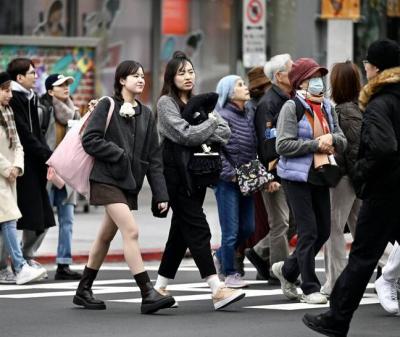
A cold surge advisory was today issued for 18 cities and counties across Taiwan, with temperatures of below 10°C forecast during the day and into tonight, the Central Weather Administration (CWA) said. New Taipei City, Taipei, Taoyuan and Hsinchu, Miaoli and Yilan counties are expected to experience sustained temperatures of 10°C or lower, the CWA said. Temperatures are likely to temporarily drop below 10°C in most other areas, except Taitung, Pingtung, Penghu and Lienchiang (Matsu) counties, CWA data showed. The cold weather is being caused by a strong continental cold air mass, combined with radiative cooling, a process in which heat escapes from

Snow this morning fell on Alishan for the first time in seven years, as a strong continental cold air mass sent temperatures plunging across Taiwan, the Central Weather Administration (CWA) said. The Alishan weather station, located at an elevation of about 2,200m in central Taiwan, recorded snowfall from 8:55am to 9:15am, when the temperature dropped to about 1°C, the CWA said. With increased moisture and low temperatures in the high-altitude Alishan area, the conditions were favorable for snow, CWA forecaster Tsai Yi-chi (蔡伊其) said. The last time snow fell at the Alishan weather station was on Jan. 10, 2018, while graupel fell there


 RSS
RSS