


Former president Ma Ying-jeou (馬英九) yesterday called on President Tsai Ing-wen’s (蔡英文) administration not to let populism and discrimination dictate its governance, following a government decision on Wednesday not to allow Chinese children of Taiwanese and Chinese couples to enter Taiwan, reversing a measure announced a day earlier by the Mainland Affairs Council (MAC).
The ban contravenes the spirit of the UN’s Convention on the Rights of the Child, Ma said, adding that existing regulations impose more stringent requirements on such children to acquire Republic of China (ROC) nationality compared with people from other countries.
“It is not that they did not choose Taiwan; it is that even if they had chosen, they must wait a long time,” Ma said.
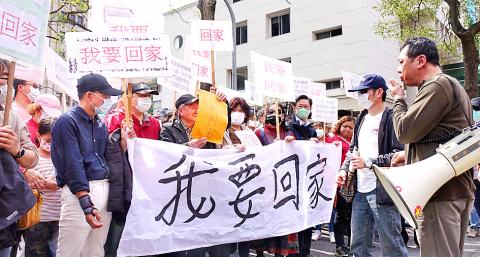
Photo: Fang Pin-chao, Taipei Times
The council’s initial announcement was correct and humane, he said.
“We cannot just let children who have lived in Taiwan for so many years roam the streets,” he added.
While people should support the government’s disease-prevention efforts, Ma said he believes that under a consistent and thorough system, it is possible to adopt a more humane approach that takes the rights of others into consideration.
“President Tsai once said that ‘migrant spouses and workers are all a part of Taiwan.’ As such, these ‘children of Taiwan,’ even without their parents at their side, should be considered our fellow citizens,” Ma said.
“Let them come home and be united with their families, President Tsai. Do not let populism trample on human rights and discrimination trump humanity,” Ma added.
Separately, former New Taipei City mayor Eric Chu (朱立倫) said on Facebook that the “citizens first” mindset should not include separating families.
“Our customs policy should not pander to populist sentiments and promote discrimination,” he said.
In response, Premier Su Tseng-chang (蘇貞昌) said that to save others, one must save oneself first.
There must not be any breaches in disease-prevention efforts, because “everyone would die if the ship sinks, which would defeat the purpose of saving others,” Su said. “And so we must act within our power.”
The policy reversal came on the heels of a firestorm of criticism on social media over the MAC’s announcement.
MAC Minister Chen Ming-tong (陳明通) said that the announcement was not designed to open Taiwan’s borders to relatives of Chinese spouses in contravention of a temporary ban on the entry of Chinese nationals to prevent the spread of COVID-19, which originated in Wuhan, China.
Later that day, at a news briefing held by the Central Epidemic Command Center (CECC), Chen added new stipulations, saying that only minor Chinese children who do not have relatives to look after them in China would be allowed to enter Taiwan.
Hours later, with public anger still running high, the MAC listed a third condition, saying only if both a child’s parents are currently in Taiwan would the child be allowed entry.
The news triggered another round of heated discussion on social media, prompting Minister of Health and Welfare Minister Chen Shih-chung (陳時中), who heads the CECC, on Wednesday to announce a policy U-turn.
Chinese children of Taiwanese and Chinese couples who hold residence or visitor permits, but not ROC passports, would not be allowed into the country, he said.
While such children have equal rights to healthcare in Taiwan, priority must be given to ROC citizens in the face of a fast-spreading epidemic, he said.
“They must shoulder the consequences of not choosing to apply for Taiwanese citizenship for their children,” Chen said.
Additional reporting by Sean Lin
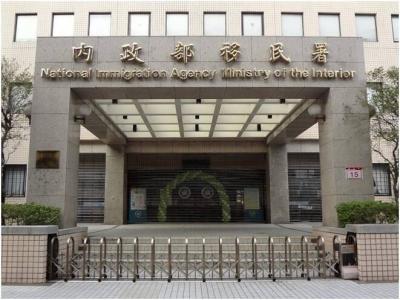
A small number of Taiwanese this year lost their citizenship rights after traveling in China and obtaining a one-time Chinese passport to cross the border into Russia, a source said today. The people signed up through Chinese travel agencies for tours of neighboring Russia with companies claiming they could obtain Russian visas and fast-track border clearance, the source said on condition of anonymity. The travelers were actually issued one-time-use Chinese passports, they said. Taiwanese are prohibited from holding a Chinese passport or household registration. If found to have a Chinese ID, they may lose their resident status under Article 9-1
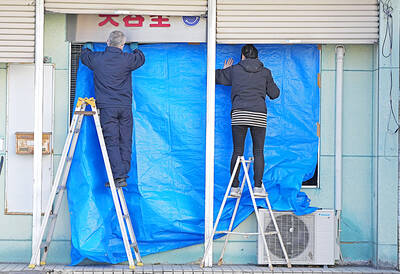
Taiwanese were praised for their composure after a video filmed by Taiwanese tourists capturing the moment a magnitude 7.5 earthquake struck Japan’s Aomori Prefecture went viral on social media. The video shows a hotel room shaking violently amid Monday’s quake, with objects falling to the ground. Two Taiwanese began filming with their mobile phones, while two others held the sides of a TV to prevent it from falling. When the shaking stopped, the pair calmly took down the TV and laid it flat on a tatami mat, the video shows. The video also captured the group talking about the safety of their companions bathing

PROBLEMATIC APP: Citing more than 1,000 fraud cases, the government is taking the app down for a year, but opposition voices are calling it censorship Chinese Nationalist Party (KMT) Chairwoman Cheng Li-wun (鄭麗文) yesterday decried a government plan to suspend access to Chinese social media platform Xiaohongshu (小紅書) for one year as censorship, while the Presidential Office backed the plan. The Ministry of the Interior on Thursday cited security risks and accusations that the Instagram-like app, known as Rednote in English, had figured in more than 1,700 fraud cases since last year. The company, which has about 3 million users in Taiwan, has not yet responded to requests for comment. “Many people online are already asking ‘How to climb over the firewall to access Xiaohongshu,’” Cheng posted on

A classified Pentagon-produced, multiyear assessment — the Overmatch brief — highlighted unreported Chinese capabilities to destroy US military assets and identified US supply chain choke points, painting a disturbing picture of waning US military might, a New York Times editorial published on Monday said. US Secretary of Defense Pete Hegseth’s comments in November last year that “we lose every time” in Pentagon-conducted war games pitting the US against China further highlighted the uncertainty about the US’ capability to intervene in the event of a Chinese invasion of Taiwan. “It shows the Pentagon’s overreliance on expensive, vulnerable weapons as adversaries field cheap, technologically


 RSS
RSS