


National Yang-Ming University president Steve Kuo (郭旭崧), former head of the Centers for Disease Control (CDC), called on the government to establish an “Asia-Pacific epidemic prevention center” that would enable it to contribute to global epidemic prevention efforts.
Kuo made the remarks in an interview with the Liberty Times (the Taipei Times’ sister newspaper) on Jan. 14.
During the 2003 SARS outbreak, the world was divided into “three categories of countries”: ones that could help themselves and others; ones that could protect themselves, but not help others; and ones that could not protect themselves and needed help, Kuo said, giving the US, Japan and Taiwan as examples of each respective category.
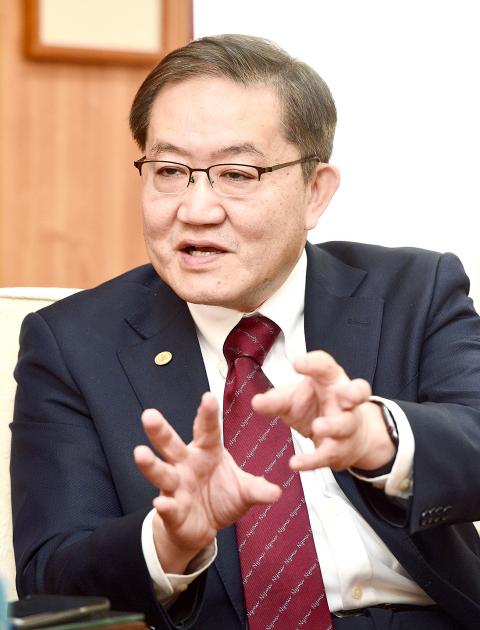
Photo: Peter Lo, Taipei Times
Taiwan received a lot of help at the time, he said, adding that he believes if Taiwan were given 20 years, it could make progress in global epidemic prevention and even play a partial role in helping other nations.
In 2015, Taiwan and the US signed the Global Cooperation and Training Framework and their first task was to fight the Ebola virus, he said.
Through the US Department of State, the US gathered its Southeast Asian allies in Taiwan to attend epidemic prevention training with experts who had experience in Africa, and gradually created a model for international epidemic prevention cooperation, Kuo said.
Starting as the US’ “teaching assistant,” Taiwan slowly learned how to help others, he said, adding: “This skill is more important than arguing about whether it can join the WHO everyday.”
The government needs to be responsible for the development of Taiwan’s international healthcare, he said.
Just as the US treats health as part of national security, Taiwan also needs be able to “rescue” its citizens if they become infected, he added.
Taiwan should have that ability today, but first it needs to strengthen its cooperation with the US, to form a partnership or even work with the US to assist other nations, he said.
Taiwan has gradually formed a vaccine industry, Kuo said.
However, public health and epidemic prevention cannot only rely on the government, he said, adding that “industry-academic” connections are important.
For example, most doctoral students at the Harvard T.H. Chan School of Public Health are in the industry, he said.
He came up with the concept of establishing an alliance between epidemic prevention and industry later in his tenure as CDC director-general, Kuo said.
Taiwan should be able to establish an “Asia-Pacific epidemic prevention center,” he said, adding that he hopes the public will think carefully about how to develop it.
Taiwan’s international healthcare output is relatively low at NT$15 billion (US$498 million), he said, adding that he hopes it reaches NT$40 billion by 2025.
Many regulations still need to be relaxed, Kuo said.
Taiwan’s healthcare sector should seize the roughly “10-year advantage” it has over China’s, he added.
The Ministry of the Interior is planning an international healthcare section inside the Taoyuan Aerotropolis and hopes to invite the healthcare industry to participate in a build-operate-transfer model, he said.
Hospitals should not develop individually, Kuo said, adding that a foreign consultant has suggested integration and the creation of a “Taiwan brand.”
Eighty percent of the focus could be placed on the high-income medical tourism industry, while 20 percent could be invested in the epidemic prevention industry, with epidemic prevention personnel and supplies ready near the airport to be dispatched at any time, he said.
By creating an “Asia-Pacific epidemic prevention center,” even if Taiwan is not a member of the WHO, as long as it has key supplies and technology, it would be able to cooperate with international organizations and fulfill its global responsibilities, he added.
Taiwan could work toward a “semi-militarization” of its epidemic prevention efforts, Kuo said, adding that the US adopts “militarized management” of such efforts.
There should also be a “command system” for research and development that brings together Academia Sinica, the National Health Research Institutes and universities, he said.
The National Health Command Center was established 17 years ago during the SARS outbreak, he said, adding that at the time, there were concerns that there would be lack of coordination between the central and local governments.
The “most important” aspect of epidemic prevention is the issuing of commands, Kuo said, adding that they should be quick and unified.
The government should also learn from other nations and introduce legislation to subsidize and purchase vaccines from manufacturers, he said.
It would not need to provide large sums of money beforehand, as manufacturers would be able to find sponsors for good ideas, Kuo said.
However, once vaccines have been developed and are proven effective, the government could provide money, and once mass production begins, the government could promise to purchase the vaccines, which would encourage investment in epidemic prevention, he said.
A small number of Taiwanese this year lost their citizenship rights after traveling in China and obtaining a one-time Chinese passport to cross the border into Russia, a source said today. The people signed up through Chinese travel agencies for tours of neighboring Russia with companies claiming they could obtain Russian visas and fast-track border clearance, the source said on condition of anonymity. The travelers were actually issued one-time-use Chinese passports, they said. Taiwanese are prohibited from holding a Chinese passport or household registration. If found to have a Chinese ID, they may lose their resident status under Article 9-1

Taiwanese were praised for their composure after a video filmed by Taiwanese tourists capturing the moment a magnitude 7.5 earthquake struck Japan’s Aomori Prefecture went viral on social media. The video shows a hotel room shaking violently amid Monday’s quake, with objects falling to the ground. Two Taiwanese began filming with their mobile phones, while two others held the sides of a TV to prevent it from falling. When the shaking stopped, the pair calmly took down the TV and laid it flat on a tatami mat, the video shows. The video also captured the group talking about the safety of their companions bathing

PROBLEMATIC APP: Citing more than 1,000 fraud cases, the government is taking the app down for a year, but opposition voices are calling it censorship Chinese Nationalist Party (KMT) Chairwoman Cheng Li-wun (鄭麗文) yesterday decried a government plan to suspend access to Chinese social media platform Xiaohongshu (小紅書) for one year as censorship, while the Presidential Office backed the plan. The Ministry of the Interior on Thursday cited security risks and accusations that the Instagram-like app, known as Rednote in English, had figured in more than 1,700 fraud cases since last year. The company, which has about 3 million users in Taiwan, has not yet responded to requests for comment. “Many people online are already asking ‘How to climb over the firewall to access Xiaohongshu,’” Cheng posted on

A classified Pentagon-produced, multiyear assessment — the Overmatch brief — highlighted unreported Chinese capabilities to destroy US military assets and identified US supply chain choke points, painting a disturbing picture of waning US military might, a New York Times editorial published on Monday said. US Secretary of Defense Pete Hegseth’s comments in November last year that “we lose every time” in Pentagon-conducted war games pitting the US against China further highlighted the uncertainty about the US’ capability to intervene in the event of a Chinese invasion of Taiwan. “It shows the Pentagon’s overreliance on expensive, vulnerable weapons as adversaries field cheap, technologically


 RSS
RSS