


President Tsai Ing-wen (蔡英文) on Monday said that she would consider meeting Chinese President Xi Jinping (習近平) as long as it was on an equal footing.
In an interview with SET News, Tsai said that she would be willing to meet with Xi based on the four principles she says are needed to stabilize the relationship across the Taiwan Strait: peace, parity, democracy and dialogue.
“We hope cross-strait interactions will take place based on such a foundation,” Tsai said. “We will consider any form of interaction” with China based on the four principles.
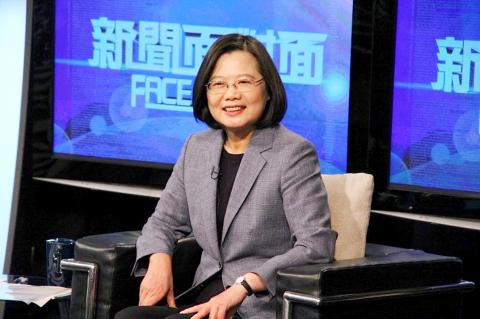
Photo courtesy of Era News
Tsai, of the Democratic Progressive Party (DPP), won a second term on Jan. 11, beating her closest rival, Kaohsiung Mayor Han Kuo-yu (韓國瑜) of the Chinese Nationalist Party (KMT), by more than 18 percentage points.
In her victory speech on election day, Tsai said that her win was an indication of the value Taiwanese place on democracy, and unveiled her four principles.
According to Tsai, “peace” means that China must abandon threats of force against Taiwan, while “parity” means that neither side of the Taiwan Strait should deny the other’s existence.
“Democracy” means that the future of Taiwan must be decided by the nation’s 23 million people and “dialogue” means that the two sides must be able to sit down and discuss the development of cross-strait relations, she said.
Beijing has responded to Tsai’s four principles by reiterating its advocacy of the so-called “1992 consensus” — a formula China sees as advocating Taiwan belonging to “one China.”
The “1992 consensus,” a term former Mainland Affairs Council chairman Su Chi (蘇起) in 2006 admitted making up in 2000, refers to a tacit understanding between the KMT and the Chinese government that both sides of the Strait acknowledge there is “one China,” with each side having its own interpretation of what “China” means.
Tsai and the DPP have long rejected the “1992 consensus.”
Beijing has not hinted at any possibility of Tsai meeting Xi, but the media has continued to ask about her willingness to meet with him.
During the interview, Tsai said she hoped that China would listen carefully to what Taiwanese implied with their votes, especially when considering policies on Taiwan.
“Taiwanese loudly said that they cannot accept China’s ‘one country, two systems’ formula, because Taiwan is a free and democratic society, and each person is used to this lifestyle,” Tsai said.
In a speech in January last year, Xi proposed unifying Taiwan with China using the “one country, two systems” formula, and did not rule out using force to do so.
“People in Taiwan have expressed their attitude very clearly and many countries have explained the election outcome in such a way,” Tsai said.
Tsai said she would prioritize peace and stability when dealing with China.
Taiwan must be able to defend itself sufficiently to ensure peace and stability, which means not only focusing on its weapons-building capabilities, but also on purchasing defense equipment from other countries, she said.
When asked whether Taiwan could protect itself if China uses force against it, Tsai said she has faith in the nation’s self-defense capabilities, but emphasized that more must be done to strengthen its defenses and ensure peace.
In a separate interview with Era News, Tsai said that it would be impossible for Taiwan and China to keep their ties as ambiguous as they are, as Taiwanese have expressed their attitude clearly.
“This election had the advantage of reflecting the will of Taiwanese so that China could clearly hear public opinion,” she said.
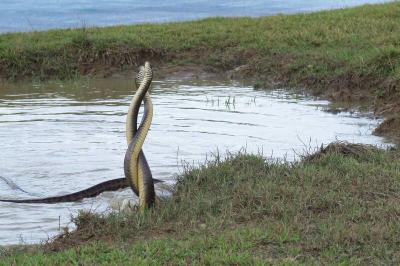
Kenting National Park service technician Yang Jien-fon (楊政峰) won a silver award in World Grand Prix Photography Awards Spring Season for his photograph of two male rat snakes intertwined in combat. Yang’s colleagues at Kenting National Park said he is a master of nature photography who has been held back by his job in civil service. The awards accept entries in all four seasons across six categories: architectural and urban photography, black-and-white and fine art photography, commercial and fashion photography, documentary and people photography, nature and experimental photography, and mobile photography. Awards are ranked according to scores and divided into platinum, gold and

More than half of the bamboo vipers captured in Tainan in the past few years were found in the city’s Sinhua District (新化), while other districts had smaller catches or none at all. Every year, Tainan captures about 6,000 snakes which have made their way into people’s homes. Of the six major venomous snakes in Taiwan, the cobra, the many-banded krait, the brown-spotted pit viper and the bamboo viper are the most frequently captured. The high concentration of bamboo vipers captured in Sinhua District is puzzling. Tainan Agriculture Bureau Forestry and Nature Conservation Division head Chu Chien-ming (朱健明) earlier this week said that the

The Chinese Nationalist Party (KMT) caucus yesterday said it opposes the introduction of migrant workers from India until a mechanism is in place to prevent workers from absconding. Minister of Labor Hung Sun-han (洪申翰) on Thursday told the Legislative Yuan that the first group of migrant workers from India could be introduced as early as this year, as part of a government program. The caucus’ opposition to the policy is based on the assessment that “the risk is too high,” KMT caucus secretary-general Lin Pei-hsiang (林沛祥) said. Taiwan has a serious and long-standing problem of migrant workers absconding from their contracts, indicating that

SPACE VETERAN: Kjell N. Lindgren, who helps lead NASA’s human spaceflight missions, has been on two expeditions on the ISS and has spent 311 days in space Taiwan-born US astronaut Kjell N. Lindgren is to visit Taiwan to promote technological partnerships through one of the programs organized by the US for its 250th national anniversary. Lindgren would be in Taiwan from Tuesday to Saturday next week as part of the US Bureau of Educational and Cultural Affairs’ US Speaker Program, organized to celebrate the 250th anniversary of the signing of the Declaration of Independence, the American Institute in Taiwan (AIT) said in a statement yesterday. Lindgren plans to engage with key leaders across the nation “to advance cutting-edge technological partnerships and inspire the next generation of scientists and engineers,”


 RSS
RSS