


Hung Chun-hsiung (洪鈞雄), the eldest son of Taiwanese artist Hung Jui-lin (洪瑞麟), said he was taking an evening stroll with his father in California 24 years ago, when the senior Hung looked at the sunset and said: “If I keep walking in that direction, I could walk to Taiwan.”
Hung Jui-lin passed away only months after that conversation.
“My dad was an ordinary man, who led an ordinary life,” Hung Chun-hsiung said.
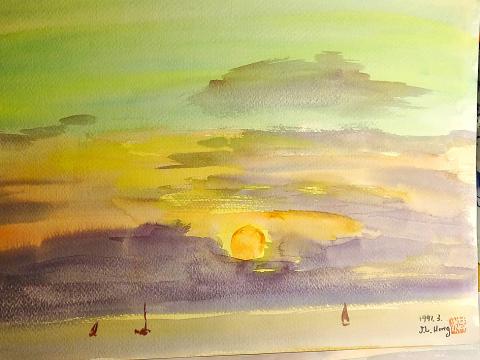
Photo: CNA
THOUSANDS OF WORKS
Now, more than 2,500 of his works dating from 1930 to 1996 are to return home from the US, after Hung Chun-hsiung and his family decided to donate them to the Ministry of Culture.
These include paintings of miners, as well as nudes and landscapes, painted in watercolors, oils and ink, art historian Hsiao Chong-ray (蕭瓊瑞) and the National Taiwan Museum of Fine Arts said.
There are also some sketches, handwritten notes taken by Hung Jui-lin in mines and his last painting, which is of a group of miners sitting in a circle, they said.
Hung Chun-hsiung said the family would keep some of the paintings as mementos, adding that although he is sad to let most of the paintings go, he is grateful to have found a home for them.
One of the few paintings that the family is keeping depicts a sunset by the sea, the sky painted in shades of purple, pink, orange and green, with sailboats on the water.
Hung Chun-hsiung said that his father created the painting when he was feeling homesick.
“As we walked, he said that he could hear music playing, although I could only hear the sound of waves,” Hung Chun-hsiung said.
“He said that the sunset was performing a symphony. ‘All of the colors are coming out to speak to me,’ he told me. ‘Like at the end of a concert where all of the instruments join in one by one, before going out with a bang. It is as if the colors are saying goodbye,’” Hung Chun-hsiung said.
“Whenever I look at this painting, I feel as though my father is speaking to me,” he added.
BORN IN TAIPEI
Hung Jui-lin was born in Taipei in 1912, when Taiwan was under Japanese colonial rule. When he was 18, he traveled to Tokyo to pursue a degree at Teikoku Art School and returned to Taiwan eight years later.
He married a mine foreman’s daughter, and started working as a supervisor in a mine in Rueifang (瑞芳), now a district in New Taipei City.
He worked there for the next 35 years, during which he cultivated a simple, rugged and expressive style of painting.
Hung Jui-lin became renowned for his paintings of miners, the central motif of most of his works. He had a profound respect for miners and referred to them as “mighty, nameless warriors” in a poem.
In his later years, he moved to the US to live with Hung Chun-hsiung, who operated a restaurant in California.
He continued to paint in the family’s home on Redondo Beach, California, until he passed away from heart complications at age 84.
A small number of Taiwanese this year lost their citizenship rights after traveling in China and obtaining a one-time Chinese passport to cross the border into Russia, a source said today. The people signed up through Chinese travel agencies for tours of neighboring Russia with companies claiming they could obtain Russian visas and fast-track border clearance, the source said on condition of anonymity. The travelers were actually issued one-time-use Chinese passports, they said. Taiwanese are prohibited from holding a Chinese passport or household registration. If found to have a Chinese ID, they may lose their resident status under Article 9-1
Taiwanese were praised for their composure after a video filmed by Taiwanese tourists capturing the moment a magnitude 7.5 earthquake struck Japan’s Aomori Prefecture went viral on social media. The video shows a hotel room shaking violently amid Monday’s quake, with objects falling to the ground. Two Taiwanese began filming with their mobile phones, while two others held the sides of a TV to prevent it from falling. When the shaking stopped, the pair calmly took down the TV and laid it flat on a tatami mat, the video shows. The video also captured the group talking about the safety of their companions bathing

PROBLEMATIC APP: Citing more than 1,000 fraud cases, the government is taking the app down for a year, but opposition voices are calling it censorship Chinese Nationalist Party (KMT) Chairwoman Cheng Li-wun (鄭麗文) yesterday decried a government plan to suspend access to Chinese social media platform Xiaohongshu (小紅書) for one year as censorship, while the Presidential Office backed the plan. The Ministry of the Interior on Thursday cited security risks and accusations that the Instagram-like app, known as Rednote in English, had figured in more than 1,700 fraud cases since last year. The company, which has about 3 million users in Taiwan, has not yet responded to requests for comment. “Many people online are already asking ‘How to climb over the firewall to access Xiaohongshu,’” Cheng posted on

A classified Pentagon-produced, multiyear assessment — the Overmatch brief — highlighted unreported Chinese capabilities to destroy US military assets and identified US supply chain choke points, painting a disturbing picture of waning US military might, a New York Times editorial published on Monday said. US Secretary of Defense Pete Hegseth’s comments in November last year that “we lose every time” in Pentagon-conducted war games pitting the US against China further highlighted the uncertainty about the US’ capability to intervene in the event of a Chinese invasion of Taiwan. “It shows the Pentagon’s overreliance on expensive, vulnerable weapons as adversaries field cheap, technologically


 RSS
RSS