


To ensure that today’s presidential and legislative elections proceed in an orderly fashion, people may not canvass for votes for any political party or candidate, including on social media, the Central Election Commission (CEC) reiterated yesterday, adding that offenders would face a fine.
Article 56-2 of the Civil Servants Election and Recall Act (公職人員選舉罷免法) prohibits people on election day from canvassing for votes, distributing election-related flyers, sending text messages, putting up posters, raising flags that bear candidates’ slogans or portraits, broadcasting from campaign vehicles or loitering near polling stations in clothing bearing candidates’ names, the commission said.
Offenders would be reported by polling station supervisors to the commission’s board of supervisors and would face a fine of NT$500,000 to NT$5 million (US$16,656 to US$166,561), with repeat fines possible if offenders refuse to comply, the commission said.
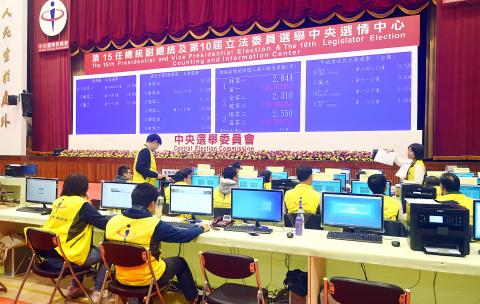
Photo: Liao Chen-huei, Taipei Times
If people hand out water or other beverages to voters on behalf of a candidate or party, they would be stopped by polling supervisors, the commission added.
If people interfere with the voting by becoming violent or attempting to coerce others, polling supervisors would inform the commission to contact the police or a prosecutors’ office, it said.
On election day in 2012, the “Taiwan Cheers, Great!” Facebook page, set up by then-president Ma Ying-jeou’s (馬英九) re-election campaign office, posted a message urging people to vote for Ma, resulting in a NT$500,000 fine from the commission.
Today at the polls, voters are to receive three ballots — a presidential ballot, a regional or Aboriginal legislator ballot and a ballot for a political party, which would determine the legislator-at-large seats.
According to the commission, more than 19.31 million people are eligible to vote today.
A two-month difference in voting residency requirements allows 19,311,105 people to cast their ballots for president, while 1,000 more can do so for the legislator-at-large seats, the commission said.
The election laws stipulate that Republic of China citizens must at some point have resided in Taiwan for a minimum of six consecutive months to be eligible to vote for president, or four months to vote for other civil servants.
Of the nation’s eligible voters, 13.37 million (69 percent) are registered in the six special municipalities: Taipei, New Taipei City, Taoyuan, Taichung, Tainan and Kaohsiung, the commission said.
People aged 40 to 49 make up the largest voting bloc with 3.74 million eligible voters (19 percent), followed by those aged 50 to 59 with 3.63 million, it said.
About 1.18 million 20 to 23-year-olds (6 percent) are eligible to vote in the presidential and legislative elections for the first time, it added.
After the polling stations close at 4pm today, votes for president are to be tallied first, followed by regional/Aboriginal legislator votes, with political party ballots counted last, the commission said.

Chinese spouse and influencer Guan Guan’s (關關) residency permit has been revoked for repeatedly posting pro-China videos that threaten national security, the National Immigration Agency confirmed today. Guan Guan has said many controversial statements in her videos posted to Douyin (抖音), including “the red flag will soon be painted all over Taiwan” and “Taiwan is an inseparable part of China,” and expressing hope for expedited reunification. The agency last year received multiple reports alleging that Guan Guan had advocated for armed reunification. After verifying the reports, the agency last month issued a notice requiring her to appear and explain her actions. Guan

GIVE AND TAKE: Blood demand continues to rise each year, while fewer young donors are available due to the nation’s falling birthrate, a doctor said Blood donors can redeem points earned from donations to obtain limited edition Formosan black bear travel mugs, the Kaohsiung Blood Center said yesterday, as it announced a goal of stocking 20,000 units of blood prior to the Lunar New Year. The last month of the lunar year is National Blood Donation Month, when local centers seek to stockpile blood for use during the Lunar New Year holiday. The blood demand in southern Taiwan — including Tainan and Kaohsiung, as well as Chiayi, Pingtung, Penghu and Taitung counties — is about 2,000 units per day, the center said. The donation campaign aims to boost

The Kaohsiung Tourism Bureau audited six hotels in an effort to prevent price gouging ahead of Korean band BTS’ concert tour in the city scheduled for Nov. 19, 21 and 22 this year. The bureau on Friday said that the audits — conducted in response to allegations of unfair pricing posted on social media — found no wrongdoing. These establishments included the local branches of Chateau de Chine, Hotel Nikko, My Humble House, and Grand Hai Lai, it said, adding that the Consumer Protection Commission would have penalized price gougers had the accusations been substantiated. The bureau said the Tourism Development Act
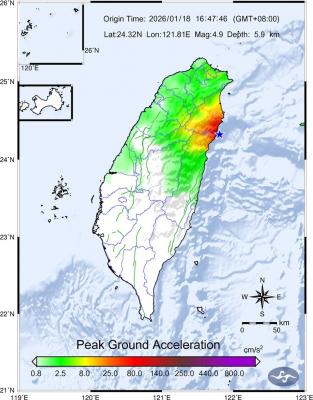
The Central Weather Administration (CWA) said a magnitude 4.9 earthquake that struck off the coast of eastern Taiwan yesterday was an independent event and part of a stress-adjustment process. The earthquake occurred at 4:47pm, with its epicenter at sea about 45.4km south of Yilan County Hall at a depth of 5.9km, the CWA said. The quake's intensity, which gauges the actual effects of a temblor, was highest in several townships in Yilan and neighboring Hualien County, where it measured 4 on Taiwan's seven-tier intensity scale, the CWA said. Lin Po-yu (林柏佑), a division chief at the CWA's Seismological Center, told a news conference


 RSS
RSS