


After a two-year renovation, the nation’s oldest zoo yesterday reopened with a new layout that it said brings visitors and animals closer than before.
Built in 1936, the Hsinchu Zoo overhauled its aging infrastructure with a no-cage approach to better protect and manage its animals in five areas, where they are separated from the public by moats or bushes and fences no taller than 120cm, allowing people to observe them at a closer distance without disturbing them, the city government said.
Visitors would be able to view all the animals, including orangutans and Bengal tigers, up close, it said, adding that common eland antelopes would be visible from the canteen area.
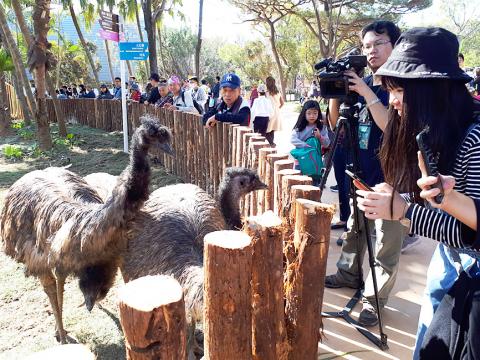
Photo: Hung Mei-hsiuh, Taipei Times
“Seeing the zoo become a center of tourism again has always been a dream of mine, and now I have seen that dream fulfilled,” Hsinchu Mayor Lin Chih-chien (林智堅) said.
Lin, whose mayoral campaign platform last year centered on renovating the zoo, presided over the reopening with President Tsai Ing-wen (蔡英文).
He said that he hoped the zoo would usher in a new period of prosperity for the city.
The zoo has also reduced the number of animals it cares for, from 70 species to 44, to make sure each group has ample space, zoo director Yang Chia-min (楊家民) said.
Most of the other species, which were released to the wild or relocated to other facilities, were birds, Yang said, adding that one of the old bird cages was turned into an art installation that visitors would walk through when entering the zoo.
The installation was designed to help visitors experience a caged animal’s perspective and inspire them to think differently about nature, he said.
The city government said that it has retained nearly 80 percent of the plants it had before the renovation, as well as familiar structures, such as a fountain and an entryway inspired by the former main entrance at the Tierpark Hagenbeck in Hamburg, Germany.
The Hsinchu zoo also kept the pen of an elephant that was gifted to the zoo, the city government said, adding that its preserved bones would be displayed in the building, along with historic photographs of the zoo.

The Centers for Disease Control (CDC) yesterday reported the first case of a new COVID-19 subvariant — BA.3.2 — in a 10-year-old Singaporean girl who had a fever upon arrival in Taiwan and tested positive for the disease. The girl left Taiwan on March 20 and the case did not have a direct impact on the local community, it said. The WHO added the BA.3.2 strain to its list of Variants Under Monitoring in December last year, but this was the first imported case of the COVID-19 variant in Taiwan, CDC Deputy Director-General Lin Ming-cheng (林明誠) said. The girl arrived in Taiwan on

South Korea is planning to revise its controversial electronic arrival card, a step Taiwanese officials said prompted them to hold off on planned retaliatory measures, a South Korean media report said yesterday. A Yonhap News Agency report said that the South Korean Ministry of Foreign Affairs is planning to remove the “previous departure place” and “next destination” fields from its e-arrival card system. The plan, reached after interagency consultations, is under review and aims to simplify entry procedures and align the electronic form with the paper version, a South Korean ministry official said. The fields — which appeared only on the electronic form

The Ministry of Foreign Affairs (MOFA) is suspending retaliation measures against South Korea that were set to take effect tomorrow, after Seoul said it is updating its e-arrival system, MOFA said today. The measures were to be a new round of retaliation after Taiwan on March 1 changed South Korea's designation on government-issued alien resident certificates held by South Korean nationals to "South Korea” from the "Republic of Korea," the country’s official name. The move came after months of protests to Seoul over its listing of Taiwan as "China (Taiwan)" in dropdown menus on its new online immigration entry system. MOFA last week
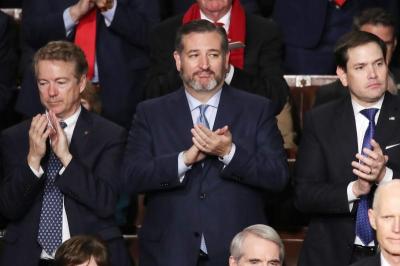
A bipartisan group of US senators has introduced a bill to enhance cooperation with Taiwan on drone development and to reduce reliance on supply chains linked to China. The proposed Blue Skies for Taiwan Act of 2026 was introduced by Republican US senators Ted Cruz and John Curtis, and Democratic US senators Jeff Merkley and Andy Kim. The legislation seeks to ease constraints on Taiwan-US cooperation in uncrewed aerial systems (UAS), including dependence on China-sourced components, limited access to capital and regulatory barriers under US export controls, a news release issued by Cruz on Wednesday said. The bill would establish a "Blue UAS


 RSS
RSS