


National Taiwan University (NTU) researchers yesterday unveiled a water purification device that they said can absorb three times more pollutants than activated carbon and would help industrial plants reuse wastewater.
The deionization device could be used to process industrial wastewater and allow them to reuse the treated water in manufacturing processes, and it could also be used to remove calcium and magnesium in household drinking water to make it taste better, chemical engineering professor Kevin Wu (吳嘉文) told a news conference at the Ministry of Science and Technology in Taipei.
The key to purifying water is to remove heavy metal ions, Wu said, adding that previously used materials had insufficient capacity for absorbing pollutants due to their limited electrical conductivity.
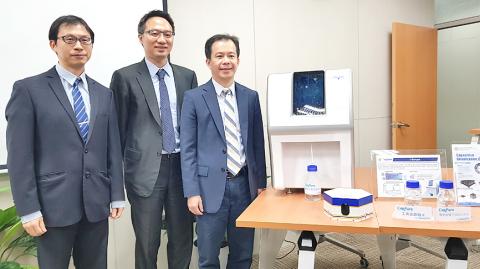
Photo: Chien Hui-ju, Taipei Times
After experimenting with different materials, the team developed nitrogen-doped nanoporous carbon materials, which have larger surface areas allowing for enhanced electrosorption capacity, but their conductivity was still insufficient, he said.
To solve the issue, they embedded gold nanoparticles in the materials and added a highly conductive polymer, resulting in two new materials with higher conductivity and absorption capacity, he said.
The electrosorption capacities of existing activated carbon materials range from 5 to 10mg per gram, while those of their new materials can reach 15mg per gram or more, Wu said.
Additionally, deionization systems using reverse osmosis or electrodialysis techniques usually consume 2 to 8 kilowatt-hours (kWh) of electricity per cubic meter of water processed, but theirs only uses 0.1 to 0.5kWh per cubic meter of water, he added.
Hou Chia-hung (侯嘉洪), an associate professor at NTU’s Graduate Institute of Environmental Engineering, utilized the materials and capacitive deionization techniques to develop the new energy-efficient device.
Although the team still needs one to three more years to make the product commercially viable, some firms have already expressed an interest in their technique, Hou said.
In addition to purifying water, the team also hopes to apply the device to collect rare earths, such as lanthanum and cerium, from water, Wu said.
The research led to the formation of the company Power Pure, whose CEO, Fan Chen-hsuan (范振軒) was a postdoctoral researcher at Hou’s laboratory.
Their findings were detailed in a paper published last year in issue No. 31 of the journal Nanoscale, where it was featured on its cover.

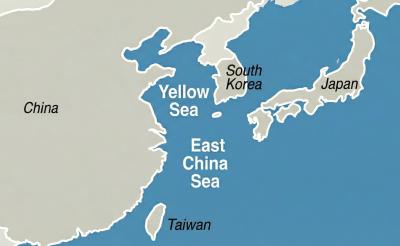
China has reserved offshore airspace in the Yellow Sea and East China Sea from March 27 to May 6, issuing alerts usually used to warn of military exercises, although no such exercises have been announced, the Wall Street Journal (WSJ) reported yesterday. Reserving such a large area for 40 days without explanation is an “unusual step,” as military exercises normally only last a few days, the paper said. These alerts, known as Notice to Air Missions (Notams), “are intended to inform pilots and aviation authorities of temporary airspace hazards or restrictions,” the article said. The airspace reserved in the alert is
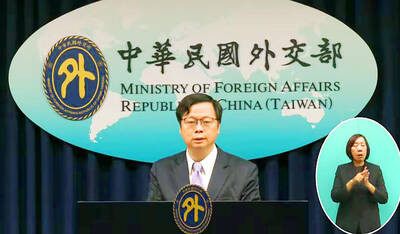
NAMING SPAT: The foreign ministry called on Denmark to propose an acceptable solution to the erroneous nationality used for Taiwanese on residence permits Taiwan has revoked some privileges for Danish diplomatic staff over a Danish permit that lists “Taiwan” as “China,” Eric Huang (黃鈞耀), head of the Ministry of Foreign Affairs’ Department of European Affairs, told a news conference in Taipei yesterday. Reporters asked Huang whether the Danish government had responded to the ministry’s request that it correct the nationality on Danish residence permits of Taiwanese, which has been listed as “China” since 2024. Taiwan’s representative office in Denmark continues to communicate with the Danish government, and the ministry has revoked some privileges previously granted to Danish representatives in Taiwan and would continue to review
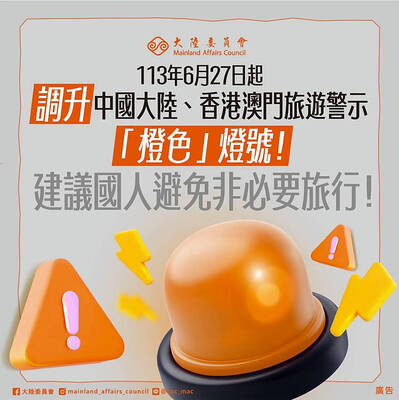
More than 6,000 Taiwanese students have participated in exchange programs in China over the past two years, despite the Mainland Affairs Council’s (MAC) “orange light” travel advisory, government records showed. The MAC’s publicly available registry showed that Taiwanese college and university students who went on exchange programs across the Strait numbered 3,592 and 2,966 people respectively. The National Immigration Agency data revealed that 2,296 and 2,551 Chinese students visited Taiwan for study in the same two years. A review of the Web sites of publicly-run universities and colleges showed that Taiwanese higher education institutions continued to recruit students for Chinese educational programs without
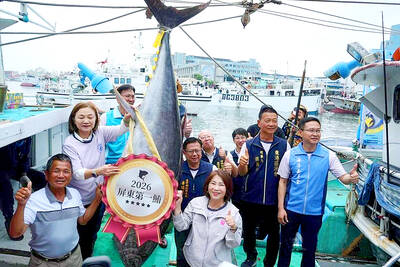
The first bluefin tuna of the season, brought to shore in Pingtung County and weighing 190kg, was yesterday auctioned for NT$10,600 (US$333.5) per kilogram, setting a record high for the local market. The auction was held at the fish market in Donggang Fishing Harbor, where the Siaoliouciou Island-registered fishing vessel Fu Yu Ching No. 2 delivered the “Pingtung First Tuna” it had caught for bidding. Bidding was intense, and the tuna was ultimately jointly purchased by a local restaurant and a local company for NT$10,600 per kilogram — NT$300 ,more than last year — for a total of NT$2.014 million. The 67-year-old skipper


 RSS
RSS