


The National Taiwan University (NTU) Student Association yesterday accused university officials of refusing to provide it with the student roster it says it needs to hold its elections.
Elections for the National Taiwan University Student Congress — the association’s legislative branch — are held in May and December each year, association president Tu Chun-ching(凃峻清) said.
According to Article 33 of the University Act (大學法), institutes should provide guidance in the formation of a student association or other self-governing organizations elected by the entire student body, Tu said.
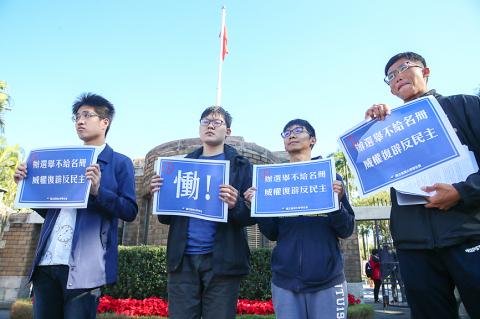
Photo: CNA
However, citing concerns that providing a roster would contravene the Personal Data Protection Act (個人資料保護法), the university has “repeatedly refused to provide the student association with the voter roster it needs for its elections,” he said.
The only way the association can hold its elections is with the roster, he said, adding that the information the association is requesting includes student names, ID numbers and departments.
“Not one [of the university’s offices] is willing to take responsibility and make a decision, make a judgement, make a promise to give or not to give” the association a roster, Tu said.
National Taiwan University has asked the association to use other means to conduct the elections — such as asking students to present polling staff with proof of enrollment or using the university’s online system to vote, he said.
However, the association believes such means would be unable to guarantee ballot secrecy or a fair election, he said.
For the past three or four years, the association has verified identification electronically by swiping ID cards, he said.
However, the university’s network has “crashed multiple times,” resulting in elections being interrupted or declared void, Tu said.
After the association’s election committee guaranteed that it would follow confidentiality procedures, the university was still unwilling to provide it with the roster, he said.
“In doing so, [NTU] is obstructing the elections and returning the campus back to the authoritarian era of 30 years ago,” he added.
Fan Yun (范雲), an NTU professor of sociology who was president of the association 30 years ago, said she regretted that after Kuan Chung-ming (管中閔) became NTU president, “it has returned to how it was 30 years ago.”
University autonomy is a common value and protected by law, Fan said.
“It is a shame that President Kuan called for university autonomy every day while he was fighting for his own authority, but after he became NTU president he openly violated the University Act,” she said.
Later yesterday, Lo Ching-shui (羅清水), director-general of the Ministry of Education’s Youth Development Administration, said that the ministry would ask NTU to respect the association’s resolution “on the basis of the University Act.”
It would ask it to “discuss a feasible plan with the students and to provide them with the assistance they need,” Lo said.
Additional reporting by Rachel Lin

The Centers for Disease Control (CDC) yesterday reported the first case of a new COVID-19 subvariant — BA.3.2 — in a 10-year-old Singaporean girl who had a fever upon arrival in Taiwan and tested positive for the disease. The girl left Taiwan on March 20 and the case did not have a direct impact on the local community, it said. The WHO added the BA.3.2 strain to its list of Variants Under Monitoring in December last year, but this was the first imported case of the COVID-19 variant in Taiwan, CDC Deputy Director-General Lin Ming-cheng (林明誠) said. The girl arrived in Taiwan on

South Korea is planning to revise its controversial electronic arrival card, a step Taiwanese officials said prompted them to hold off on planned retaliatory measures, a South Korean media report said yesterday. A Yonhap News Agency report said that the South Korean Ministry of Foreign Affairs is planning to remove the “previous departure place” and “next destination” fields from its e-arrival card system. The plan, reached after interagency consultations, is under review and aims to simplify entry procedures and align the electronic form with the paper version, a South Korean ministry official said. The fields — which appeared only on the electronic form

The Ministry of Foreign Affairs (MOFA) is suspending retaliation measures against South Korea that were set to take effect tomorrow, after Seoul said it is updating its e-arrival system, MOFA said today. The measures were to be a new round of retaliation after Taiwan on March 1 changed South Korea's designation on government-issued alien resident certificates held by South Korean nationals to "South Korea” from the "Republic of Korea," the country’s official name. The move came after months of protests to Seoul over its listing of Taiwan as "China (Taiwan)" in dropdown menus on its new online immigration entry system. MOFA last week
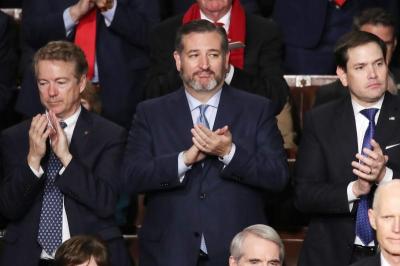
A bipartisan group of US senators has introduced a bill to enhance cooperation with Taiwan on drone development and to reduce reliance on supply chains linked to China. The proposed Blue Skies for Taiwan Act of 2026 was introduced by Republican US senators Ted Cruz and John Curtis, and Democratic US senators Jeff Merkley and Andy Kim. The legislation seeks to ease constraints on Taiwan-US cooperation in uncrewed aerial systems (UAS), including dependence on China-sourced components, limited access to capital and regulatory barriers under US export controls, a news release issued by Cruz on Wednesday said. The bill would establish a "Blue UAS


 RSS
RSS