


A group of about 300 protesters yesterday gathered at “tofu rocks” along Hsinchu County’s Toucian River (頭前溪) to demand clean drinking water for the county’s residents.
The protesters stood on the riverbank to form the Chinese character for the word “water” (水, shui), and captured the scene using a drone.
A group of local environmental activists tested water and demonstrated the effects of water-borne parasites on water quality.
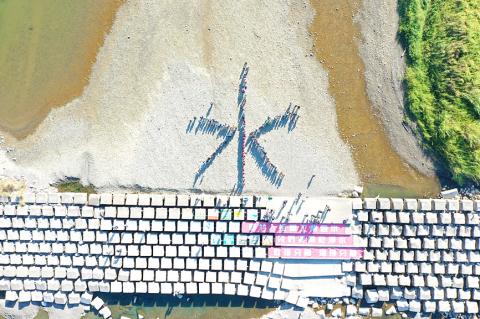
Photo provided by the Society of Wilderness’ Hsinchu Qinzi Group
Event organizers invited local politicians from across party lines to participate, saying that water quality was everyone’s concern.
“We refuse to drink wastewater. The government must amend the Water Pollution Control Act [水污染防治法],” the organizers said, adding that water sources for drinking and irrigation must be clearly separated from factory and sewage runoffs.
The group chose yesterday for the protest in the hopes that with elections only a month away, politicians would be willing to promise to improve water quality, they said.
“Toucian River supplies water to 750,000 people, but as soon as winter arrives, water levels drop. One-fourth of the water that remains is wastewater,” they said.
The river supplies 200,000 tonnes of water daily to the Longen weir (隆恩堰) downstream from tofu rocks, but further upstream 25,000 tonnes of wastewater is pumped into the river every day, they said.
The ratio of wastewater increases in the winter when water levels fall, they added.
The organizers and other local activists had been for two-and-a-half years calling on the government to install a wastewater pipe for industrial runoff, but officials had insisted water quality was not a problem, they said.
Establishing a water treatment facility and installing a wastewater pipe would be in the interests of local residents and industry, which would be spared from protests, they said.
“If they pipe out the wastewater to an off-site water-treatment facility it would make management of the river easier, and would take the pressure off the government,” they said.

The Centers for Disease Control (CDC) yesterday reported the first case of a new COVID-19 subvariant — BA.3.2 — in a 10-year-old Singaporean girl who had a fever upon arrival in Taiwan and tested positive for the disease. The girl left Taiwan on March 20 and the case did not have a direct impact on the local community, it said. The WHO added the BA.3.2 strain to its list of Variants Under Monitoring in December last year, but this was the first imported case of the COVID-19 variant in Taiwan, CDC Deputy Director-General Lin Ming-cheng (林明誠) said. The girl arrived in Taiwan on

South Korea is planning to revise its controversial electronic arrival card, a step Taiwanese officials said prompted them to hold off on planned retaliatory measures, a South Korean media report said yesterday. A Yonhap News Agency report said that the South Korean Ministry of Foreign Affairs is planning to remove the “previous departure place” and “next destination” fields from its e-arrival card system. The plan, reached after interagency consultations, is under review and aims to simplify entry procedures and align the electronic form with the paper version, a South Korean ministry official said. The fields — which appeared only on the electronic form

The Ministry of Foreign Affairs (MOFA) is suspending retaliation measures against South Korea that were set to take effect tomorrow, after Seoul said it is updating its e-arrival system, MOFA said today. The measures were to be a new round of retaliation after Taiwan on March 1 changed South Korea's designation on government-issued alien resident certificates held by South Korean nationals to "South Korea” from the "Republic of Korea," the country’s official name. The move came after months of protests to Seoul over its listing of Taiwan as "China (Taiwan)" in dropdown menus on its new online immigration entry system. MOFA last week

A bipartisan group of US senators has introduced a bill to enhance cooperation with Taiwan on drone development and to reduce reliance on supply chains linked to China. The proposed Blue Skies for Taiwan Act of 2026 was introduced by Republican US senators Ted Cruz and John Curtis, and Democratic US senators Jeff Merkley and Andy Kim. The legislation seeks to ease constraints on Taiwan-US cooperation in uncrewed aerial systems (UAS), including dependence on China-sourced components, limited access to capital and regulatory barriers under US export controls, a news release issued by Cruz on Wednesday said. The bill would establish a "Blue UAS


 RSS
RSS