


Uber drivers found offering taxi services are from Sunday to be fined for contravening the Transportation Management Regulations (汽車運輸業管理規則), the Ministry of Transportation and Communications said yesterday.
Authorities are to start enforcing an amendment to Article 103-1 of the rules, which was announced in June, after giving Uber drivers a five-month grace period that included a two-month extension.
The amended rules stipulate that taxi and vehicle rental services are separate businesses, and that passengers using the latter must pay an hourly or daily rate.
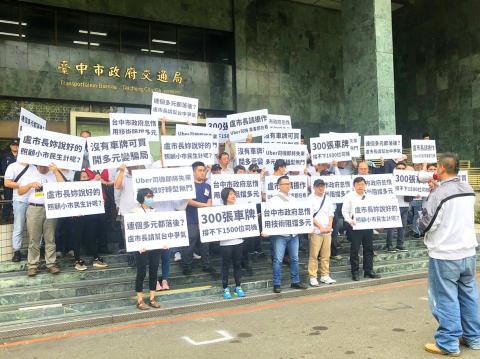
Photo: Hsu Kuo-chen, Taipei Times
While the ministry did not find Uber’s partnerships with vehicle rental businesses illegal, it said that some Uber drivers have been offering taxi services under the guise of a vehicle rental service, which is against the regulations.
From Sunday, vehicle rental operators working with Uber drivers offering taxi services would be fined NT$9,000 to NT$90,000, the ministry said.
Uber drivers who have not become legal taxi drivers may continue to provide vehicle rental services, provided that they charge customers hourly or daily rates, it said.
The ministry reiterated that the amendment was proposed to uphold its policy that all aspects of a taxi service — drivers, vehicles and service platforms — should be legal.
“We have encouraged Uber drivers to obtain business registration certificates by passing the taxi drivers’ exam. They can also work as independent contractors in taxi companies or as drivers in the diversified taxi service program,” the ministry said.
It added that it worked with the National Police Agency to increase the number of exam sessions so that more Uber drivers can obtain business certificates.
The ministry also amended other regulations, such as those that allow diversified taxi service program drivers to disclose fares in advance to passengers through a smartphone app.
There are about 12,000 Uber drivers in Taiwan, of who 7,000 to 8,000 have secured taxi business certificates, Platform Driver Alliance data showed.
However, only 2,000 to 3,000 of those with certificates have obtained taxi license plates for their vehicles in the past five months, and most operate in Taipei, New Taipei City and Taoyuan, the alliance said.
Some Uber drivers have said that the transition period was too short, as it takes a long time to pass the exam and secure taxi license plates, adding that several cities and counties have not released enough taxi license plates to meet demand.
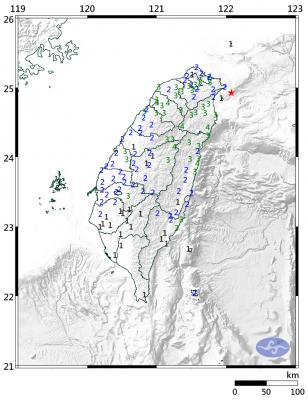
A magnitude 6.1 earthquake struck off the coast of Yilan County at 8:39pm tonight, the Central Weather Administration (CWA) said, with no immediate reports of damage or injuries. The epicenter was 38.7km east-northeast of Yilan County Hall at a focal depth of 98.3km, the CWA’s Seismological Center said. The quake’s maximum intensity, which gauges the actual physical effect of a seismic event, was a level 4 on Taiwan’s 7-tier intensity scale, the center said. That intensity level was recorded in Yilan County’s Nanao Township (南澳), Hsinchu County’s Guansi Township (關西), Nantou County’s Hehuanshan (合歡山) and Hualien County’s Yanliao (鹽寮). An intensity of 3 was
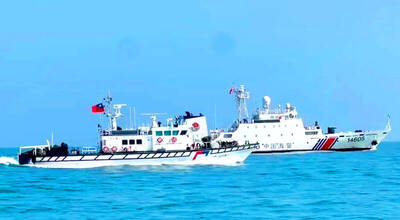
Instead of focusing solely on the threat of a full-scale military invasion, the US and its allies must prepare for a potential Chinese “quarantine” of Taiwan enforced through customs inspections, Stanford University Hoover fellow Eyck Freymann said in a Foreign Affairs article published on Wednesday. China could use various “gray zone” tactics in “reconfiguring the regional and ultimately the global economic order without a war,” said Freymann, who is also a nonresident research fellow at the US Naval War College. China might seize control of Taiwan’s links to the outside world by requiring all flights and ships entering or leaving Taiwan
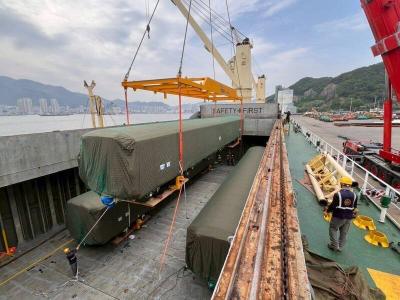
The first of 10 new high-capacity trains purchased from South Korea’s Hyundai Rotem arrived at the Port of Taipei yesterday to meet the demands of an expanding metro network, Taipei Rapid Transit Corp (TRTC) said yesterday. The train completed a three-day, 1,200km voyage from the Port of Masan in South Korea, the company said. Costing NT$590 million (US$18.79 million) each, the new six-carriage trains feature a redesigned interior based on "human-centric" transportation concepts, TRTC said. The design utilizes continuous longitudinal seating to widen the aisles and optimize passenger flow, while also upgrading passenger information displays and driving control systems for a more comfortable
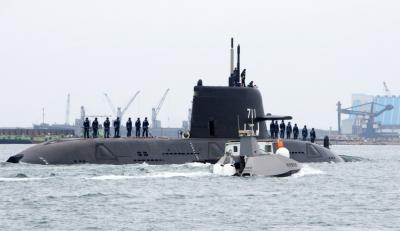
Taiwan's first indigenous defense submarine, the SS-711 Hai Kun (海鯤, or Narwhal), departed for its 13th sea trial at 7am today, marking its seventh submerged test, with delivery to the navy scheduled for July. The outing also marked its first sea deployment since President William Lai (賴清德) boarded the submarine for an inspection on March 19, drawing a crowd of military enthusiasts who gathered to show support. The submarine this morning departed port accompanied by CSBC Corp’s Endeavor Manta (奮進魔鬼魚號) uncrewed surface vessel and a navy M109 assault boat. Amid public interest in key milestones such as torpedo-launching operations and overnight submerged trials,


 RSS
RSS