


Taiwan International Airport Corp (TIAC) yesterday said it would next year begin testing autonomous vehicles to carry passengers to a parking lot at Taiwan Taoyuan International Airport.
The test is part of the company’s plan to turn the facility into a “smart airport,” company spokesman Lee Jian-kuo (李建國) said, adding that it would also involve self check-in systems and electronic gates at passport control.
The test is to be conducted at Terminal 2’s No. 4 parking lot, Lee said.
Passengers who want to use the service would need to enter their license plate numbers on a mobile app. An automated vehicle would then them up and transport them to their vehicles at the parking lot.
As there would be other vehicles in the parking lot, Lee said that the company has asked the test’s contractor whether the trial could be performed by maintaining a safe distance with other vehicles.
TIAC would also begin testing facial recognition technology to allow passengers to access the airport’s VIP lounge without having to use their boarding passes, Lee said.
The company has yet to set schedules for the trials, he added.
Hsin Tung Yang, a Taipei-based company that operates the food court in Terminal 1, has already been using two robotic waiters to collect empty trays and plates.
Tasa Meng Group, which runs the duty-free shops in Terminal 2, is also to use two robots to offer Taiwanese tea to travelers.
In related news, the airport ranked No. 13 among the world’s 100 best airports this year, its highest ranking in the past few years, in a survey by UK-based consultancy firm Skytrax.
However, it dropped to No. 7 in best airport staff, down from No. 1 in 2015, No. 4 in 2016, No. 1 in 2017 and No. 3 last year.
TIAC said the rise of Japanese airports was the reason it did not make it to the top five this year, as Japan has invested massive amounts of resources in airport facilities in preparation for the Tokyo Summer Olympic Games next year.
While the planned Terminal 3 is considered to be the key to improving the airport’s global ranking, TIAC has failed to attract bidders for the project, which caused it to postpone the completion date to 2024.
Many major developers are occupied with other public infrastructure projects and those from the private sector, the company said.
The airport was accessed by 46.53 million travelers last year, it said, adding that it expects passenger volume would grow by 1 million to 2 million annually in coming years due to increasing numbers of airlines and flights.
Should traveler numbers continue to increase at this rate, the two existing terminals would be accessed by 60 million people annually, which would far exceed their combined capacity of 37 million and compromise service quality, the company said.
TIAC said it is striving to deliver a feasible plan by February, as requested by the Ministry of Transportation and Communications.
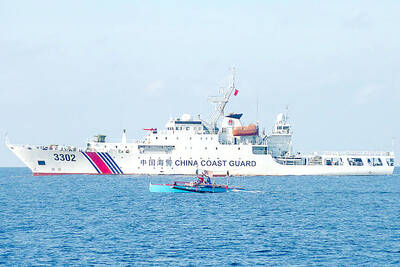
EXPANSIONIST: China deploys an average of 40 to 50 warships and coast guard vessels daily in the South China Sea, despite pledges not to militarize the region, an official said China is attempting to expand its influence across the First Island Chain and increase pressure on Japan by sending coast guard vessels into waters off of Taiwan under the pretext of maritime negotiations with Japan and the Philippines, a national security official said yesterday. China’s recent actions in the waters east of Taiwan and Japan and the Philippines’ exclusive economic zones (EEZ) are attempts to establish dominance in First Island Chain waters, said the official who declined to be named, adding that this is “expansion disguised as law enforcement.” Framing China’s actions solely as a cross-strait issue is a serious misjudgment that
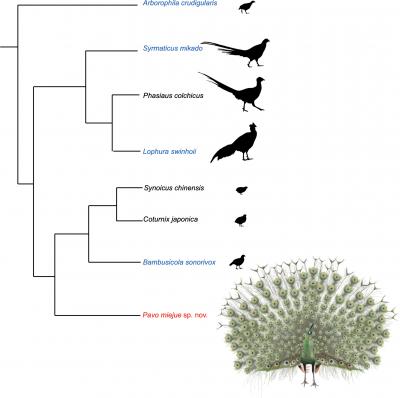
Through analyzing fossil evidence, a research team at National Taiwan University (NTU) discovered the largest endemic bird to have lived in Taiwan, naming it Pavo miejue, or extinct peafowl (滅絕孔雀). The Mikado pheasant, which is printed on the back of the NT$1,000 bank note, was previously believed to be the biggest endemic bird to Taiwan. The research team’s findings suggest that Pavo miejue lived during the Pleistocene epoch tens of thousands of years ago. It is the first endemic extinct bird species discovered and formally named in Taiwan. The study was coauthored by NTU Institute of Ecology and Evolutionary Biology professor Tsai Cheng-hsiu (蔡政修),
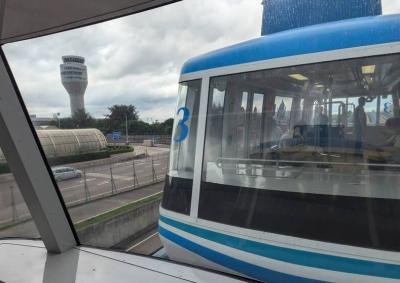
Taiwan Taoyuan International Airport is to suspend its automated Skytrain service connecting Terminal 1 and Terminal 2 starting on July 1 to facilitate connection works for the upcoming Terminal 3, the airport operator said today. Passengers and staff who need to travel between the two terminals after the suspension can instead use the Taoyuan MRT or the airport's 24-hour shuttle bus service, Taoyuan International Airport Corp said. The Taoyuan MRT Airport Line directly links the two terminals, while the shuttle buses are to operate around the clock, the company added. The Skytrain provides free transportation between the airport’s two terminals for travelers and
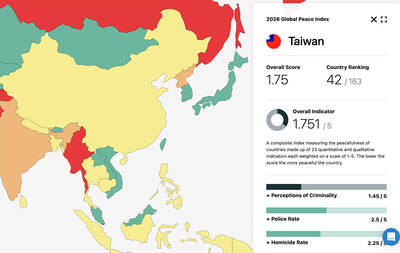
Taiwan ranked 42nd in terms of peacefulness among 163 countries, down five places from last year, according to this year’s Global Peace Index. With an overall score of 1.751, Taiwan dropped from 37th last year, the report published by the global Institute for Economics and Peace showed. The overall score measures a country’s level of peacefulness using 23 quantitative and qualitative indicators across three domains — ongoing domestic and international conflict, societal safety and security, and militarization. While Taiwan ranked 42nd worldwide, it was listed in ninth place among the 19 Asian-Pacific countries in the report, after New Zealand, Singapore, Japan, Malaysia,


 RSS
RSS