


A teenager, who used steroids over a long period to treat atopic dermatitis (eczema), developed retinal detachment after rubbing their eyes too hard.
Asia University Hospital Eye Center deputy director Lin Chun-ju (林純如), who treated the patient surnamed Chang, said that before the retinal detachment occurred, the patient had 20/25 vision in the left eye and 20/20 vision in the right eye when using glasses or contacts.
However, the patient’s long-term use of steroids triggered early cataracts, causing the vision in both eyes to drop to 20/200, Lin said, without specifying the gender of the patient.
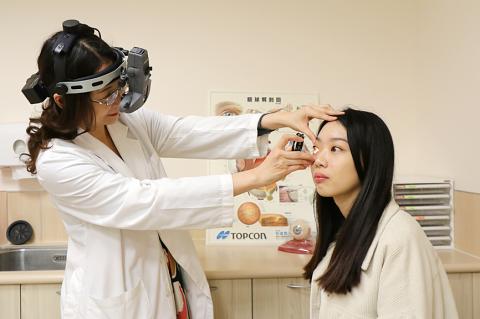
Photo: Su Chin-feng, Taipei Times
Because the patient also suffers from allergic conjunctivitis — commonly known as “pink eye,” which occurs when the eye comes into contact with allergens — and was rubbing their eyes too hard, the force applied to right eye caused the retina to detach, Lin said.
After surgery and the use of immunosuppressive drugs, which can treat ocular inflammatory disorders such as allergic conjunctivitis, the patient’s retina returned to its normal position, she said.
Prescribing steroids is often a dilemma for doctors, because they are useful for treating conditions such eczema, but for some people, using steroids over a long period creates higher risks of developing cataracts and glaucoma, Lin said.
Those who are at risk of these side effects and who are also prone to itchy eyes should use government-approved immunosuppressive drugs that will weaken the body’s immune response and prevent discomfort and itching, she said.
Momentary pain or irritation around the eyes after using these drugs is normal, she added.
The doctor asked parents to remind children with eye allergies not to rub their eyes too hard, especially those taking steroids to treat another condition.
Taiwanese paleontologists have discovered fossil evidence that pythons up to 4m long inhabited Taiwan during the Pleistocene epoch, reporting their findings in the international scientific journal Historical Biology. National Taiwan University (NTU) Institute of Ecology and Evolutionary Biology associate professor Tsai Cheng-hsiu (蔡政修) led the team that discovered the largest snake fossil ever found in Taiwan. The single trunk vertebra was discovered in Tainan at the Chiting Formation, dated to between 400,000 and 800,000 years ago in the Middle Pleistocene, the paper said. The area also produced Taiwan’s first avian fossil, as well as crocodile, mammoth, saber-toothed cat and rhinoceros fossils, it said. Discoveries

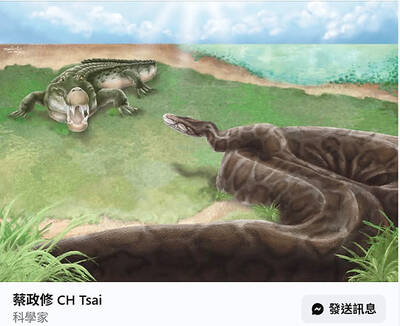
Taiwanese paleontologists have discovered fossil evidence that pythons up to 4m long inhabited Taiwan during the Pleistocene epoch, reporting their findings in the international scientific journal Historical Biology. National Taiwan University (NTU) Institute of Ecology and Evolutionary Biology associate professor Tsai Cheng-hsiu (蔡政修) led the team that discovered the largest snake fossil ever found in Taiwan. A single trunk vertebra was discovered in Tainan at the Chiting Formation, dated to between 800,000 to 400,000 years ago in the Middle Pleistocene, the paper said. The area also produced Taiwan’s first avian fossil, as well as crocodile, mammoth, sabre-toothed cat and rhinoceros fossils, it said. Discoveries
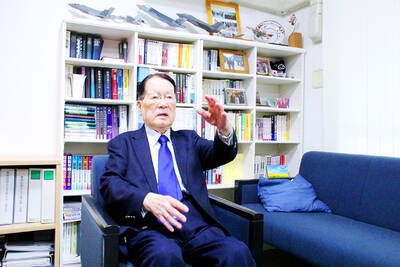
Whether Japan would help defend Taiwan in case of a cross-strait conflict would depend on the US and the extent to which Japan would be allowed to act under the US-Japan Security Treaty, former Japanese minister of defense Satoshi Morimoto said. As China has not given up on the idea of invading Taiwan by force, to what extent Japan could support US military action would hinge on Washington’s intention and its negotiation with Tokyo, Morimoto said in an interview with the Liberty Times (sister paper of the Taipei Times) yesterday. There has to be sufficient mutual recognition of how Japan could provide
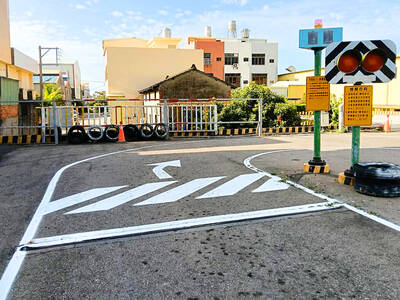
UPDATED TEST: The new rules aim to assess drivers’ awareness of risky behaviors and how they respond under certain circumstances, the Highway Bureau said Driver’s license applicants who fail to yield to pedestrians at intersections or to check blind spots, or omit pointing-and-calling procedures would fail the driving test, the Highway Bureau said yesterday. The change is set to be implemented at the end of the month, and is part of the bureau’s reform of the driving portion of the test, which has been criticized for failing to assess whether drivers can operate vehicles safely. Sedan drivers would be tested regarding yielding to pedestrians and turning their heads to check blind spots, while drivers of large vehicles would be tested on their familiarity with pointing-and-calling


 RSS
RSS