


The first case in Taiwan of severe fever with thrombocytopenia syndrome (SFTS), a tick-borne virus, was confirmed last week in a man in his 70s living in the north of the country, the Centers for Disease Control (CDC) said yesterday.
The man, who had not recently traveled overseas, but had often visited mountainous areas, sought treatment several times between Oct. 24 and Nov. 2 after experiencing reoccurring fever and vomiting, CDC disease prevention physician Chen Meng-yu (陳孟妤) said.
After having changes in consciousness and a rash, the man was hospitalized on Nov. 3, Chen said.
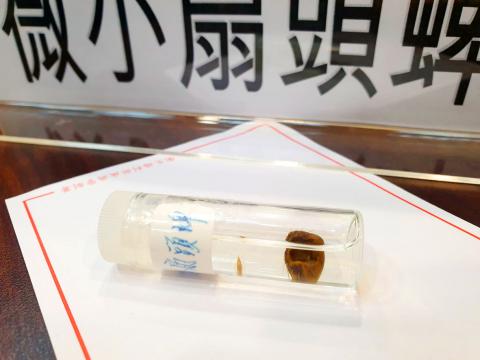
Photo: CNA
The hospital suspected dengue fever, but a blood sample sent to the CDC came back negative on Nov. 6, she added.
Disease prevention inspectors examined the case and on Wednesday last week confirmed that the man was infected with SFTS — the first case in Taiwan, Chen said.
The man remains in an intensive care unit, she said.
First confirmed in China in 2009, and subsequently in Japan and South Korea, SFTS is an emerging tick-borne infectious disease caused by a novel Phlebovirus, one of five, in the order Bunyavirales, CDC Deputy Director-General Philip Lo (羅一鈞) said.
Cases of SFTS increase from May to October and it has a mortality rate of 5 to 15 percent, Lo said, adding that the disease is transmitted by bites from Haemaphysalis longicornis, a tick more likely found in mountainous or hillside areas.
The incubation period is about seven to 14 days and patients might experience redness, swelling, a rash or a blister at the bite site, as well as fever, nausea, vomiting, loss of appetite, a low platelet count, a low white blood cell count or even multiple organ failure, Lo said.
As there is no antiviral drug for treating SFTS, supportive care is the treatment, he said.
People might worry that dogs or cats might bring a tick into the house, but there are many types of ticks and SFTS is mainly transmitted by H. longicornis, which has not yet been discovered in Taiwan, National Taiwan University College of Public Health associate professor Wang Hsi-chieh (王錫杰) said.
However, SFTS can also be transmitted by the Rhipicephalus microplus, so people who farm or frequently go mountain climbing have a greater risk of exposure, he said, adding that people should wear bright-colored, long-sleeve clothing, socks and insect repellent, but not stay in grasslands or forests for too long a time.
More than 5,300 cases of SFTS were reported in China from 2011 to 2016; 96 cases, including five deaths, have been confirmed this year in Japan — surpassing all the cases in Japan from 2013 to last year — and 223 cases have been confirmed this year in South Korea — surpassing the number there from 2014 to 2016, the centers said.
Since 2013, Taiwan has conducted tests for the SFTS Phlebovirus and its vectors, but all tests returned negative until last week’s case, Lo said.
A task force has been established to investigate the case’s source and SFTS is within a month to be announced as a notifiable communicable disease, he added.

LOUD AND PROUD Taiwan might have taken a drubbing against Australia and Japan, but you might not know it from the enthusiasm and numbers of the fans Taiwan might not be expected to win the World Baseball Classic (WBC) but their fans are making their presence felt in Tokyo, with tens of thousands decked out in the team’s blue, blowing horns and singing songs. Taiwanese fans have packed out the Tokyo Dome for all three of their games so far and even threatened to drown out home team supporters when their team played Japan on Friday. They blew trumpets, chanted for their favorite players and had their own cheerleading squad who dance on a stage during the game. The team struggled to match that exuberance on the field, with
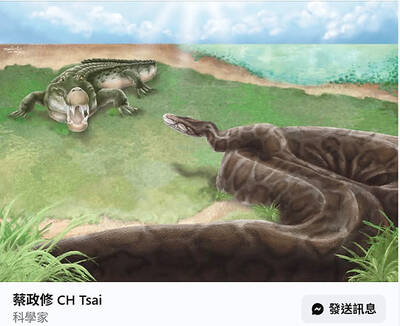
Taiwanese paleontologists have discovered fossil evidence that pythons up to 4m long inhabited Taiwan during the Pleistocene epoch, reporting their findings in the international scientific journal Historical Biology. National Taiwan University (NTU) Institute of Ecology and Evolutionary Biology associate professor Tsai Cheng-hsiu (蔡政修) led the team that discovered the largest snake fossil ever found in Taiwan. The single trunk vertebra was discovered in Tainan at the Chiting Formation, dated to between 400,000 and 800,000 years ago in the Middle Pleistocene, the paper said. The area also produced Taiwan’s first avian fossil, as well as crocodile, mammoth, saber-toothed cat and rhinoceros fossils, it said. Discoveries

Taiwanese paleontologists have discovered fossil evidence that pythons up to 4m long inhabited Taiwan during the Pleistocene epoch, reporting their findings in the international scientific journal Historical Biology. National Taiwan University (NTU) Institute of Ecology and Evolutionary Biology associate professor Tsai Cheng-hsiu (蔡政修) led the team that discovered the largest snake fossil ever found in Taiwan. A single trunk vertebra was discovered in Tainan at the Chiting Formation, dated to between 800,000 to 400,000 years ago in the Middle Pleistocene, the paper said. The area also produced Taiwan’s first avian fossil, as well as crocodile, mammoth, sabre-toothed cat and rhinoceros fossils, it said. Discoveries

Whether Japan would help defend Taiwan in case of a cross-strait conflict would depend on the US and the extent to which Japan would be allowed to act under the US-Japan Security Treaty, former Japanese minister of defense Satoshi Morimoto said. As China has not given up on the idea of invading Taiwan by force, to what extent Japan could support US military action would hinge on Washington’s intention and its negotiation with Tokyo, Morimoto said in an interview with the Liberty Times (sister paper of the Taipei Times) yesterday. There has to be sufficient mutual recognition of how Japan could provide


 RSS
RSS