


The first Taiwan-US cyberexercises that concluded on Friday might be held again next year, an official said on Saturday on condition of anonymity.
Taiwan has been holding the Cyber Offensive and Defensive Exercises (CODE) every two years since 2013, but this year was the first time that foreign teams have participated, with more than 10 nations sending participants for the five-day program.
The three-day simulation portion, that began on Wednesday, saw red teams made up of foreign and Taiwanese specialists launch simulated attacks on Taiwanese government and financial institutions’ Web sites, mimicking a North Korean cyberattack, while a blue team of Taiwanese experts defended against the assaults.
After the exercises ended, participants exchanged reports in a closed-door, confidential meeting.
The large-scale drills provided domestic experts with a valuable opportunity to interact with foreign professionals, the official said.
Cyberattacks have become diversified with the emergence of various social media platforms, and international cooperation is needed to boost security across Internet systems, the official said.
Many participants were also concerned about how to identify a cyberattack’s point of origin, sources said.
As hackers often launch attacks from a nation other than their own, it is difficult to track their sources through Internet protocol addresses, making professional judgement and the use of big data tools crucial in cyberdefense, they said.
Several high-ranking officials spoke during the event, including American Institute in Taiwan (AIT) Director Brent Christensen and Deputy Director Raymond Greene, Vice Premier Chen Chi-mai (陳其邁) and National Security Council adviser Lee Der-tsai (李德財).
The week’s program was organized by the Department of Cyber Security and the AIT, and Christensen said the AIT’s participation was aimed at sending a message to the world that “Taiwan is not alone on cyber. The United States stands with you, side by side, as a friend and partner.”
“Every country that values a free and open Internet should join us in partnering with Taiwan to collectively bolster our respective cyberdefenses,” he said on Wednesday. “Taiwan is a reliable and highly capable partner, and we are eager to deepen our cooperation across all dimensions of cybersecurity.”

Yangmingshan National Park authorities yesterday urged visitors to respect public spaces and obey the law after a couple was caught on a camera livestream having sex at the park’s Qingtiangang (擎天崗) earlier in the day. The Shilin Police Precinct in Taipei said it has identified a suspect and his vehicle registration number, and would summon him for questioning. The case would be handled in accordance with public indecency charges, it added. The couple entered the park at about 11pm on Thursday and began fooling around by 1am yesterday, the police said, adding that the two were unaware of the park’s all-day live

Fast food chain McDonald's is to raise prices by up to NT$5 on some products at its restaurants across Taiwan, starting on Wednesday next week, the company announced today. The prices of all extra value meals and sharing boxes are to increase by NT$5, while breakfast combos and creamy corn soup would go up by NT$3, the company said in a statement. The price of the main items of those meals, if ordered individually, would remain the same. Meanwhile, the price of a medium-sized lemon iced tea and hot cappuccino would rise by NT$3, extra dipping sauces for chicken nuggets would go up
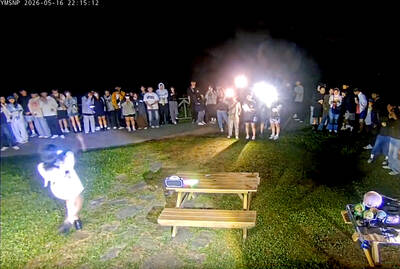
Yangmingshan National Park’s Qingtiangang (擎天崗) nature area has gone viral after a park livestream camera observed a couple in the throes of intimate congress, which was broadcast live on YouTube, drawing large late-night crowds and sparking a backlash over noise, bright lights and disruption to wildlife habitat. The area’s livestream footage appeared to show a couple engaging in sexual activity on a picnic table in the park on Friday last week, with the uncensored footage streamed publicly online. The footage quickly spread across social media, prompting a tide of visitors to travel to the site to “check in” and recreate the

Minister of Digital Affairs Lin Yi-ching (林宜敬) yesterday cited regulatory issues and national security concerns as an expert said that Taiwan is among the few Asian regions without Starlink. Lin made the remarks on Facebook after funP Innovation Group chief executive officer Nathan Chiu (邱繼弘) on Friday said Taiwan and four other countries in Asia — China, North Korea, Afghanistan and Syria — have no access to Starlink. Starlink has become available in 166 countries worldwide, including Ukraine, Malaysia, the Philippines and Vietnam, in the six years since it became commercial, he said. While China and North Korea block Starlink, Syria is not


 RSS
RSS