


Air traffic controllers are facing increasing challenges with the continuous development of uncrewed aerial vehicles (UAVs), experts said yesterday, the second day of the three-day International Aviation Safety Summit in Taipei.
A presentation from NASA Airspace Operations and Safety Program director Akbar Sultan showed that the airspace between 18,000 feet and 60,000 feet (5,486m and 18,288m) above ground could in future be jointly shared by supersonic crewed aircraft, subsonic fixed-wing aircraft and large UAVs.
Not only would there be airports monitoring the traffic of large civil aviation aircraft on the ground, but there would also be vertiports or droneports on top of buildings or inside airports to accommodate vertical landing and takeoff of electric and hybrid-electric aircraft, the presentation showed, adding that this presents an urgent need for the integration of different air traffic control systems.
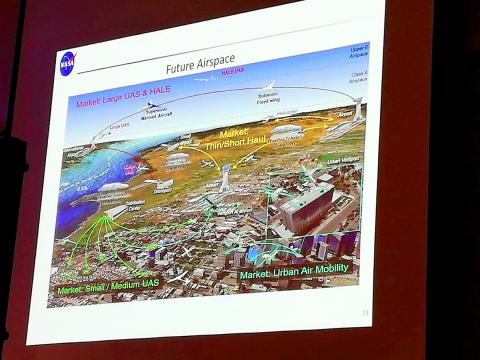
Photo: CNA
As UAV applications are set to expand — from accelerating urban air mobility to facilitating short-haul and medium-haul transportation services — experts said that UAV manufacturers must standardize safety criteria, such as categorization of UAV certification and automatic dependent surveillance-broadcast (ADS-B) devices.
CAA Flight Standards Division Director Clark Lin (林俊良) said that the nation’s air traffic controllers should be prepared to meet the challenges brought by increased deployment of drones for commercial purposes.
Lin cited as an example German aircraft manufacturer Volocopter’s successful test flight of a drone-like flying taxi in Singapore last month.
Regulations governing the use of drones are to take effect on March 31, Lin said.
These include a ban on drones operating 400 feet or more above ground, unless operators have filed an application beforehand, Lin said.
UAVs weighing 250g or more have to be registered with the Civil Aeronautics Administration (CAA), while those weighing 2kg or more would also need an operating license, he said.
The CAA has designed a mobile phone application that allows operators to see if their UAVs might have flown into prohibited or restricted areas, he said.
Taiwan Transportation Safety Board chief aviation investigator Thomas Wang (王興中), who was in charge of investigating the causes of two TransAsia Airways plane crashes in 2014 and 2015, said there are not many drones operating above 400 feet for now because of government restrictions.
However, as Amazon and other retail business owners have started experimenting with drones to deliver goods, air traffic controllers have to think ahead what they would when they need to regulate traffic involving UAVs and large aircraft at the same time, Wang said.

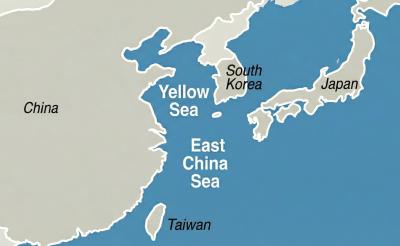
China has reserved offshore airspace in the Yellow Sea and East China Sea from March 27 to May 6, issuing alerts usually used to warn of military exercises, although no such exercises have been announced, the Wall Street Journal (WSJ) reported yesterday. Reserving such a large area for 40 days without explanation is an “unusual step,” as military exercises normally only last a few days, the paper said. These alerts, known as Notice to Air Missions (Notams), “are intended to inform pilots and aviation authorities of temporary airspace hazards or restrictions,” the article said. The airspace reserved in the alert is
NAMING SPAT: The foreign ministry called on Denmark to propose an acceptable solution to the erroneous nationality used for Taiwanese on residence permits Taiwan has revoked some privileges for Danish diplomatic staff over a Danish permit that lists “Taiwan” as “China,” Eric Huang (黃鈞耀), head of the Ministry of Foreign Affairs’ Department of European Affairs, told a news conference in Taipei yesterday. Reporters asked Huang whether the Danish government had responded to the ministry’s request that it correct the nationality on Danish residence permits of Taiwanese, which has been listed as “China” since 2024. Taiwan’s representative office in Denmark continues to communicate with the Danish government, and the ministry has revoked some privileges previously granted to Danish representatives in Taiwan and would continue to review
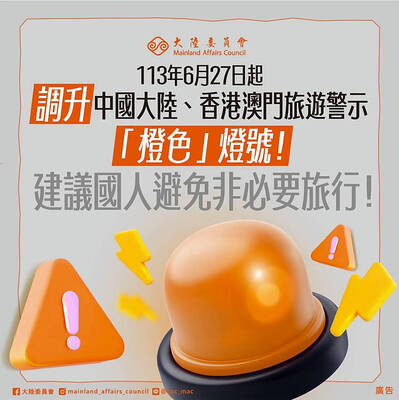
More than 6,000 Taiwanese students have participated in exchange programs in China over the past two years, despite the Mainland Affairs Council’s (MAC) “orange light” travel advisory, government records showed. The MAC’s publicly available registry showed that Taiwanese college and university students who went on exchange programs across the Strait numbered 3,592 and 2,966 people respectively. The National Immigration Agency data revealed that 2,296 and 2,551 Chinese students visited Taiwan for study in the same two years. A review of the Web sites of publicly-run universities and colleges showed that Taiwanese higher education institutions continued to recruit students for Chinese educational programs without
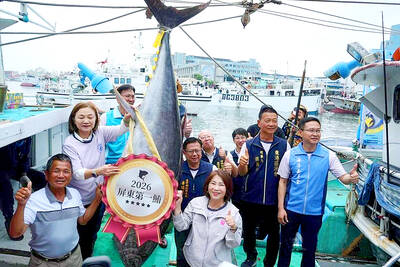
The first bluefin tuna of the season, brought to shore in Pingtung County and weighing 190kg, was yesterday auctioned for NT$10,600 (US$333.5) per kilogram, setting a record high for the local market. The auction was held at the fish market in Donggang Fishing Harbor, where the Siaoliouciou Island-registered fishing vessel Fu Yu Ching No. 2 delivered the “Pingtung First Tuna” it had caught for bidding. Bidding was intense, and the tuna was ultimately jointly purchased by a local restaurant and a local company for NT$10,600 per kilogram — NT$300 ,more than last year — for a total of NT$2.014 million. The 67-year-old skipper


 RSS
RSS