


Prosecutors said yesterday they will appeal a local court’s decision to acquit 30 suspects in the so-called Catch Power business scam, a failed shopping platform using “smart lockers” that were installed at Taipei MRT stations.
Three key individuals in the case have fled to China, after allegedly pocketing NT$18.8 billion (US$616.81 million) of investors’ money.
The ruling was made on Thursday, when the Chiayi District Court acquitted the 30 suspects, who had been charged with illegally procuring investments and earning profits on the invested money, in contravention of the Banking Act (銀行法).

Photo: Huang Yao-cheng, Taipei Times
The court said there was insufficient evidence to prove that the 30 suspects had colluded with the three main organizers of the scam.
About 500 investors, who had formed victims’ self-help associations and invested billions into what they believed was a legitimate business, awaited the ruling.
Investigators identified three main organizers: Catch Power president Sun Yueh-tse (孫岳澤) and his wife, Lee Hsin-chieh (李欣潔), along with company board member Wang Mu-sheng (王木生).
Chiayi prosecutors said they will appeal Thursday’s ruling by submitting more evidence gathered during the investigation.
Taipei Rapid Transit Corp (TRTC) partnered with the online shopping platform, which offered delivery services for food and other items that could be paid for online. The “smart lockers” were advertised as being able to store refrigerated and frozen goods and began to appear inside Taipei MRT stations from about September 2016.
TRTC officials said at the time that Catch Power would eventually install lockers at all Taipei MRT stations, but the company started to have financial issues.
The judiciary began the investigation in March 2017, and Catch Power units were removed from MRT stations.
During that time, investigators also discovered that Sun, Lee and Wang took a flight to Hong Kong and then headed to China, where they are reportedly still residing.
They are listed as wanted by Taiwan’s judiciary and are among the suspects charged in the case. However, as they fled to China and did not face prosecution in the nation, the acquittal only applies to the 30 suspects who were tried.
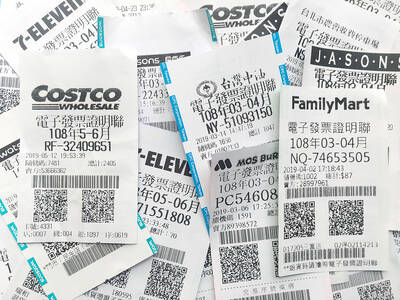
A NT$39 receipt for two bottles of tea at a FamilyMart was among the NT$10 million (US $312,969) special prize winners in the January-February uniform invoice lottery. FamilyMart said that two NT$10 million-winning receipts were issued at its stores, as well as two NT$2 million grand prizes and three NT$200,000 first prizes. The two NT$10 million receipts were issued at stores in Pingtung County and Yilan County’s Dongshan Township (冬山). One winner spent just NT$39 on two bottles of tea, while another spent NT$80 on water, tea and coffee, the company said. Meanwhile, 7-Eleven reported three NT$10 million winners — in New Taipei

Considering that most countries issue more than five denominations of banknotes, the central bank has decided to redesign all five denominations, the bank said as it prepares for the first major overhaul of the banknotes in more than 24 years. Central bank Governor Yang Chin-lung (楊金龍) is expected to report to the Legislative Yuan today on the bank’s operations and the redesign’s progress. The bank in a report sent to the legislature ahead of today’s meeting said it had commissioned a survey on the public’s preferences. Survey results showed that NT$100 and NT$1,000 banknotes are the most commonly used, while NT$200 and NT$2,000

ANNUAL EVENT: Two massive Pokemon balloons are to be set up in Daan Park, with an event zone operating from 10am to 6pm This year’s Taipei Floral Picnic is to be held at Daan Park today and tomorrow, featuring an exclusive Pokemon Go event, a themed food market, a coffee rave picnic area and stage performances, the Taipei Department of Information and Tourism said yesterday. Two massive Pokemon balloons are to be set up in the park as attractions, with an exclusive event zone operating from 10am to 6pm, it said. Participants who complete designated tasks on-site would have a chance to receive limited-edition souvenirs, it added. People could also try the newly launched game Pokemon Pokopia in the trial area, the department said. Three PokeStops are

Taiwan is concerned that China could exploit the US’ war in the Middle East, with state media citing examples from the conflict to cast doubt on the efficiency of US weapons Taiwan would use to repel an invasion. Taiwanese officials said the resumption of Beijing’s large-scale air force incursions near Taiwan after an unusual decline show that China wants to take advantage of the redeployment of US forces from East Asia to the Middle East. “This is a moment for China to exercise influence,” a senior Taiwanese security official said, speaking on condition of anonymity. “What China is trying to create is a


 RSS
RSS