

The government has allowed shipping firms to offer direct passenger services between Penghu County and China since 2008, although none have yet applied to do so, Deputy Minister of Transportation and Communications Wang Kwo-tsai (王國材) said yesterday.
Wang made the remarks on the sidelines of a meeting at the legislature in Taipei in response to media queries for comment about Kaohsiung Mayor Han Kuo-yu’s (韓國瑜) proposal to launch direct ferry services between the outlying county and China’s Fujian Province, as are offered from Kinmen and Lienchiang counties.
Han, the Chinese Nationalist Party’s (KMT) presidential candidate, made the promise to Penghu County Commissioner Lai Feng-wei (賴峰偉) at a campaign rally in Penghu on Sunday.
The county does not have a direct ferry service to China, even though it is permitted by law, Lai told Han, adding that the lack of such services means most Chinese tourists from Fujian arrive in Penghu via Kinmen.
Lai said that he has been working to establish direct services from Penghu to Xiamen and Pingtan, as well as direct flights from Penghu’s Magong Airport to Quanzhou Jinjiang International Airport.
However, as cross-strait affairs fall under the jurisdiction of the central government, none of these services would be realized if the government disapproves, he said.
Tourists from Fujian are indeed more likely to arrive in Penghu via Kinmen and Lienchiang, Wang said yesterday, adding that Penghu’s cross-strait shipping services are mostly for cargo.
Chinese tourists often arrive on chartered vessels, he said.
Penghu welcomes about 1.2 million domestic tourists annually and that number is rising at about 10 percent per year, he said.
The number of tourists visiting Penghu has grown from about 1.15 million in 2017 to 1.8 million last year, Tourism Bureau statistics showed.
About 1.1 million tourists have visited the outlying island this year to last month, an 11 percent increase from the same period last year, the statistics showed.
Penghu has emerged as a popular travel destination thanks to the government’s travel subsidy program, the bureau said.
The program has subsidized 173 tour groups and 88,000 independent visitors to the islands, it said.

A Hualien pomelo farmer refused to sell to China after the country announced it would permit more Taiwanese pomelo imports, prompting widespread support from Taiwanese consumers, who rallied to buy his fruit. China’s Taiwan Affairs Office last month said that China’s General Administration of Customs registered an additional 79 Taiwanese pomelo orchards and packing facilities in Hualien County, allowing more Taiwanese producers to export pomelos to China. “I am a Hualien fruit farmer and I refuse to sell to China,” Liu Tzu-hao (劉子豪) from Ruisui Township (瑞穗) said in an online post. Liu is a well-known farmer in the community and has served
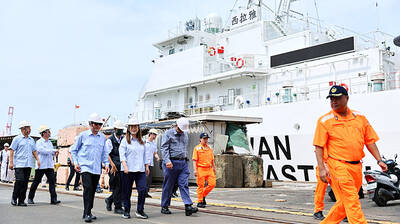
Ocean Affairs Council (OAC) Minister Kuan Bi-ling (管碧玲) on Wednesday said decommissioned coast guard vessels were given to the Philippines to enhance regional rescue capacity and would not affect Taiwanese fishers’ rights and benefits. Kuan made the remarks after confirmation on Tuesday that a 500-tonne Coast Guard Administration (CGA) patrol and rescue vessel would be given to the Philippine Coast Guard. The donation ceremony was reportedly done in Manila, but whether the vessel — previously numbered “CG123” and named Kinmen (金門) — has been handed over has yet to be confirmed. China’s Taiwan Affairs Office (TAO) on Wednesday criticized the donation for “taking
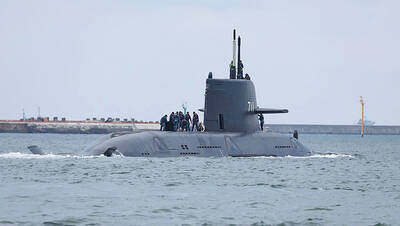
UPDATE: The submarine would need to undergo combined systems testing and crew training for navy personnel before it is ready for mission, an expert said Taiwan’s first domestically built submarine, the Hai Kun (Narwhal, 海鯤), could be delivered to the navy as early as next month, military expert and Taiwan Association for Security and Development chairman Chi Tung-yun (紀東昀) said yesterday. The submarine was yesterday morning observed departing for its 21st sea trial and its 15th submerged test. The vessel missed the initial delivery deadline of November last year due to “testing delays,” its primary contractor, shipbuilder CSBC Corp, Taiwan, said in June. The contractor also cited “political pressure from China” in procuring critical equipment. All testing operations are in the final stages, with the
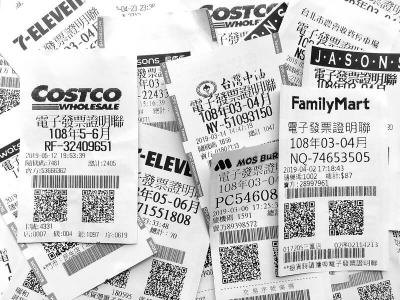
Six NT$10 million (US$315,527) special prizes and seven NT$2 million grand prizes in Taiwan's May-June uniform invoice lottery remained unclaimed as of today, including one NT$10 million winner who spent only NT$10 on an Uber Eats delivery order, the Ministry of Finance said. The ministry said the 13 winners need to claim their prizes by Nov. 5. The eight-digit serial number that won the NT$10 million special prize for May-June was 38548029, with 18 winning receipts in total. The NT$2 million grand prize number was 10138845, of which there were 22 winning receipts, the ministry said. In addition to the receipt issued for an


 RSS
RSS