


While many people adore furry four-legged creatures, not everyone is able to raise one in their home. Fortunately, there are other ways to show love to stray animals in Taiwan.
“You Adopt, I Raise” (您領我養) is a program introduced in 2005 by Huang Ching-jung (黃慶榮), a former secretary-general of the Animal Protection Association. It has since helped thousands of strays.
As a veterinarian who has long promoted animal protection, Huang said that one day he had the idea that “if there are people who can raise animals for those who wish to but are unable, then a win-win situation could be created.”
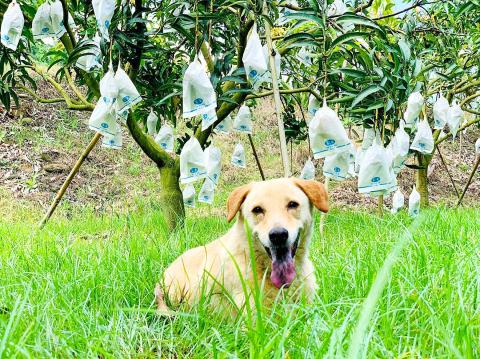
Photo courtesy of the Animal Protection Association of the Republic of China
Under the program, adopters make small donations on a regular basis to people who raise the dogs for them.
However, the program is not just about making donations.
After adopting one dog or more, adopters can visit the program’s animal shelter in New Taipei City’s Bali District (八里) to meet the dogs and spend time with them, or even bring them home for a stay of any duration, he said.
Stray dogs in the shelter have all had microchips implanted, and the association compiles pictures and identification information of the dogs for management, Huang said, adding that adopters are given a card with a microchip number that helps them quickly locate their adopted friends when they visit.
“Adopters would feel frustrated if they have to spend a long time trying to find their dogs at the shelter, or if they find that their dogs have already passed away when they visit, they would definitely be angry and suspect that we have stolen their money. That is why we have all the dogs microchipped and will inform adopters and stop receiving donations from them once their dogs pass away,” he said.
When asked where the dogs at the Bali shelter come from, Huang said that most of them come from public shelters, where less visually appealing strays seldom get adopted.
“They are all very healthy and have great personalities though, so we set an upper limit to the number of adopters for each dog, hoping that every dog would be given an equal chance for adoption,” he said.
“Our shelter is kind of like a training center for new recruits,” Huang said with a smile. “The dogs learn how to get close to humans by following basic orders and becoming more socialized, so as to increase their chance of being adopted.”
After “You Adopt, I Raise,” Huang launched another program in 2011 called “Dogs Come With Wealth” (狗來富).
According to Huang, a number of well-trained dogs are still not adopted from the shelter because of their appearance. He wanted the dogs to have more living space, such as in an orchard, where they can run freely.
The second program includes full coverage for dog feed and medical costs, plus a subsidy of NT$500 per dog per month to the orchard owner.
Huang said the program requires an orchard owner to raise at least 20 dogs, and before adoption, the association conducts site visits to evaluate the space and determine whether the owner and others would enjoy raising the animals.
Volunteers visit the orchards each month to ensure the adoption process is going smoothly and to keep track of the dogs.
To date, 320 dogs have been adopted by orchard owners in central and southern Taiwan, he said.
“Our association makes it clear to the orchard owners that they should never abandon or harm their dogs if one day they do not feel like raising them any more,” Huang said. “If they really cannot continue with the program, they can send the dogs back to our association.”
“You Adopt, I Raise” has been successful and has educated and involved more people who are interested in protecting stray animals, Huang said.
As for “Dogs Come With Wealth,” it would not have been possible were it not for the success of the first program, which helped the organization financially, he said.
Huang said he would feel sorry if these dogs spend their whole lives at the shelter, because every animal deserves freedom and happiness rather than just having their basic life needs met.
“The reason I designed these two programs was to help dogs — who have been harmed and abandoned — live a brand-new life with dignity, freedom and love again,” he said.

Taiwanese can file complaints with the Tourism Administration to report travel agencies if their activities caused termination of a person’s citizenship, Mainland Affairs Council Minister Chiu Chui-cheng (邱垂正) said yesterday, after a podcaster highlighted a case in which a person’s citizenship was canceled for receiving a single-use Chinese passport to enter Russia. The council is aware of incidents in which people who signed up through Chinese travel agencies for tours of Russia were told they could obtain Russian visas and fast-track border clearance, Chiu told reporters on the sidelines of an event in Taipei. However, the travel agencies actually applied

Japanese footwear brand Onitsuka Tiger today issued a public apology and said it has suspended an employee amid allegations that the staff member discriminated against a Vietnamese customer at its Taipei 101 store. Posting on the social media platform Threads yesterday, a user said that an employee at the store said that “those shoes are very expensive” when her friend, who is a migrant worker from Vietnam, asked for assistance. The employee then ignored her until she asked again, to which she replied: "We don't have a size 37." The post had amassed nearly 26,000 likes and 916 comments as of this

New measures aimed at making Taiwan more attractive to foreign professionals came into effect this month, the National Development Council said yesterday. Among the changes, international students at Taiwanese universities would be able to work in Taiwan without a work permit in the two years after they graduate, explainer materials provided by the council said. In addition, foreign nationals who graduated from one of the world’s top 200 universities within the past five years can also apply for a two-year open work permit. Previously, those graduates would have needed to apply for a work permit using point-based criteria or have a Taiwanese company

The Shilin District Prosecutors’ Office yesterday indicted two Taiwanese and issued a wanted notice for Pete Liu (劉作虎), founder of Shenzhen-based smartphone manufacturer OnePlus Technology Co (萬普拉斯科技), for allegedly contravening the Act Governing Relations Between the People of the Taiwan Area and the Mainland Area (臺灣地區與大陸地區人民關係條例) by poaching 70 engineers in Taiwan. Liu allegedly traveled to Taiwan at the end of 2014 and met with a Taiwanese man surnamed Lin (林) to discuss establishing a mobile software research and development (R&D) team in Taiwan, prosecutors said. Without approval from the government, Lin, following Liu’s instructions, recruited more than 70 software


 RSS
RSS