


President Tsai Ing-wen’s (蔡英文) re-election team hopes to run an “innovative and united campaign” to communicate with young and first-time voters in the hopes of winning their support, spokesman Liao Tai-hsiang (廖泰翔) said on Saturday.
Young voters can access Tsai’s social media content through a variety of channels, including Facebook, Instagram, Line and YouTube, which her team hopes will make them feel that there is no gap in communications between the president and themselves, he said.
Tsai’s Line account allows followers to insert images of themselves into photographs of her and Democratic Progressive Party (DPP) legislative candidates, he said.
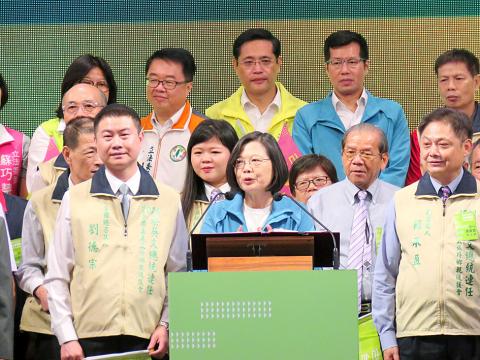
Photo: Chen Hsin-yi, Taipei Times
The campaign team aims to improve integration of its offline and online interactions with Tsai’s supporters to boost online support for her, an anonymous source said.
A recent “Social Media Night” the campaign organized was well-received by young attendees, and more such events are planned for next month and later to “turn online support into actual votes,” the source said.
Asked why Tsai appears to be polling higher among young voters than her Chinese Nationalist Party opponent, Kaohsiung Mayor Han Kuo-yu (韓國瑜), a DPP member, speaking on condition of anonymity, said Han’s “China-friendly” cross-strait stance, his unwillingness to condemn Beijing’s “one country, two systems” policy and the KMT’s claims that the DPP is instilling fear in Taiwanese by evoking “dried mango strips” (芒果乾) — a play on words with the Chinese phrase “a sense of the nation’s impending doom” (亡國感) — are at odds with the views of young voters.
While Han has not kept his mayoral campaign promise to “make Kaohsiung rich” and is “running away” by seeking the presidency, Tsai’s positions on issues such as pension reform, transitional justice, marriage equality and national sovereignty “protect the rights and interests of young people,” and are reasons why she is leading in the polls, the DPP member said.
Han has “clearly become the butt of the joke for young people on the Internet,” they added.
The achievements of Tsai’s administration — including wage increases, tax reductions and childcare and housing subsidies — are “gradually coming to the surface,” Liao said.
Tsai’s administration will continue to pay attention to the issues faced by young people, such as employment and starting a family, and she would continue to seek to ease the pressure on the younger generation through her policies, he said.
Younger people support Tsai because of her “clear stance of insisting on Taiwan’s sovereignty,” he said.
In cross-strait relations, diplomacy, defense and other areas, Tsai’s performance has “met the young generation’s expectations about a national identity,” he added.

NATIONAL SECURITY: Authorities are working to confirm the identities of the military personnel involved and investigating possible illegal conduct and regulatory violations Authorities are probing possible national security implications after Kinmen police and immigration officers on Sunday found a Chinese woman allegedly posing as a tourist while engaging in prostitution involving more than 10 military personnel. The woman, surnamed Chen (陳), has since been deported, authorities said, adding that investigators are still working to confirm the identities of those implicated, as the records only listed code names and aliases. The case stemmed from a report received by the Kinmen District Prosecutors’ Office on Friday last week from the Jinhu Precinct of the Kinmen County Police Bureau. On Sunday, police, along with the National Immigration

GLOBALGIVING: ‘ Caving to external pressure is not acceptable for an organization that has cultivated justice reform and human rights for 30 years,’ one NGO said A slew of non-government organizations (NGOs) have withdrawn from the GlobalGiving fundraising platform after it announced it would use “Chinese Taipei” instead of “Taiwan” from next month. The Taiwan Good Rice Association wrote on Facebook on Friday that it was informed on April 28 via a teleconference call of the change, which was made because the platform wanted to operate in China. Taiwan Good Rice is to terminate all cooperative relationships with GlobalGiving in response to the platform’s “unilateral and non-negotiable” decision to remove references to Taiwan, the NGO said. “Taiwan is in the official name of Taiwan Good Rice Association and the

HEAVY WEATHER: Typhoon Jangmi is due to crash straight into the Ryukyus as airlines look to shift flights to larger aircraft or cancel flights to Okinawa entirely Taiwan’s international air carriers announced flight adjustments over the weekend as Typhoon Jangmi is forecast to hit the Ryukyu Islands today and tomorrow. The Central Weather Administration (CWA) upgraded Jangmi from a tropical storm to a typhoon at 8am yesterday, with the eye located 580km south of Naha city. It was moving north at 19kph. Today, China Airlines’ CI-120, CI-121, CI-122 and CI-123 flights between Taoyuan and Naha, Okinawa, have been canceled as well as CI-132 and CI-133 between Kaohsiung and Naha. EVA Air’s BR-112, BR-113, BR-186 and BR-185 flights between Taoyuan and Naha are also canceled. Low-cost carrier Tigerair Taiwan canceled IT-230,

Chinese Nationalist Party (KMT) Chairwoman Cheng Li-wun (鄭麗文) yesterday briefed her party’s Central Standing Committee regarding her scheduled visit to the US between Monday next week and June 16, saying that her purpose would be to persuade the US that the Republic of China (ROC) Constitution was a “one China” constitution that would foster stable and peaceful cross-strait relations. The ROC Constitution is the most important defense for all Taiwanese citizens, as it upholds our democracy and has contributed to our robust economy, which aligns with international and US interests, she said. “We would not be troublemakers and drag the US under,”


 RSS
RSS