


The Taiwan Transportation Safety Board (TTSB) plans to spend another year reviewing data it hopes will identify the cause of the Puyuma Express derailment on Oct. 21 last year, and it plans to conduct an accident simulation once it has completed its data collection.
Since the board was established two months ago, it has been reviewing the Executive Yuan’s accident investigation report, as stipulated by a Legislative Yuan resolution, TTSB Chairman Young Hong-tsu (楊宏智) said.
That report covered railway track alignment, the speed at which the train derailed and whether the train’s tilting device was functioning normally at the time, and it said that the train did not encounter any foreign objects, had an unreliable power output and was operating with a malfunctioned pump compressor, he said.
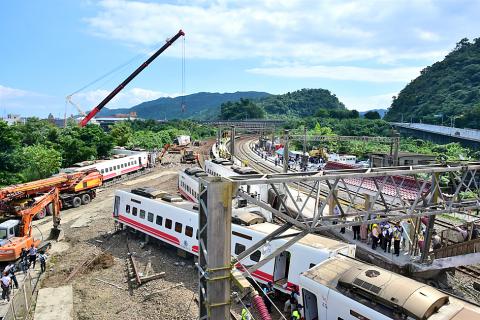
Photo: Chang Yi-chen, Taipei Times
The board has decided that it should examine evidence in six more categories, in accordance with the Transportation Occurrence Investigation Act (運輸事故調查法), Young said.
This includes how the Taiwan Railways Administration (TRA) normally handles trains with malfunctioning devices before they are dispatched; how train drivers detect and report problems with a train’s power system; how the TRA has been repairing and maintaining its pump compressors; what procedures drivers should take to deactivate the automatic train protection (ATP) system, and if the TRA has used ATPs to monitor train operations.
The board said that it would also seek to determine the speed at which the train was operating at the time of accident as well as the angle at which it tilted, and if the braking system was functioning normally.
It would review the data collected from the railway tracks and derailed train’s carriages.
Rail Occurrence Investigation Division convener Li Gang (李綱) said the Executive Yuan was under the gun when it compiled its report, which made it impossible for it to conduct an in-depth investigation.
“We will try to recover the data stored on the damaged memory chips of the train’s control-management system and use the data to conduct simulations, such as the angle at which the train tilted. We can also compare images recorded inside and from outside the train. The cross-examinations would ensure that the investigation would generate valid results,” he said.
Young said the board has also obtained photographs taken by uncrewed aerial vehicles and would compare the images with the results of the accident simulations.
It has received a letter from a TRA employee that urged it to investigate the train’s carriages as well, he said.

The Centers for Disease Control (CDC) yesterday reported the first case of a new COVID-19 subvariant — BA.3.2 — in a 10-year-old Singaporean girl who had a fever upon arrival in Taiwan and tested positive for the disease. The girl left Taiwan on March 20 and the case did not have a direct impact on the local community, it said. The WHO added the BA.3.2 strain to its list of Variants Under Monitoring in December last year, but this was the first imported case of the COVID-19 variant in Taiwan, CDC Deputy Director-General Lin Ming-cheng (林明誠) said. The girl arrived in Taiwan on

South Korea is planning to revise its controversial electronic arrival card, a step Taiwanese officials said prompted them to hold off on planned retaliatory measures, a South Korean media report said yesterday. A Yonhap News Agency report said that the South Korean Ministry of Foreign Affairs is planning to remove the “previous departure place” and “next destination” fields from its e-arrival card system. The plan, reached after interagency consultations, is under review and aims to simplify entry procedures and align the electronic form with the paper version, a South Korean ministry official said. The fields — which appeared only on the electronic form

The Ministry of Foreign Affairs (MOFA) is suspending retaliation measures against South Korea that were set to take effect tomorrow, after Seoul said it is updating its e-arrival system, MOFA said today. The measures were to be a new round of retaliation after Taiwan on March 1 changed South Korea's designation on government-issued alien resident certificates held by South Korean nationals to "South Korea” from the "Republic of Korea," the country’s official name. The move came after months of protests to Seoul over its listing of Taiwan as "China (Taiwan)" in dropdown menus on its new online immigration entry system. MOFA last week

A bipartisan group of US senators has introduced a bill to enhance cooperation with Taiwan on drone development and to reduce reliance on supply chains linked to China. The proposed Blue Skies for Taiwan Act of 2026 was introduced by Republican US senators Ted Cruz and John Curtis, and Democratic US senators Jeff Merkley and Andy Kim. The legislation seeks to ease constraints on Taiwan-US cooperation in uncrewed aerial systems (UAS), including dependence on China-sourced components, limited access to capital and regulatory barriers under US export controls, a news release issued by Cruz on Wednesday said. The bill would establish a "Blue UAS


 RSS
RSS