


Lamigo Monkeys’ officials yesterday said that the club would still play home games at the Taoyuan International Baseball Stadium following its sale to Tokyo-based Rakuten Inc, an electronics and Internet firm.
Rakuten and La New Corp, the former owner, made the official announcement at a news conference in Taipei that was attended by Lamigo general manager Justin Liu (劉玠廷), Rakuten Asia chief operating officer Takashi Watanabe, Chinese Professional Baseball League (CPBL) commissioner John Wu (吳志揚) and Tohoku Rakuten Golden Eagles general manager Kawada Yoshinori.
“La New has reached an agreement with Rakuten in which our shares in Lamigo would be completely sold to the Japanese corporation,” Liu said, adding that it began the procedure on July 3.
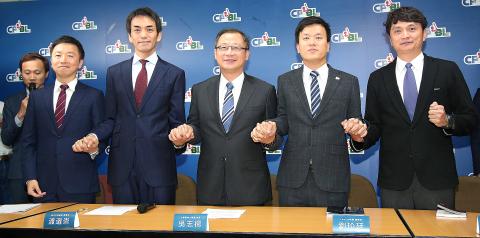
Photo: CNA
Even though the team attracted many suitors after it announced in July that it was looking for a buyer, Liu said that Rakuten was the most active one.
They quickly reached a deal, as they shared similar ideas on how the team should be managed, he said.
Rakuten pledged to keep the club’s administrative staff and remain in Taoyuan, he said.
Asked how much Rakuten paid to acquire La New’s stake, Watanabe declined to disclose the exact amount, as both sides signed a nondisclosure agreement.
“We have yet to decide on a new name following the change of ownership,” Watanabe said. “We are discussing several possibilities, but it is certain that ‘Lamigo’ will be no longer be part of it.”
Watanabe said that Rakuten would discuss keeping Liu as general manager, as he and his father, Monkeys founder Liu Pao-yu (劉保佑), are passionate about what they do.
Liu said that La New would continue managing the team through the second half of this season, the Taiwan Series, the World Baseball Softball Confederation Championship and a farewell game for fans.
“Before we hand the team over to Rakuten, we would continue to do our jobs,” Justin Liu said. “I do not think too much about the future. At the moment, I am just focused on taking the team higher and making sure that our experience is passed on to the new management.”
He also spoke about the difficulty of financing the team and his expectations of the new owners.
“La New is a small corporation and we could only cover costs by focusing on selling tickets, boxed lunches and team merchandise,” he said. “However, Rakuten runs e-commerce and financial technology businesses apart from managing sports teams, which helps market teams.”
The CPBL’s regulations stipulate that foreign investors can hold no more than a 49 percent stake in a baseball team if it is a new team entering the league, but the Rakuten transfer involves an existing team selling ownership to a foreign investor, Wu said.
The rules do not limit foreign investment for ownership changes, he said.
The deal would be accepted by the league as long as its executive council — formed by other teams in the league — agree, Wu said.
The deal is likely to be approved by the executive council, he added.
Rakuten has been running its e-commerce business in Taiwan for 10 years and has secured a virtual bank license from the Financial Supervisory Commission, he said, adding that it is buying a well-managed team.
The deal would generate discussion among fans, boost ticket sales and facilitate the exchange of professional baseball teams between Taiwan and Japan, he said.

FUKUOKA SITUATION: Japanese media reported that the pathogen is expected to be identified by the summer, while the CDC downplayed the idea that it was hMPV A “mysterious cold-like illness” reported in Japan’s Fukuoka Prefecture does not seem to be a new disease, but Japanese authorities have been asked about the situation, the Centers for Disease Control (CDC) said yesterday. The Fukuoka Prefectural Medical Association on Wednesday told a news conference that a “mystery cold” that has become a hot topic on social media is “highly likely to be caused by some kind of viral infection,” Japan’s KBC News reported. “Many people are experiencing symptoms starting with a sore throat, followed by a runny nose, phlegm and a severe cough,” KBC News reported, citing association officials. Health authorities are

Nvidia Corp CEO Jensen Huang (黃仁勳) arrived in Taiwan yesterday ahead of upcoming AI and technology events, saying he plans to meet with clients and Taiwan Semiconductor Manufacturing Co Chairman C.C. Wei (魏哲家) during his visit. After landing at Taipei Songshan Airport, Huang posed for photos with fans and handed out Yakult drinks to reporters and supporters waiting at the scene, saying he has “a lot to do” during the trip. Asked about reports that Nvidia’s planned headquarters site in Taipei’s Beitou Shilin Technology Park could break ground on May 27, Huang said that if the company holds an event, he would
Carrefour Taiwan is to begin using a new name from the start of July, but it cannot divulge the name until then, the chairman of the supermarket chain's parent company said today. President Chain Store Co chairman Lo Chih-hsien (羅智先) was asked by reporters after a shareholders' meeting to confirm whether the company has settled on a new name for the supermarket brand. In March, the government-registered name of two Carrefour Taiwan branches was quietly changed to "Le Chia Kang" (樂家康) in Chinese, raising speculation that has been selected as the name. Lo said that because of local regulations and contractual obligations, the
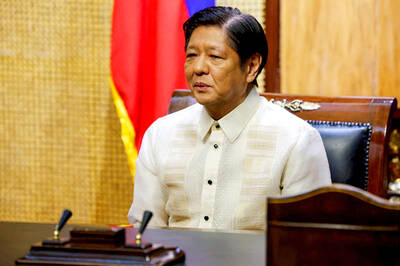
The Philippines would likely be involved in any conflict over Taiwan due to its proximity to the democracy claimed by China, President Ferdinand Marcos Jr said, reiterating a stance that risks angering Beijing. “In the Philippines, we do not have a choice because Taiwan is so close to the Philippines and we have almost 200,000 Filipino nationals living and working in Taiwan,” Marcos said in an interview with Japanese media in Manila on Monday. The Philippine leader’s comments come ahead of a state visit to Japan next week, where he is to meet with Japanese Prime Minister Sanae Takaichi to discuss security


 RSS
RSS