


Several US senators have called for the swift passage of a bill in the US Congress aimed at helping Taiwan keep its diplomatic allies, one day after Taiwan announced the severance of ties with the Solomon Islands.
Taiwan cut diplomatic ties with the Solomon Islands after the South Pacific nation decided to switch diplomatic recognition from Taipei to Beijing, Minister of Foreign Affairs Joseph Wu (吳釗燮) said on Monday.
It left Taiwan with 16 diplomatic allies.
Taiwan-friendly US Senator Cory Gardner denounced Beijing’s actions in a tweet and called on the US Senate to pass the legislation he introduced to help Taiwan amid China’s growing efforts to poach its diplomatic allies.
“China’s hostile actions toward Taipei will be met with resolve by the free world. I urge the Senate to immediately consider my TAIPEI Act, which would impose consequences on nations downgrading ties with Taiwan in favor of China,” Gardner said on Twitter, referring to the draft “Taiwan allies international protection and enhancement initiative act,” which he and senators Marco Rubio, John Cornyn and Chris Coons reintroduced to the Senate earlier this year.
The bill, if passed, would require the US government to engage with other nations to support Taiwan’s diplomatic recognition and strengthen unofficial ties with Taiwan.
Rubio made a similar statement in a separate tweet, in which he criticized the Solomon Islands’ “shameful” decision.
“It’s shameful that the Solomon Islands is bending to Beijing’s pressure to sever ties with Taiwan. Congress should pass the TAIPEI Act and send a strong message that the US will not stay silent as the Chinese govt aggressively moves to isolate Taiwan,” he said on Twitter.
The draft legislation authorizes the US Department of State to downgrade US ties with any government that takes adverse actions with regard to Taiwan, and allows the department to suspend or adjust US foreign assistance to governments that take such actions.
The bill says that the US government should also help Taiwan gain permission to participate in international organizations, either as a member or an observer, and express its support for Taiwan’s international participation when it interacts with Beijing.
Since its reintroduction, the bill has been read twice and was referred to the US Senate Committee on Foreign Relations in May, but no progress has been made since.
Taiwan would be happy to see further developments on the proposed legislation, Ministry of Foreign Affairs Department of North American Affairs Director Vincent Yao (姚金祥) told a news conference yesterday, expressing appreciation for Gardner’s and Rubio’s support.
Taipei and Washington maintain close communication and cooperation through the Global Cooperation and Training Framework and the recently established Indo-Pacific Democratic Governance Consultations, Yao said.
Republican US representatives Ted Yoho and Michael McCaul also expressed disappointment over the severance of ties.
“Disappointed to see one of the largest nations in the Pacific choose #China’s Belt and Road to serfdom over Taiwan, a longstanding democratic ally and friend,” McCaul said on Twitter.
Asked to comment on Taiwan losing yet another diplomatic ally to China, former American Institute in Taiwan chairman Richard Bush said that it is not really a “fair fight,” but added that it is debatable whether stealing more diplomatic allies from Taipei is an effective means for Beijing in its ongoing suppression of Taiwan.

Taiwan has received more than US$70 million in royalties as of the end of last year from developing the F-16V jet as countries worldwide purchase or upgrade to this popular model, government and military officials said on Saturday. Taiwan funded the development of the F-16V jet and ended up the sole investor as other countries withdrew from the program. Now the F-16V is increasingly popular and countries must pay Taiwan a percentage in royalties when they purchase new F-16V aircraft or upgrade older F-16 models. The next five years are expected to be the peak for these royalties, with Taiwan potentially earning
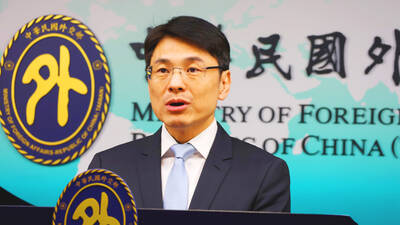
STAY IN YOUR LANE: As the US and Israel attack Iran, the ministry has warned China not to overstep by including Taiwanese citizens in its evacuation orders The Ministry of Foreign Affairs (MOFA) yesterday rebuked a statement by China’s embassy in Israel that it would evacuate Taiwanese holders of Chinese travel documents from Israel amid the latter’s escalating conflict with Iran. Tensions have risen across the Middle East in the wake of US and Israeli airstrikes on Iran beginning Saturday. China subsequently issued an evacuation notice for its citizens. In a news release, the Chinese embassy in Israel said holders of “Taiwan compatriot permits (台胞證)” issued to Taiwanese nationals by Chinese authorities for travel to China — could register for evacuation to Egypt. In Taipei, the ministry yesterday said Taiwan
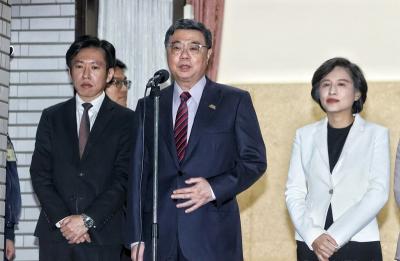
Taiwan is awaiting official notification from the US regarding the status of the Agreement on Reciprocal Trade (ART) after the US Supreme Court ruled US President Donald Trump's global tariffs unconstitutional. Speaking to reporters before a legislative hearing today, Premier Cho Jung-tai (卓榮泰) said that Taiwan's negotiation team remains focused on ensuring that the bilateral trade deal remains intact despite the legal challenge to Trump's tariff policy. "The US has pledged to notify its trade partners once the subsequent administrative and legal processes are finalized, and that certainly includes Taiwan," Cho said when asked about opposition parties’ doubts that the ART was
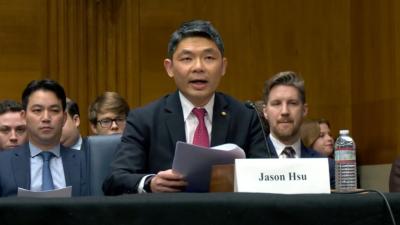
If China chose to invade Taiwan tomorrow, it would only have to sever three undersea fiber-optic cable clusters to cause a data blackout, Jason Hsu (許毓仁), a senior fellow at the Hudson Institute and former Chinese Nationalist Party (KMT) legislator, told a US security panel yesterday. In a Taiwan contingency, cable disruption would be one of the earliest preinvasion actions and the signal that escalation had begun, he said, adding that Taiwan’s current cable repair capabilities are insufficient. The US-China Economic and Security Review Commission (USCC) yesterday held a hearing on US-China Competition Under the Sea, with Hsu speaking on


 RSS
RSS