


Average life expectancy in Taiwan last year rose to historic highs of 84 years for women and 77.5 years for men, the Ministry of the Interior said yesterday.
The national average of 80.7 years, up from 78.6 years in 2008, was also higher than the global average, a 2018 life expectancy chart released by the ministry showed.
The ministry attributed the increased life expectancy to improved medical care, as well as a greater emphasis on food safety, better living quality and growing numbers of people exercising regularly.
While the national life expectancy was higher than the global average, it still lagged behind that of Japan, Switzerland, Spain and Singapore, the ministry said.
In term of deaths, the nation’s standardized mortality ratio is on the decline, the ministry said.
The standardized death rate last year stood at 4,115 per 100,000 people, down 2.2 percent from 2017, it said.
The nation registered 172,700 deaths, 672 more than in 2017, the ministry said.
The nation’s crude death rate —the total number of deaths per year per 1,000 people — stood at 0.00732, rising by 0.02 percentage points compared with 2017.
Taipei had the highest average life expectancy among the six special municipalities at 83.6 years, followed in descending order by New Taipei City, Taoyuan, Taichung, Tainan and Kaohsiung.
Taipei also led in average life expectancy of both sexes, displaying an evident trend of northern Taiwan having a higher life expectancy in the nation and life expectancy rates dropping from north to south.
In other cities and counties, Hsinchu led with an average life expectancy of 81.1 years, while Taitung County came in last at 75.8 years, the ministry said.
The average life expectancy of cities and counties in eastern Taiwan was comparatively lower than that in the west by at least five years, due primarily to a lack of transportation and medical resources, the ministry said.
Difference in culture and lifestyle could be contributing factors, but the gap between the two is closing compared with a decade ago, it said.
The chart not only gives the government a more accurate gauge of life expectancy in the nation, but also an insight into average health status, the economy, social welfare and the nation’s competitiveness, the ministry said.


Kenting National Park service technician Yang Jien-fon (楊政峰) won a silver award in World Grand Prix Photography Awards Spring Season for his photograph of two male rat snakes intertwined in combat. Yang’s colleagues at Kenting National Park said he is a master of nature photography who has been held back by his job in civil service. The awards accept entries in all four seasons across six categories: architectural and urban photography, black-and-white and fine art photography, commercial and fashion photography, documentary and people photography, nature and experimental photography, and mobile photography. Awards are ranked according to scores and divided into platinum, gold and

More than half of the bamboo vipers captured in Tainan in the past few years were found in the city’s Sinhua District (新化), while other districts had smaller catches or none at all. Every year, Tainan captures about 6,000 snakes which have made their way into people’s homes. Of the six major venomous snakes in Taiwan, the cobra, the many-banded krait, the brown-spotted pit viper and the bamboo viper are the most frequently captured. The high concentration of bamboo vipers captured in Sinhua District is puzzling. Tainan Agriculture Bureau Forestry and Nature Conservation Division head Chu Chien-ming (朱健明) earlier this week said that the
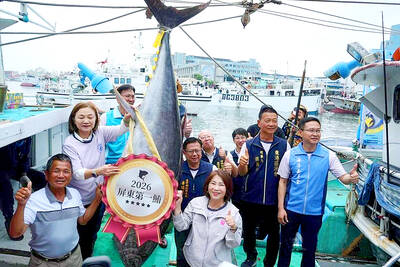
The first bluefin tuna of the season, brought to shore in Pingtung County and weighing 190kg, was yesterday auctioned for NT$10,600 (US$333.5) per kilogram, setting a record high for the local market. The auction was held at the fish market in Donggang Fishing Harbor, where the Siaoliouciou Island-registered fishing vessel Fu Yu Ching No. 2 delivered the “Pingtung First Tuna” it had caught for bidding. Bidding was intense, and the tuna was ultimately jointly purchased by a local restaurant and a local company for NT$10,600 per kilogram — NT$300 ,more than last year — for a total of NT$2.014 million. The 67-year-old skipper
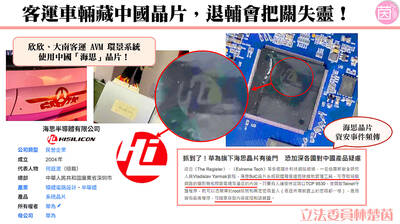
BREACH OF CONTRACT: The bus operators would seek compensation and have demanded that the manufacturer replace the chips with ones that meet regulations Two bus operators found to be using buses with China-made chips are to demand that the original manufacturers replace the systems and provide compensation for breach of contract, the Veterans Affairs Council said yesterday. Democratic Progressive Party Legislator Michelle Lin (林楚茵) yesterday said that Da Nan Bus Co and Shin-Shin Bus Co Ltd have fielded a total of 82 buses that are using Chinese chips. The bus models were made by Tron-E, while the systems provider was CYE Electronics, Lin said. Lin alleged that the buses were using chips manufactured by Huawei subsidiary HiSilicon Co, which presents a national security risk if the


 RSS
RSS