


A team led by National Taipei University of Technology (NTUT) researchers yesterday unveiled smart communication systems for people with amyotrophic lateral sclerosis (ALS), aiming to help them reconnect with people and the world.
As people with the neurological disease experience gradual loss of motion and communication skills, they often feel that they are souls trapped in their bodies, as making a simple utterance such as “I love you” can be demanding, Minister of Science and Technology Chen Liang-gee (陳良基) told a news conference at the university.
The Ministry of Science and Technology offered NT$7 million (US$223,172) to the NTUT team, as part of its Breakout program, which began last year, subsidizing projects that use technology to solve social problems.
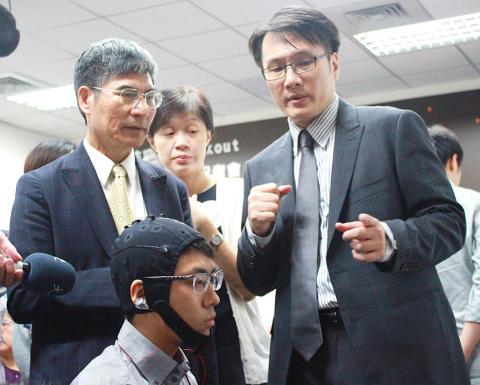
Photo: CNA
As project head, NTUT Department of Mechanical Engineering professor Liu Yi-hung (劉益宏) and researchers from NTUT and Shih Chien University, as well as therapists from Taipei Veterans General Hospital, developed devices to help people with more severe ALS symptoms.
The team developed an eye-tracking system that allows lamps to be turned on or a call for help to be made and a system that meshes a brain-computer interface with voice synthesis, Liu said.
The brain-computer interface was tested on five people and had an average precision rate of 85 percent for analyzing brain waves, he said, but added that there is a long way to go before the system can be commercialized.
Developing such tools for people with a rare disease is challenging due to the limited number of potential users, he said, adding that hopefully more businesses would devote resources to help advance the technology.
Without proper assistive technology, theoretical physicist Stephen Hawking — who died last year aged 76 after spending most of his life all but immobilized by the disease — would not have been able to leave his research legacy, Taiwan Motor Neuron Disease Association chairman Lin Yung-yi (林詠沂) said.
Many people with ALS cannot express themselves to the world, Lin said.
Businessman Huang Ching-hsiang (黃景祥) said that his wife, Anita Chen (陳俊芝), was diagnosed with the disease nearly 13 years ago and that she lost functions most quickly in the third and fourth year.
Although her degeneration has slowed, he often needs a lot of time to understand his wife’s speech, Huang said.
The ministry should also support more development plans for carer robots to ease the burden on caregivers, he said.

Taiwan has received more than US$70 million in royalties as of the end of last year from developing the F-16V jet as countries worldwide purchase or upgrade to this popular model, government and military officials said on Saturday. Taiwan funded the development of the F-16V jet and ended up the sole investor as other countries withdrew from the program. Now the F-16V is increasingly popular and countries must pay Taiwan a percentage in royalties when they purchase new F-16V aircraft or upgrade older F-16 models. The next five years are expected to be the peak for these royalties, with Taiwan potentially earning
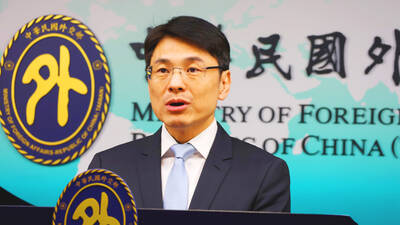
STAY IN YOUR LANE: As the US and Israel attack Iran, the ministry has warned China not to overstep by including Taiwanese citizens in its evacuation orders The Ministry of Foreign Affairs (MOFA) yesterday rebuked a statement by China’s embassy in Israel that it would evacuate Taiwanese holders of Chinese travel documents from Israel amid the latter’s escalating conflict with Iran. Tensions have risen across the Middle East in the wake of US and Israeli airstrikes on Iran beginning Saturday. China subsequently issued an evacuation notice for its citizens. In a news release, the Chinese embassy in Israel said holders of “Taiwan compatriot permits (台胞證)” issued to Taiwanese nationals by Chinese authorities for travel to China — could register for evacuation to Egypt. In Taipei, the ministry yesterday said Taiwan
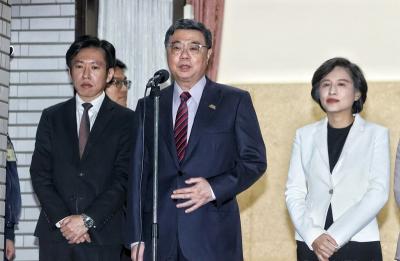
Taiwan is awaiting official notification from the US regarding the status of the Agreement on Reciprocal Trade (ART) after the US Supreme Court ruled US President Donald Trump's global tariffs unconstitutional. Speaking to reporters before a legislative hearing today, Premier Cho Jung-tai (卓榮泰) said that Taiwan's negotiation team remains focused on ensuring that the bilateral trade deal remains intact despite the legal challenge to Trump's tariff policy. "The US has pledged to notify its trade partners once the subsequent administrative and legal processes are finalized, and that certainly includes Taiwan," Cho said when asked about opposition parties’ doubts that the ART was
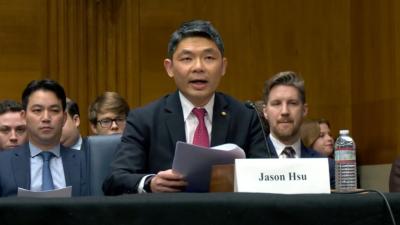
If China chose to invade Taiwan tomorrow, it would only have to sever three undersea fiber-optic cable clusters to cause a data blackout, Jason Hsu (許毓仁), a senior fellow at the Hudson Institute and former Chinese Nationalist Party (KMT) legislator, told a US security panel yesterday. In a Taiwan contingency, cable disruption would be one of the earliest preinvasion actions and the signal that escalation had begun, he said, adding that Taiwan’s current cable repair capabilities are insufficient. The US-China Economic and Security Review Commission (USCC) yesterday held a hearing on US-China Competition Under the Sea, with Hsu speaking on


 RSS
RSS